
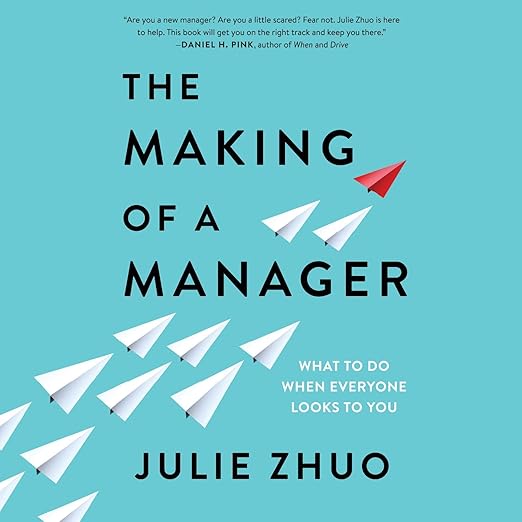
The Short Version
- Performance: Karissa Vacker reads with practiced composure and a thoughtful rhythm that suits Zhuo's reflective, first-person style, an unobtrusive but reliable performance.
- What it covers: Management as a learned skill, building trust through transparency, the gap between doing and leading
- Feel: Direct and pragmatic, with enough vulnerability to feel human rather than instructional
- Our call: The most practical audiobook on first-time management currently available, written by someone who actually got it wrong first.
I have listened to a lot of management books, and I want to be honest about what most of them are: long articles padded to book length, written by consultants who have extracted a single insight and stretched it across twelve chapters with case studies of dubious relevance. The Making of a Manager is not that. Julie Zhuo became a manager at Facebook at 25, understood almost nothing about what she was doing, and had the considerable advantage of spending the next decade figuring it out inside one of the most scrutinized organizations in the world. The book she wrote from that experience is specific, honest, and genuinely useful.
Karissa Vacker's narration is clean and measured, matching Zhuo's direct prose without imposing her own personality on it. At just under eight hours, the audiobook is compact enough to finish in a weekend and dense enough that you will want to return to specific chapters. That is the right balance for this kind of professional reading.
Where This One Lands
The book's central argument, great managers are made, not born, is not new. What Zhuo does differently is ground it in the granular: what does a one-on-one meeting actually look like when it is working? How do you build trust with someone who reports to you without abdicating your authority? When should you look past an uncomfortable interview and hire someone anyway? These are the questions that new managers lie awake thinking about, and Zhuo addresses them with the specificity that comes from having made the mistakes first.
Her framework for evaluating whether you are managing effectively is simple: look at three things, the quality of the work, the quality of the team, and whether the people on your team are growing. This sounds obvious until you realize most new managers are evaluating themselves entirely on the first criterion and ignoring the other two. The shift in attention that the book demands is subtle but consequential.
What Makes The Making of a Manager Worth Hearing
One reviewer praised it as the rare management book that avoids consultant-speak and is written for real-life people who are good at their jobs, then thrown into the role of managing others. That is an accurate description. Zhuo writes from inside the experience, not above it. The anecdotes are from her own first years managing teams, including the embarrassing moments, the feedback she gave badly, the hire she misjudged, the meeting she designed that wasted everyone's time.
This first-person accountability is the book's distinguishing quality. Management books written from a position of authority tend to smooth out the learning curve into a sequence of wise decisions. Zhuo's version includes the wrong turns, which makes the practical advice more trustworthy. You are not being told how an expert does it; you are being shown how someone learned to do it better.
What Gives Us Pause
One substantive critique, raised by a reviewer who had recommended the book until they got to the second half, is that the later chapters become increasingly specific to Facebook-scale organization dynamics. The guidance on managing large organizations, multiple teams, and the particular rhythms of a tech company in hypergrowth is less universally applicable than the opening chapters on individual management fundamentals.
If you work at a small startup, a nonprofit, or an established company outside the tech sector, the first half of this audiobook will feel immediately useful and the second half will require some translation. The fundamental principles survive the context shift; the specific tactical advice less so. This is worth knowing before you cite chapter ten to a manager at a hospital or a school.
Who Should Listen to The Making of a Manager
New managers who have just been promoted and feel the specific panic of not knowing what they are supposed to be doing will find this the most immediately useful resource available. It is also worth recommending to people who are being groomed for management and want to understand what the role actually requires before they take it.
Experienced managers will find the foundational chapters useful for articulating things they do intuitively, which can help them teach and develop their own reports. They can afford to skim the later chapters unless they work in a large tech organization. Anyone who reads this book and comes away thinking management is a soft discipline should probably read it again more carefully.







