Quick Take
- Narration: Daniel Henning reads with the clear, unobtrusive competence that suits Minter’s ground-level reportage style, letting the reporting carry the interest.
- Themes: global consumption cycles, the hidden economics of thrift, sustainability and its limits
- Mood: Curious and methodical, with moments of genuine surprise and quiet unease
- Verdict: A thoroughly reported journey through the global secondhand economy that answers questions you did not know you had and raises others you will not be able to stop thinking about.
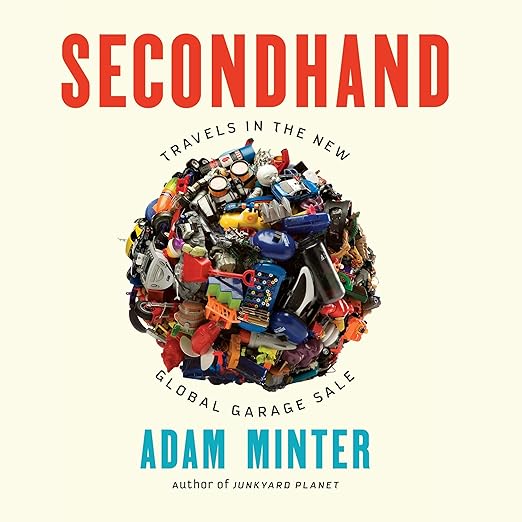
I picked up Secondhand the week I had spent three hours deciding what to do with a closet full of clothes I had not worn in two years. The timing was not planned, but it was apt. Adam Minter is a journalist who grew up in a family scrapyard business and has spent his career following what happens to discarded things. He brings to Secondhand the same on-the-ground curiosity that shaped his earlier Junkyard Planet, and the result is a book that answers, in sometimes uncomfortable detail, the question I had been avoiding while staring at those clothes.
The central question Minter is investigating is deceptively simple: when you drop a box of unwanted items at the local thrift store, where do they actually go? The answer, it turns out, is almost anywhere. From the closets and storage units of Middle America, discarded goods travel to epic used-goods markets in Canada, Mexico, Japan, Ghana, India, and Malaysia, among other destinations. The scale of this trade is genuinely staggering, running to multiple billions of dollars annually, and Minter documents it through the specific people and operations that make it function rather than through statistics alone. The book is a reminder that abstract economic systems are composed of individual human decisions made by people with specific knowledge and specific needs.
Following the Chain: From American Closets to Global Markets
Minter structures the book as a series of journeys, literal journeys he takes to track the movement of specific categories of goods. He follows clothing, furniture, electronics, and household items through the systems that sort, grade, bundle, ship, and sell them. Each stop on these journeys produces a new set of characters: the thrift store sorters who make snap judgments about what has resale value, the consolidators who aggregate goods for international shipping, the market operators in Ghana and Malaysia who know their customers’ tastes better than any algorithm could predict.
One reviewer accurately described Minter as a dogged, thorough reporter who operates at ground level on streets and at warehouses and refuse heaps all over the world. That ground-level quality is what prevents Secondhand from becoming a birds-eye survey of abstract global trade. The book has specific faces and specific stories embedded in its argument, and those specificities carry the weight of the broader points Minter is making about consumption, value, and waste.
Why Grandmother’s China Is Now Worth Less Than You Think
Among the more surprising insights in the book is the explanation for why certain categories of items that previous generations considered valuable have lost market value as they have aged into antique status. The example of grandmother’s china becoming less rather than more valuable even as it becomes more genuinely antique is developed in detail, and the answer involves demographic shifts, changing tastes, and the sheer volume of similar goods in circulation. This is the kind of specific practical insight that separates Secondhand from more rhetorical accounts of consumption culture. Minter is not lecturing; he is explaining, and the explanations are often counterintuitive enough to be genuinely illuminating rather than confirming what readers already suspected.
The environmental dimension of the book is handled with more complexity than the simple narrative of thrift-as-virtue would suggest. Minter shows that the secondhand economy does real good by extending the useful life of objects and reducing manufacturing demand. He also shows that it has real problems: the volume of goods that arrive in destination countries often exceeds local capacity to absorb them, creating new waste streams in places with fewer resources to manage them. The sustainability story is not straightforwardly optimistic, which makes it considerably more honest than most popular treatments of the topic.
Daniel Henning’s Narration and the Book’s Rhythms
Daniel Henning narrates with a style that suits the reportage structure of the book. Minter’s prose is clear and direct, built around observation and interview rather than argument, and Henning reads it without imposing interpretive choices that the text does not call for. At ten hours and two minutes, the book is a comfortable length for the scope of the investigation. The journeys give the structure natural variety, and Henning’s consistency makes the transitions between them feel smooth rather than disjointed. He is the kind of narrator you stop noticing, which in nonfiction journalism is the highest praise.
One reviewer who came to the book after hearing Minter interviewed on radio noted being intrigued enough to buy it, which tells you something about how the material presents in oral form. Secondhand is a book that sounds like what it is: a knowledgeable journalist talking clearly and engagingly about something he has spent years understanding. That quality transfers well to audio.
For Whom This Will Matter Most
Secondhand works best for listeners with an existing interest in sustainability, global trade, or the economics of consumption who want something more rigorous and surprising than the usual decluttering narrative. It will also resonate with anyone who has spent time at thrift stores, estate sales, or secondhand markets and wondered about the systems behind what they were seeing. Reviewers who worked in retail, or who had family members in the informal secondhand trade, found the book particularly illuminating for making sense of experiences they had lived without fully understanding. Those looking for a polemical argument about consumption culture will find Minter more interested in how things work than in assigning blame, which is either a virtue or a limitation depending on what you came for.
Frequently Asked Questions
Does Secondhand cover the environmental impact of the secondhand economy, or is it primarily about the economics?
Both. Minter traces the economics in detail but consistently intersects them with environmental questions about whether the secondhand system actually reduces overall consumption and waste, or whether it creates new problems in destination countries that lack infrastructure to manage the volume of goods that arrive. The environmental picture he presents is more complex than simple thrift-as-virtue narratives suggest.
What specific categories of goods does the book follow, and which sections are most surprising?
The book follows clothing, furniture, electronics, and household goods through their various global journeys. Many readers found the section on why certain antique items, including china and furniture that previous generations valued highly, have declined rather than increased in market value to be among the most counterintuitive and useful insights in the book.
How does Adam Minter’s background in a family scrapyard business affect the book’s perspective?
It gives the book an insider credibility and a comfort with the practical reality of the trade that distinguishes it from outside-looking-in accounts of recycling and reuse. Minter understands the economics from the ground up and writes about workers and operators in the secondhand chain with genuine respect for their expertise.
Is Secondhand suitable for listeners who are not particularly interested in economics but care about sustainability?
Yes. Minter makes the economic material accessible and uses specific people and places rather than abstract data to tell the story. Listeners motivated by environmental concerns will find the book illuminating on how the secondhand economy interacts with sustainability goals, even if they have no prior background in trade economics.