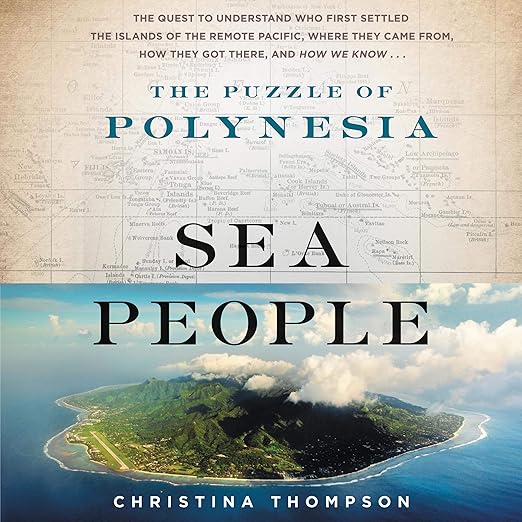
Christina Thompson answers a genuine three-hundred-year-old mystery in Sea People, and she does it with the pacing of a detective story rather than a dry academic survey, which is exactly why this audiobook works as well as it does. The question driving the book, how the earliest Polynesians found and settled the most remote islands on earth without writing or metal tools, has occupied explorers, linguists, and archaeologists since the eighteenth century, and Thompson synthesizes centuries of competing theories into a single coherent narrative without flattening the genuine uncertainty still baked into the field.
What sets this apart from a purely academic treatment is Thompson's personal stake in the material: her husband and sons are Maori, direct descendants of the very navigators whose migration she is tracing, and that family connection threads through the historical and scientific material without ever tipping into sentimentality. The publisher pitches Sea People as a blend of Jared Diamond's Guns, Germs, and Steel and Simon Winchester's Pacific, and having listened to the whole thing, that comparison holds up: same ambition to synthesize a huge, scattered body of knowledge into one accessible argument.
Staying Focused on a Foggy, Side-Trackable Topic
An Amazon Customer reviewer placed Sea People among the top five history books they had ever read, and praised Thompson for staying 'so focused on such a foggy and easily side-trackable topic,' a phrase that captures precisely what makes this material difficult to pull off and precisely what Thompson does well. The Problem of Polynesian Origins, as it was known historically, spans linguistics, oceanography, genetics, and oral tradition, and a lesser writer would have let the book sprawl into disconnected chapters. Thompson keeps the throughline visible even as she moves between disciplines.
Reviewer Desiree Brown-Quilty singled out the material on early European navigation, calling the idea of crossing the Pacific without GPS 'awe-inspiring,' while also praising the book as 'well-researched' with a genuine 'diversity of viewpoints.' A third reviewer, who lived in Hawaii during the years of the Hokule'a voyage to Tahiti, described being freshly amazed by Thompson's account even with firsthand familiarity with the material, a strong signal for how much new synthesis this book actually offers longtime enthusiasts of the subject.
Most Related, Most Widely Dispersed, All at Once
Thompson structures the book roughly chronologically by scholarly approach rather than strictly by island group or century, moving from early European speculation through linguistic reconstruction and finally to the genetic and archaeological evidence that has only become available in recent decades. That organizational choice mirrors the actual history of how the mystery got solved, incrementally and by multiple disciplines building on each other's work, rather than presenting a single triumphant breakthrough.
The synopsis frames Polynesians as both the most closely related and the most widely dispersed people in the world before the era of mass migration, a genuine paradox worth sitting with: genetically and culturally connected across a triangle spanning Hawaii, New Zealand, and Easter Island, thousands of ocean miles apart, without the mass movement of later centuries to explain it. Thompson spends real energy making that paradox concrete rather than treating it as a passing statistic, which is part of what makes the mystery land emotionally as well as intellectually.
Lyons Holds Steady Across Genetics and Memoir
Susan Lyons narrates, and the demands of this particular book are unusual: she has to hold scholarly precision across genetics, archaeology, and linguistics steady for over eleven hours while also carrying the more intimate, memoir-adjacent passages about Thompson's own family without a jarring tonal shift between the two registers. That balance, rigorous but never dry, matches what listener reviews describe as the book's own core achievement on the page.
The comparison to Guns, Germs, and Steel is not just marketing shorthand. Both books ask a version of the same question, why history unfolded this way for this specific population, and both build their answer from an accumulation of specific, checkable evidence rather than sweeping generalization. Listeners who found Diamond's approach satisfying will recognize the same intellectual rigor at work here, applied to a genuinely different ocean and a genuinely different migration story.
The dual comparison to Diamond and Winchester is worth separating out rather than treating as one blended pitch. The Diamond connection is about ambition and scope, a single unifying question answered through the accumulation of specialist evidence. The Winchester connection is closer to voice and pacing, a scholarly subject rendered with genuine narrative propulsion rather than academic detachment. Sea People earns both comparisons somewhat differently, more analytically rigorous than a typical Winchester book, more narratively alive than a typical Diamond one.
No Single, Simple, Quotable Answer Offered Here
This is narrative nonfiction with real scholarly density, not a breezy pop-history overview, and reviewer language describing the topic as 'foggy and easily side-trackable' is a fair warning as much as a compliment. Listeners should expect sustained attention to competing academic theories, some now discredited, some still contested, rather than a single tidy answer delivered early and repeated for reassurance, a demand some listeners used to more conclusive popular history may need time to adjust to.
Sea People also spans multiple disciplines in ways that occasionally slow the narrative's forward momentum, since Thompson is careful to represent genuinely contested scholarship rather than picking a single theory and running with it. Listeners who prefer their nonfiction to move in a straight line toward a clean conclusion may find some chapters more deliberate than propulsive, though the payoff at the book's synthesis is worth the patience it asks for.
Listeners should also expect real methodological humility throughout. Thompson is careful to flag which conclusions are well-supported by converging evidence and which remain genuinely contested among specialists, rather than presenting every claim with uniform confidence. That intellectual honesty is a strength for readers who want an accurate picture of where the scholarship actually stands, though it does mean the book resists offering one single, simple, quotable answer to its own central question.
Curiosity About How Historians Build Knowledge
Listen if you are drawn to narrative nonfiction that treats a genuine historical mystery with real intellectual seriousness, especially if you enjoyed Diamond, Winchester, or similar synthesis-driven popular history. Listen if you have any personal or scholarly interest in Oceania, Pacific migration, or Polynesian culture specifically.
Skip it if you want fast-paced, plot-driven nonfiction without sustained engagement with scientific and historiographic debate. Sea People rewards patience and genuine curiosity about how historians and scientists actually build knowledge, rather than delivering trivia-style facts in isolation.
- Voice: Susan Lyons holds scholarly precision steady across genetics, linguistics, and archaeology while still carrying the memoir's personal family passages.
- Big ideas: Polynesian migration history, scientific detective work, personal ancestry intersecting with scholarly research
- Atmosphere: Absorbing and detail-rich, demanding real attention but consistently rewarding it
- Worth it?: A genuinely excellent narrative history pick for anyone who enjoyed Guns, Germs, and Steel or similar synthesis-driven nonfiction.
Frequently Asked Questions
Does the Sea People audiobook require background knowledge of Polynesian history?
No prior background is needed. Christina Thompson builds the case for how Polynesian navigators settled the Pacific from the ground up, synthesizing centuries of competing theories into one coherent account.
How does Susan Lyons handle the scientific and linguistic detail in this audiobook?
She keeps the material steady and clear across genetics, archaeology, and linguistics while also carrying the more personal, memoir-adjacent passages about the author's own family without a jarring shift in register.
Is Sea People more focused on hard science or personal storytelling?
Both. Christina Thompson threads her own family's Maori ancestry through the historical and scientific material, giving a scholarly subject genuine emotional stakes without sacrificing rigor.
How does the Sea People audiobook compare to Guns, Germs, and Steel for listeners who enjoyed that book?
The publisher draws that comparison directly, and it holds up: both books build a big historical argument from an accumulation of specific, checkable evidence rather than sweeping generalization.