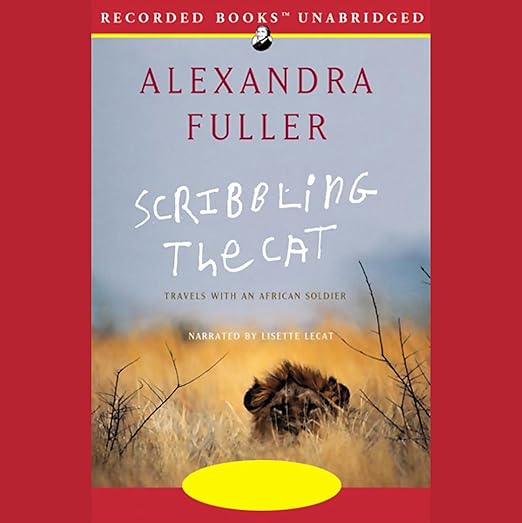
Quick Take
- Narration: Lisette Lecat’s South African cadence is an irreplaceable asset, lending the African landscape and dialogue an authenticity that a neutral American voice simply could not access.
- Themes: War trauma and its long aftermath, white African identity, the ethics of witnessing
- Mood: Haunted, raw, and at times uncomfortably intimate
- Verdict: A genuinely difficult piece of travel writing that asks hard questions about complicity and remembrance, and earns the discomfort it creates.
I had read Don’t Let’s Go to the Dogs Tonight years before I came to Scribbling the Cat, and Fuller’s first memoir had left the kind of mark that makes you cautious about the follow-up. Some writers build a particular world so precisely in one book that the next one feels like a violation. I was wrong to worry here, though Scribbling the Cat is a profoundly different kind of book, less about Fuller’s own childhood and more about the cost of living in someone else’s war, both during it and long after it ends.
The premise is deceptively simple. Fuller, home in Zambia visiting her parents for Christmas, asks about a local banana farmer her father calls a tough bugger, a white African veteran of the Rhodesian conflict known as K. The title comes from her father’s warning: curiosity, he tells her, scribbled the cat. She ignores the warning. What follows is a strange, uneasy friendship that becomes a road journey through Zimbabwe and Mozambique, retracing the battlefields where K fought, killed, and survived things that have never fully released him. It is the kind of travel writing that uses movement through landscape to excavate the interior, and Fuller is extraordinarily good at it.
K and the Problem of the Protagonist’s Gaze
K is a figure who resists comfortable framing. He is tattooed, physically imposing, a born-again Christian who weeps when discussing his romantic failures and holds inside him the weight of acts committed in wartime that he has not been able to forget or fully atone for. Fuller does not sanitize him or redeem him neatly, and some readers have found her portrayal of him manipulative, as though she uses his wounds for literary material without adequate accountability.
One reviewer argued the opposite: that Fuller is not shallow or naive but is telling a story in which K himself opened up to her, even as he struggled with his own delusions about what she represented to him. Both readings coexist in the text, and I think that ambiguity is deliberate. Fuller is not K’s therapist or his confessor. She is his witness, and the book keeps asking whether that role, in the context of what was done and to whom, is enough. It is an uncomfortable question, and the book does not relieve you of it.
Africa as More Than Setting
What distinguishes Fuller’s prose from most travel writing set in Africa is that the landscape is never merely backdrop. The continent in her work is agential: it bestows and it destroys, it outlasts its inhabitants, and it shapes the people who choose or are forced to remain in it more thoroughly than they reshape it. The journey through Zimbabwe and Mozambique is not just a tour of K’s psychological history. It is also a meditation on what it means to call a place home when that place is built on a foundation of dispossession and violence.
Fuller does not resolve this, and she is too honest to offer a redemption arc that the history cannot support. The book is haunting partly because the landscapes she describes are beautiful and because the beautiful things in them coexist with what has been done there without any apparent concern for the moral weight. That indifference of place to human meaning is one of the book’s most quietly devastating observations.
Lisette Lecat and the Sound of Belonging
Lecat’s narration is one of the best arguments for casting by cultural proximity that I have encountered in this genre. She reads Fuller’s prose with the ease of someone for whom the landscape and the register are native rather than performed. The South African inflections she brings to dialogue, to the names of places and people and things, carry information that a phonetically correct but culturally distant reading would lose entirely.
Some listeners come to Fuller after Don’t Let’s Go to the Dogs Tonight and find Scribbling the Cat more demanding, expecting a second childhood memoir and finding instead something rawer and more ethically unresolved. That is accurate. This is not a warmer or easier book. It is a more complicated one, and Lecat’s voice, steady even through the most difficult material, is the right companion for it.
Who This Asks Something Of
A practical note on sequencing: several readers have come to Scribbling the Cat through Fuller’s later work, particularly Cocktail Hour Under the Tree of Forgetfulness, and worked backward. That path also works. Fuller’s Africa is consistent across her books in its physical reality and its moral weight, and any of her memoirs will orient you to the others. But if you are reading in publication order, the movement from the childhood memoir to this harder, more politically engaged work is the natural trajectory, and it rewards the sequence.
Scribbling the Cat is not a comfortable listen. It does not offer the conventional satisfactions of travel memoir: the picturesque, the uplifting encounter, the personal growth neatly packaged. What it offers instead is a genuine reckoning with the costs of history as they are carried in individual bodies, and a portrait of friendship that is strange and genuine and shot through with things neither participant can fully name. Readers who want to be challenged by the books they listen to will find this rewards the difficulty. Those looking for Fuller’s lyrical warmth from the first memoir without the moral complexity should know this is a harder book in every meaningful sense.
Frequently Asked Questions
Should I listen to Don’t Let’s Go to the Dogs Tonight before Scribbling the Cat?
It is not required, but it adds considerably to the experience. Fuller’s first memoir establishes her childhood in Rhodesia and her relationship with Africa, giving her presence in Scribbling the Cat more context. Several reviewers specifically recommend the first book as preparation for this one.
How much does this book deal with explicit descriptions of wartime violence?
Fuller does not shy away from the subject. K’s wartime acts, including the killing of civilians, are discussed with directness. The book is not gratuitous, but it does not soften the material either. Listeners sensitive to unflinching accounts of conflict and its psychological aftermath should be aware of this.
Is Lisette Lecat’s narration consistent with the South African and Rhodesian settings, or is it a neutral voice?
Lecat’s narration is decidedly not neutral, and that is its great strength. Her South African background brings genuine regional cadence to the text, making the landscape and dialogue sound inhabited rather than approximated.
Is Fuller fair to K, or does the book feel exploitative of his trauma?
This is the central interpretive question the book leaves open, and Fuller seems to intend it that way. Some readers find her presence in K’s story extractive; others read it as honest witness. The text itself does not offer a clean verdict, and the discomfort that creates is arguably part of what the book is doing.