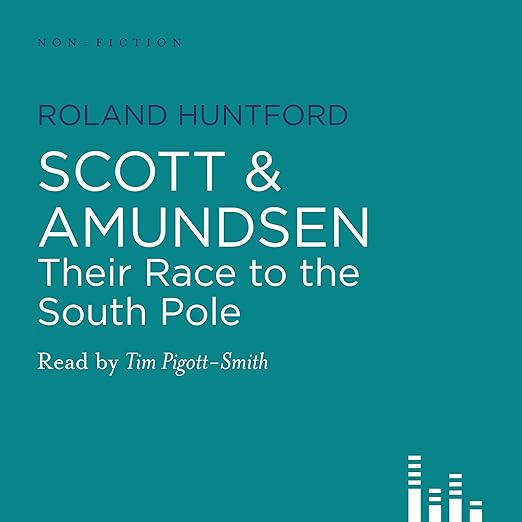
I was halfway through an afternoon walk when Tim Piggott-Smith described, in the most measured possible voice, how Robert Falcon Scott managed to lead five men to their deaths in conditions Roald Amundsen had already proved survivable. I stopped on the path and stood there for a moment. That is the effect Roland Huntford's book produces when you are not expecting it.
Scott and Amundsen is classified as polar exploration history, and in a strict sense it is. But any reader who reaches the midpoint understands that Huntford is writing about something more durable than two expeditions to the South Pole. He is writing about the difference between mythology and competence, and about how thoroughly a culture can invest in the former at the expense of the latter. This six-hour audiobook is a condensed version of the full text, but Huntford's argument survives the reduction intact.
The Review
Huntford's structural approach is to track both men in parallel, which makes the contrasts impossible to miss. Amundsen studied under experts, consulted indigenous Inuit about cold-weather survival, trained his team relentlessly, and selected dogs over ponies after careful reasoning. Scott improvised, ignored dissenting advice, brought ponies that were useless in Antarctic conditions, and relied on a romantic ideal of British suffering as preparation. The outcome was not a tragedy in the classical sense. It was a preventable disaster driven by avoidable decisions.
One reviewer called it the best book on management ever written, and while that is an unusual category for polar biography, the framing holds. The expedition decisions Huntford reconstructs read like case studies in preparation versus improvisation, in listening to expertise versus defending prior assumptions. A reader from any professional background will recognize the patterns.
Why Listen to Scott and Amundsen
The more uncomfortable dimension of Huntford's argument is not about Scott's competence but about the cultural machinery that elevated him to hero status despite the evidence. Huntford is blunt: Scott passed into legend as the archetype of the brave, noble, and tragic English explorer precisely because Britain needed that story. The uncomfortable truth of his decision-making was incompatible with the national mythology surrounding him. Huntford names this clearly and traces how it happened.
This is where the book functions as something beyond polar history. Reviewers have compared it to a parable for contemporary audiences, noting that the dynamics Huntford describes, the elevation of style over substance, the protection of institutional reputations at the expense of factual reckoning, remain visible in twenty-first-century contexts. That resonance is not incidental. It is why the book, first published in its full form decades ago, still circulates widely.
The Caveats
At six hours and thirty-four minutes, this is an abridged treatment of Huntford's much longer work. The compression is noticeable in places. Readers who want the full granularity of the expedition logistics, the route maps, the equipment debates, will need the unabridged version. One reviewer noted that the audio format also limits the charts and maps that help orient the reader in those remote, unnamed territories. That is a real limitation, and worth knowing before you start.
What the abridgment preserves is the analytical spine of Huntford's argument. The parallel portraits of both men remain coherent, the major turning points are intact, and the writing's intellectual rigor survives the cut. Piggott-Smith's narration helps: his pacing gives the denser analytical passages room to breathe without slowing the biographical momentum.
Who Should Pick Up Scott and Amundsen
If you come to Scott and Amundsen expecting a celebration of polar heroism, this book will unsettle you in productive ways. Huntford is not writing hagiography. He is doing something more demanding: revising a received story using evidence, then asking why the false version persisted. Listeners who enjoy historical biography that argues with its own subject matter, rather than simply profiling it, will find Huntford's approach exactly right.
The book is also genuinely useful for anyone interested in leadership, organizational behavior, or the psychology of catastrophic failure. That might sound like a stretch for a story set on the Antarctic ice in 1911, but Huntford earns the comparison. Readers who want their polar history celebratory and uncomplicated should look elsewhere. Everyone else should put this one in the queue.
- Read by: Tim Piggott-Smith brings a measured, authoritative register to Huntford's dense dual biography, his British cadence suits the material's transatlantic comparisons without favoring either subject.
- At its heart: Leadership philosophy, national mythology versus hard reality, the psychology of ambition
- Vibe: Rigorous and quietly devastating, like reading a very good postmortem
- Short version: One of the most instructive studies in contrasting leadership styles ever committed to audio, the polar backdrop turns out to be almost incidental to what Huntford is really arguing.
Before You Listen
Is this a full-length audiobook or an abridged version of Huntford's original text?
The audiobook version at six hours and thirty-four minutes is an abridgment of the full text, which runs considerably longer. The core argument and parallel biographical structure are preserved, but finer expedition detail and some supporting analysis are condensed.
Is prior knowledge of the Scott and Amundsen expeditions necessary to follow this audiobook?
No. Huntford builds both men's backgrounds from early in their careers, so the audiobook works as an introduction as well as a reassessment. Familiarity with the basic outcome of the race to the pole adds emotional weight, but the narrative is self-explanatory.
How does Tim Piggott-Smith handle the parallel structure of following two subjects across the same timeline?
Piggott-Smith maintains a consistent, authoritative register throughout. The switching between Scott and Amundsen's storylines could have been disorienting, but his tone remains steady enough that the transitions feel analytical rather than abrupt. He reads Huntford's judgment-heavy passages without editorializing, which is the right choice for material this pointed.