Quick Take
- Narration: Clay Lomakayu brings a measured, reverent tone to the aphorisms that serves the contemplative nature of the material without becoming monotonous.
- Themes: The nature of God and perception, devotion as a daily practice, the universality of spiritual seeking
- Mood: Still and meditative, with an accumulative depth that rewards repeated listening
- Verdict: For listeners drawn to contemplative religious texts, this is a rich twelve hours that works as well in segments as it does read through in sequence.
There are audiobooks you listen to while doing something else, and there are audiobooks that make everything else feel like an intrusion. I encountered the Sayings of Sri Ramakrishna in the second category. I started it on a Sunday afternoon with no particular intention other than curiosity, and found myself, an hour later, sitting very still, having forgotten that I had meant to start dinner. The effect is hard to explain without sounding overly reverential, but Ramakrishna’s language has a quality that does not compete for attention: it simply relocates your attention somewhere quieter.
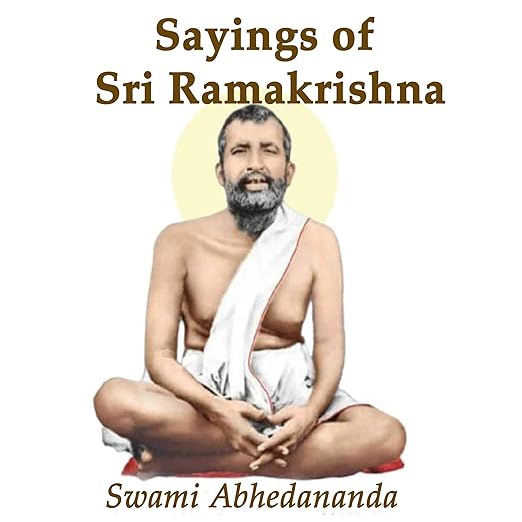
Compiled by Swami Abhedananda and running to over twelve hours in this edition, the audiobook collects hundreds of sayings, parables, and aphorisms from Sri Ramakrishna, the nineteenth-century Bengali mystic whose influence on Vedanta philosophy and Hindu spirituality in the West is difficult to overstate. The opening passage that appears in the synopsis, the one about stars being invisible during daylight without ceasing to exist, is one of the shorter examples of how Ramakrishna communicated. He worked in images, not arguments. He did not prove; he pointed.
Our Take on Sayings of Sri Ramakrishna
What distinguishes this collection from a simple anthology of religious quotes is the cumulative effect of listening in audio form. Reading a book of aphorisms, you tend to skip ahead or lose the thread. Listening, you are held in sequence, and the sequence matters more than it appears to. Themes recur across the sayings: the relationship between devotion and knowledge, the irrelevance of ritual compared to genuine feeling for God, the danger of pride even in spiritual attainment. By the midpoint, the repetition begins to work not as redundancy but as deepening. Reviewer Tarun Jasani observed that the book can be opened at any page randomly, which is true of the text, but the audio format encourages something different: sustained immersion rather than dipping.
Why Listen to Sayings of Sri Ramakrishna
Clay Lomakayu’s narration is well-suited to this material. His voice is unhurried and his pronunciation of Sanskrit and Bengali terms is careful without being stilted. The challenge with a collection like this is pacing: too fast and the sayings blur together; too slow and the listening becomes a meditation exercise rather than an intellectual one. Lomakayu finds a middle register that allows the language to settle without demanding you treat every sentence as an occasion for prolonged reflection. Reviewer dr kiran sood noted that Ramakrishna conveyed his message in simple words and small stories so that all can understand, and that quality translates particularly well to audio, where directness and clarity reward the format.
What to Watch For in Sayings of Sri Ramakrishna
The synopsis for this audiobook is minimal, essentially a single representative saying rather than a description of the work’s scope. That is appropriate but does mean listeners should arrive knowing what they are getting: this is not a biography of Ramakrishna, not a scholarly exposition of Vedanta philosophy, and not a narrative. It is a devotional anthology. If you are approaching it hoping for historical context or theological argument, you will want to pair it with something like Christopher Isherwood’s Ramakrishna and His Disciples. The sayings themselves assume a kind of spiritual earnestness in the listener; they are addressed to seekers rather than skeptics, and they do not argue their premises so much as embody them.
Who Should Listen to Sayings of Sri Ramakrishna
This is a book for listeners who are either already engaged with Vedanta or Hindu spirituality, or who are genuinely open to contemplative religious texts from outside Western traditions. The sayings work beautifully as morning or evening listening, in the way that some people use poetry or prayer: not for information but for orientation. A reviewer from Canada describes finding in the book someone who loves God like for real, and that quality of sincere devotion is the book’s emotional core. Skeptics will find little here to engage their skepticism. But listeners who come with even a basic openness to the questions Ramakrishna raises will find the twelve hours pass in a way that is difficult to categorize as merely entertainment or merely education.
Frequently Asked Questions
Is this audiobook suitable for listeners who are not familiar with Hinduism or Vedanta philosophy?
Yes, with some caveats. The sayings are deliberately accessible and avoid heavy philosophical terminology, but they do assume a basic spiritual receptivity. Listeners with no background in Indian religious thought may want a short introduction to Ramakrishna’s life and context before starting.
Can you listen to sections out of order, or is there a progression to follow?
The text works either way. Reviewers note it can be opened at any point randomly, and the audio is similarly non-linear in its reward structure. That said, sustained listening builds a cumulative depth that random dipping does not replicate.
How does Clay Lomakayu handle the Sanskrit and Bengali terms that appear throughout?
Carefully and consistently. His pronunciation of key terms is measured and he does not rush through unfamiliar words, which helps listeners unfamiliar with the languages follow the text without stumbling.
At twelve hours, is this the kind of audiobook you listen to in sessions or all at once?
Sessions are the natural unit here. The material is contemplative rather than propulsive, and most listeners will find that fifteen to thirty minute segments allow the sayings to settle more effectively than extended marathon listening.