Quick Take
- Narration: Jessica Brody narrates her own work with the enthusiasm of a teacher who genuinely loves the framework, and her self-narration adds a workshop intimacy that suits the instructional content.
- Themes: The fifteen beats, the ten story genres, structural inevitability versus creative constraint
- Mood: Enthusiastic and systematic, with a clear conviction that structure liberates rather than limits
- Verdict: The most practically-organized novel-writing guide available in audio, and Brody’s self-narration ensures the framework lands with the warmth of a mentorship session rather than a textbook.
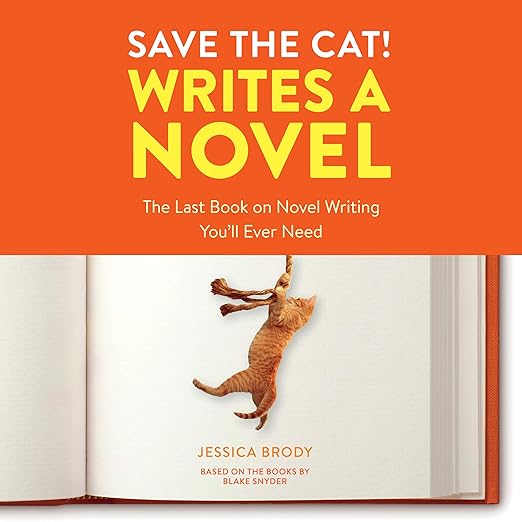
I was midway through a particularly frustrating afternoon of trying to diagnose why a manuscript I’d been working on felt structurally wrong when I started listening to Jessica Brody’s Save the Cat! Writes a Novel. I’d been aware of Blake Snyder’s original screenwriting book for years and had used its beat sheet as a loose diagnostic tool for films. I’d never seriously applied it to prose fiction. By the time I finished the audiobook, I had a completely different understanding of what my manuscript’s problem actually was, and I had a specific tool to fix it.
Brody is both a working novelist and a teacher of the Save the Cat! methodology, which means she understands the framework not just theoretically but through the friction of applying it to actual novels across multiple genres. The book’s great contribution is demonstrating that the fifteen beats Snyder identified in successful screenplays appear just as reliably in novels across every major genre, from literary fiction to thrillers to romance to young adult. This is not a trivial claim, and Brody supports it with enough worked examples that skeptical readers will find the evidence hard to dismiss.
The Fifteen Beats and What They Ask of a Novelist
The fifteen beats run from the Opening Image through the Finale, with the midpoint and the Dark Night of the Soul functioning as the structural spine of the second act. What Brody does exceptionally well is explain not just what each beat is but what function it serves. The Opening Image isn’t just the beginning of the story; it’s a visual statement of the protagonist’s flawed world that will be directly contrasted with the Closing Image to show how much has changed. Understanding the function of each beat makes it possible to interrogate your own manuscript at each stage: what is this scene actually doing? Is it earning its place?
Reviewer Southwest Reader, who had written short stories and marketing content for years but never attempted a novel, described this as “by far, the most phenomenal instructional/teaching/reference work I’ve ever read.” That’s high praise, and the reasons they gave were specific: Brody explains the framework in accessible terms, works through examples from real novels, and provides enough scaffolding that a first-time novelist has somewhere to start rather than facing a blank page.
The Ten Story Genres: Where the Framework Gets Specific
The ten story genres, which Brody adapts from Snyder’s original categories, are one of the most useful tools in the book. Monster in the House, Whydunit, Dude with a Problem, Rites of Passage, Buddy Love, Out of the Bottle, Institutionalized, Superhero, Fool Triumphant, and Golden Fleece each carry specific structural implications beyond the fifteen beats. A Whydunit has different midpoint requirements than a Rites of Passage. Understanding which genre your story belongs to tells you what readers are unconsciously expecting from your particular narrative contract. Getting this genre identification right early saves substantial rewriting later.
Reviewer cgcovert, who had read countless author-help books, was unequivocal: “You will NOT walk away from this book still in a fog of understanding.” That clarity is Brody’s signature pedagogical achievement. She doesn’t leave the hard questions for the reader to figure out. She answers them, directly and with examples.
Self-Narration and the Companion PDF
Brody’s self-narration is the correct choice for this material. Her voice has the quality of a workshop instructor who genuinely enjoys teaching, which transforms what could easily be a dry presentation of structural terminology into something that feels like collaborative creative conversation. At just under eleven hours, the book is substantial enough to feel comprehensive without becoming exhausting.
The synopsis mentions a companion PDF with charts, lists, and exercises. For audiobook listeners, this is worth seeking out. The beat sheet and genre breakdowns in particular are the kind of reference material you’ll want to consult repeatedly as you work on a project. The audio covers everything, but having a visual chart of the fifteen beats on hand makes the book significantly more useful as a working tool.
Listen if: You’re a novelist who wants a systematic structural framework for planning or diagnosing a manuscript, backed by worked examples from published fiction across multiple genres.
Skip if: You’re philosophically resistant to structural methodology and prefer to write without scaffolding, or if you’re looking for craft guidance on prose style and voice rather than plot architecture.
Frequently Asked Questions
Does the Save the Cat! methodology work equally well for literary fiction, or is it mainly suited to commercial genre fiction?
Brody makes the case that the fifteen beats are present in successful novels across the full spectrum, including literary fiction. Reviewer Amazon Customer noted that she traces the methodology back through Syd Field and Blake Snyder while adding significant grey-area explanation that the earlier books lacked. The framework is agnostic about literary versus commercial distinctions.
How essential is the companion PDF for the audiobook version?
The audio covers all the content clearly, and the beat sheet is described verbally in enough detail to follow. But the PDF includes visual charts and exercises that become extremely useful as ongoing reference material while writing. It’s worth downloading separately if you can access it.
Can someone use this book to diagnose and fix a manuscript already in progress, or is it primarily a planning tool?
Both uses are well-supported. Brody explicitly addresses how to apply the beat sheet diagnostically to existing drafts. The fifteen-beat framework makes it possible to identify exactly where a manuscript is working and where it’s missing its structural obligations.
Does Brody explain the quirky Save the Cat and Shard of Glass concepts, and do they translate to prose fiction from their screenwriting origins?
Yes. Save the Cat refers to the moment early in the story where your protagonist does something that makes the reader root for them. Shard of Glass refers to the internal wound driving the protagonist’s behavior. Both translate directly to prose fiction and Brody demonstrates their application across multiple novel examples.