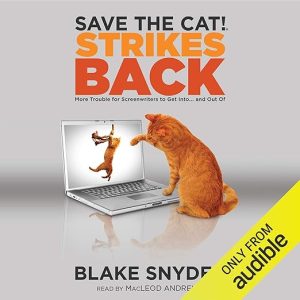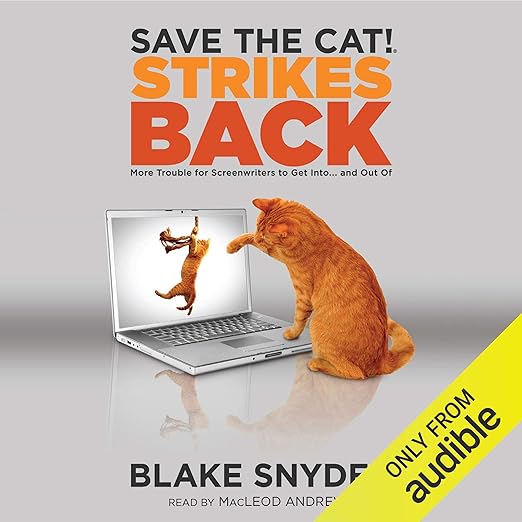
Blake Snyder spent the years after Save the Cat!'s publication answering questions from writers who had applied his beat sheet and run into problems. Save the Cat! Strikes Back, the third and final book in the series, is a collected response to those questions. The audiobook, narrated by MacLeod Andrews and produced by Arthur G. Insana, is notable as the only entry in the Save the Cat! catalog to exist in audio form, a fact Snyder's team highlights prominently. At six hours and three minutes with a companion PDF, this is a complete presentation of the material rather than an abbreviated version.
Snyder's structural contributions to screenwriting pedagogy are well established, and this volume assumes that the listener has at least some familiarity with his concepts from the first two books. The beat sheet, the Save the Cat! genre categories, the logline architecture: all of these appear here in the context of troubleshooting rather than first introduction. What Snyder adds in Strikes Back is a set of diagnostic tools. The seven warning signs that an idea may not be viable, the Transformation Machine that tracks a protagonist's internal arc step by step, and the five questions for keeping a story's spine from collapsing under the weight of subplots are practical instruments rather than philosophical frameworks, which is what makes the book useful as a working document rather than simply an inspiring read.
The chapter on the Five-Point Finale is particularly useful for writers who have found their third acts collapsing. Snyder argues that most unsatisfying endings fail not because the climax itself is weak but because the emotional and logical preparation for the climax is insufficiently structured. The Greenlight Checklist, included in the companion PDF, operationalizes this by giving writers a concrete set of questions to run against their scripts before submitting. One reviewer described using the book to complete a screenplay with an actual professional deadline, and that kind of testimonial speaks to practical utility rather than theoretical elegance. Another reviewer found the directional mantra of focus, discipline, and commitment immediately actionable.
Why It Works in Audio
Andrews's narration is a significant asset for this material. Snyder's writing is conversational by design, having evolved from his workshops and Q-and-A sessions, and Andrews handles the spoken version of that voice with appropriate energy. The difference between a writing book that reads well and one that also performs well in audio is largely a function of how the narrator inhabits the author's teaching persona, and Andrews inhabits Snyder's with the right mix of specificity and accessibility. The practical lists and checklists that might feel tedious on the page become genuinely useful when read aloud with Andrews's pacing, which gives each item room to land before moving on. This is a six-hour listen that functions as an extended workshop session in the best sense of that comparison.
The companion PDF supplements the audio with the Greenlight Checklist and other visual tools, which is important to download alongside the audio rather than treating as optional. Some of the book's most actionable content lives in that supplementary material, and the audio references it directly in several places. The production credit to Insana is worth noting; the sound quality and pacing of the recording suggest that this audiobook received genuine production attention rather than being assembled as an afterthought, which matters for a six-hour instructional listen.
What to Watch For in Save the Cat! Strikes Back
The book's Q-and-A origins mean it can feel slightly diffuse in places. Snyder moves from premise development to producer relationships to the psychology of the rewrite within a structure that is thematically coherent but not always tightly sequential. Listeners who want a single, linear argument will find the book more of a collection of related workshops than a sustained progression. The screenwriting-specific examples also skew heavily toward Hollywood features, which may require translation work for novelists, television writers, or short-form storytellers applying the principles to different formats. Reviewers who already work in screenwriting find the examples immediately applicable; those coming from other narrative forms may need to do some adaptation. The companion PDF is not navigable during an audio session, so returning to it separately after the initial listen is the practical approach.
Best Suited For
Writers who have already worked through the first Save the Cat! book will find this volume the most useful diagnostic resource in the series. The troubleshooting orientation means it functions as a companion to scripts in progress rather than a first-principles introduction. Andrews's performance makes this a better audio experience than a straightforward page read for most of the material. Listeners entirely new to Snyder's system should start with the original Save the Cat! rather than this entry, which assumes familiarity with the core vocabulary. The six-hour runtime positions it as a serious working resource, not a quick primer. Writers who use audiobooks as part of their craft development routine, listening while walking or doing other tasks, may want to schedule a deliberate re-listen for the checklist sections specifically; the practical tools are dense enough that passive listening risks missing the actionable content embedded in the workshop-style delivery. The companion PDF is the resource to return to repeatedly once the full listen is complete, as it consolidates the most practical elements into a format suited to active writing sessions and revision passes against a specific script or manuscript.
Does this audiobook include the full companion PDF, and is it necessary?
The Greenlight Checklist and other visual tools arrive in your library as a PDF alongside the audio. Several key tools are referenced directly in the audio, so downloading it separately before or after your listen is worthwhile.
Is this audiobook useful for novelists, or is it written specifically for screenwriters?
The examples skew heavily toward feature film, but the structural principles apply broadly. Novelists and TV writers have adapted Snyder's framework productively; some translation from screen to page is necessary but manageable.
How does MacLeod Andrews's narration affect the learning experience in this audiobook?
Andrews handles Snyder's workshop-derived voice naturally, giving practical lists and checklists room to land rather than rushing through them. The conversational material performs better in audio than most writing craft books because Andrews maintains the energy of a live session throughout the six hours.