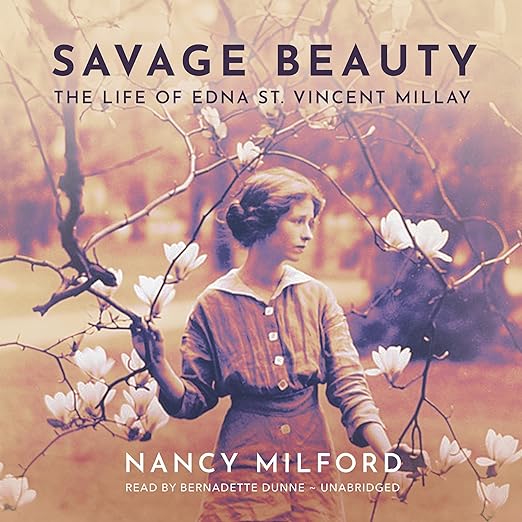
Four Millay women, a mother and three daughters, wrote each other so many letters across so many decades that Nancy Milford needed exclusive archival access just to keep the correspondence straight, and this audiobook inherits that same density across nearly twenty-five hours.
The Female Counterpart to Fitzgerald Himself
Milford's subject is Edna St. Vincent Millay, the poet whose public performance of herself, in readings, in love affairs, in sheer notoriety, made her the female counterpart to F. Scott Fitzgerald as far as the Jazz Age's cultural imagination was concerned. She won the Pulitzer Prize, and her voice was 'likened to an instrument of seduction,' according to the synopsis's own description; Milford never lets listeners forget that the performance and the private cost of maintaining it were two very different things.
A Family Romance Built From Deep Immersions
Milford calls her own book 'a family romance,' and the phrase does real work: the bond between Millay, her two sisters, and their mother was intense enough to shape and eventually distort all four lives, described in the synopsis as being 'like real-life Little Women, with a touch of Mommie Dearest.' The unpublished diary material Milford draws on gets compared, fairly, to Sylvia Plath's for its own 'ruthless honesty,' a serious claim to make about primary source material and one the book backs up with actual quoted passages rather than assertion alone.
Milford structures the book less as a chronological march from birth to death than as a series of deep immersions into the relationships that defined Millay's life at each stage: the sisters and mother first, then the love affairs, then the slow account of decline. That structure asks more patience of a listener than a strict timeline would, but it mirrors how Millay herself seems to have experienced her own life, relationally rather than as a sequence of career milestones. Listeners expecting a more conventional literary-career arc, book by book, award by award, should recalibrate before starting.
Dunne Avoids Both Hagiography and Tabloid Fascination
Bernadette Dunne narrates with the kind of warmth that keeps a subject this complicated from curdling into either hagiography or tabloid fascination, an easy trap given how much of Millay's life reads like scandal on the surface. She does not sensationalize the affairs or sand down the darker material about addiction and family dysfunction; she just keeps moving through it at a steady, literate pace that trusts Milford's own research to carry the emotional weight. That balance of warmth and restraint is arguably the single hardest register for any narrator to sustain across twenty-five hours of material this emotionally volatile, without either flattening into detachment or tipping into melodrama somewhere along the way.
Four Voices, One Reader, No Full Cast
What separates this from a standard literary biography is the sheer volume of primary material Milford had exclusive access to: boxes of sister-to-sister and daughter-to-mother correspondence never before opened to a biographer. Hearing those letters read aloud rather than skimmed on the page gives the family's specific voice, by turns adoring and possessive, a different kind of presence than it would have in silent reading, since Dunne can let each register of intimacy or manipulation land in real time.
Reading letters from four different family members aloud without a full cast requires real vocal discipline, enough differentiation that a listener can track whose voice is whose without losing the sense that these are genuinely different people, not variations on one narrator's default register. Dunne manages that differentiation through pacing and emphasis rather than exaggerated character voices, which keeps the correspondence readable as documentary material rather than dramatized reenactment, a distinction that matters for a biography this committed to primary-source integrity. That's a small but real narration achievement easy to take for granted.
Far More Sexual Than One Reader Expected
Nearly twenty-five hours is a genuine commitment, closer to a long biographical epic than a typical author profile, and the book earns most of that length through the sheer density of the sisters' relationship rather than padding a thin life story. Listeners used to tighter, more journalistic literary biographies should recalibrate expectations; Milford is working from an archive, not a magazine profile, and the pacing reflects that.
One reviewer, T.M. Johnson, frames a biographer's task as serving as 'liaison between subject and reader,' arguing a biography must 'go beyond the mere chronology of dates and events,' a standard this book is clearly trying to meet rather than settle for. Another listener, simply credited as Kindle Customer, admitted the life covered here was 'far more sexual than I had anticipated,' a fair warning for anyone expecting a tidy literary hagiography instead of the messier, more physically candid record Milford actually reconstructs.
Beyond the sexual content already flagged by one reviewer, the book is candid about substance dependency and genuine family dysfunction among the Millay women, material that goes well past a tasteful literary-biography gloss into real, sometimes difficult territory. Milford does not sensationalize any of it, but she does not soften it either, and listeners should understand going in that 'family romance' in the synopsis's own framing carries real darkness inside the word romance, not just warmth. That honesty is precisely what makes the biography feel earned rather than voyeuristic, even when specific passages are genuinely uncomfortable to sit with.
Karen Chung Has Taught This Poet for Years
Readers of literary biography who appreciate serious archival depth will recognize the same commitment to primary sources at work here that defines the best of the genre. Karen Chung, another listener, has taught Millay's poetry, including 'The Spring and the Fall,' in her own English classes for more than a decade, which points to a real secondary audience for this material: teachers and students of American poetry looking for the biographical life behind the verse.
Listeners interested in the broader question of how women artists navigated fame, sexuality, and public performance in the early twentieth century, not just Millay specifically, will find the book rewards that wider curiosity too, since Milford is constantly attentive to what Millay's choices cost her precisely because she was a woman performing this particular kind of celebrity in this particular era. Book clubs drawn to literary biography with real narrative momentum, rather than a dry academic study, will also find plenty to discuss across the sisters' shifting loyalties alone.
Anyone wanting a brisk overview of Millay's greatest poems rather than a full excavation of her private life, her marriage, and her family's tangled loyalties should look toward an anthology or a shorter critical study instead; this is a biography built for total immersion, not a quick refresher.
Before You Listen
How long is the Savage Beauty audiobook, and is that runtime justified?
It runs nearly 25 hours, which is long for a literary biography, but the length reflects genuinely exclusive access to unpublished family letters and diaries rather than padding.
Does the Savage Beauty audiobook require prior familiarity with Edna St. Vincent Millay's poetry?
No. The audiobook works as a standalone biography of her life and family, though listeners who already know her poems will get extra resonance from the biographical context.
Does Bernadette Dunne's narration handle the book's frank sexual content and family dysfunction tastefully?
Yes. Dunne reads with steady warmth rather than sensationalism, letting the material's own weight land without dramatizing it further.