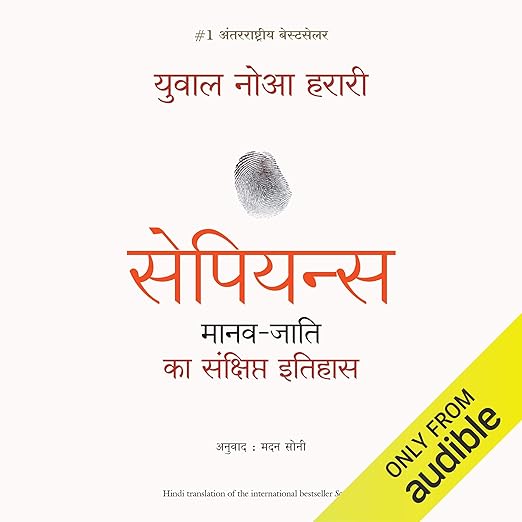
Before You Press Play
- Voice: Babla Kochhar reads the full 21 hours and 42 minutes in Hindi, a fact the description mentions only in its final line
- Big ideas: human evolution, the cognitive revolution, empires and money, the future of the species
- Atmosphere: Sweeping and conversational, popular history built for long stretches of listening
- Worth it?: A valuable full-length Hindi edition that is badly signposted, and useless to anyone who cannot read the language
Language is the first thing to settle before you buy this audiobook, and the product page leaves it until the very last line. Everything above that line is the English publisher's copy for Yuval Noah Harari's global bestseller, complete with the New York Times listing and the note that it was "A Summer Reading Pick for President Barack Obama, Bill Gates, and Mark Zuckerberg". Then, at the bottom, a single sentence: "Please note: This audiobook is in Hindi."
That is the whole review in miniature. A 21 hour and 42 minute recording, released in March 2019, presented in one language and delivered in another. Babla Kochhar is the credited voice.
English Signaling Buries the Language Disclosure
Nothing about the mismatch reflects on the recording, which is presumably exactly what it says it is. The problem sits in the presentation. A buyer scanning the description meets Harari's argument in English, sees the familiar endorsements, recognizes the book from a hundred recommendations, and can reach the purchase button without ever passing the sentence that changes the transaction entirely. If you read Hindi, this is a well-marketed edition badly signposted. If you do not, it is twenty-one hours you cannot use.
Look at how much English signaling stacks up before you reach the disclosure. A best-seller citation opens the copy, three of the most recognizable names in American public life are offered as endorsers, and the pitch closes by recommending the book to readers of Jared Diamond, James Gleick, Matt Ridley, Robert Wright and Sharon Moalem. Every one of those markers is aimed at an English-language buyer, and none is a reason to choose this particular recording.
Written responses on the page reflect the split. Two of the five are in Hindi. Suman Saurabh, writing in January 2026, describes the book as a rare confluence of history, science, philosophy and sociology and one of the most influential works written about human history, and Aziz Rai's longer response from August 2019 works through the Homo species and how sapiens built a separate image of itself. Three more are in English, ranging from santosh jha's careful four stars to a two-word verdict of "Best product".
What none of the five does is describe the recording. Not one mentions the reading, the pace, the pronunciation of the technical vocabulary, or even the fact that it is in Hindi at all. On a listing where language is the single most consequential variable, that silence is the most striking thing in the pool, and it means the only evidence about this specific edition is the sample.
Twenty-One Unabridged Hours in Hindi Are Rare
For a Hindi-reading listener the case is straightforward and strong. Harari's book is built for narration: it moves in broad sweeps, from a world where "at least six different species of humans inhabited Earth" to the cognitive shift around seventy thousand years ago, then through agriculture, empire and money. That is storytelling architecture, not a technical monograph, and it holds up over long stretches of listening in a way that argument-dense nonfiction rarely does.
Having it in Hindi at full length also matters more than the marketing suggests. Twenty-one hours and forty-two minutes indicates a complete reading rather than a condensation, and a major work of popular history available unabridged in a language other than English is worth more than the two ratings behind it imply. Readers who would otherwise take this in a second language get the whole argument in their first.
Content justifies the hours on its own. The description promises a book that connects biology and history and closes on the question of what happens now that people "have begun to bend laws of natural selection", and the reviewers confirm that reach. santosh jha, giving four stars, calls it "worth reading if you are even slightly interested in human evolution" and says it "give a very broader perspective". Another response, from December 2025, calls it one of the best books its writer has read.
Two Ratings Cannot Tell You Much
The rating field is unusable. Two ratings sit behind the 4.5 average, and five written reviews sit beneath the same average, so the counter shows fewer scores than the page shows written responses. A two-rating base carries no information in any case. Judge this edition on the sample and on the four-star review that names an actual reservation.
That reservation is worth quoting properly. santosh jha wanted more depth than he got, writing that the book gives "a very broader perspective not deeper that i was looking for". It is a fair criticism of Harari's method: the sweep from cognition to capitalism is achieved by moving fast, and specialists in any of the fields crossed will find their own area handled briskly. Over twenty-one hours of listening, without a page to slow you down, the pace is part of the experience.
Structure works in your favor across a listen this long. Harari builds in eras rather than chapters of argument, moving from cognition to farming to empire to money to science, and each of those blocks has its own beginning and end. Twenty-one hours becomes a series of arrivals rather than one undifferentiated stretch, and that is often the difference between a book somebody finishes and a book somebody abandons around hour six.
Check where the reviews come from as well. All five were filed in India, and the pool spans from August 2019 to January 2026, so it does describe sustained interest in this listing rather than a launch flurry. But since no reviewer identifies which edition or format they used, none of them can settle whether the Hindi translation reads well. Only the sample can do that, and on a purchase of this size it is worth giving several unhurried minutes of your attention.
Hindi Readers Get Harari's Argument at Full Length
Hindi-reading listeners who want Harari's argument at full length in their own language are the clear audience, and the running time suggests they are getting all of it. Anyone building a history library in Hindi, or introducing the book to a family member who reads it more comfortably than English, will find this a rare and useful edition.
English-language listeners should look for a different recording of the same title, because this one will not serve them regardless of how good it is. Specialists in evolutionary biology, anthropology or economics should note the four-star reservation about breadth over depth before committing twenty-one hours. That final line of the description is the only sentence on the page that decides whether this edition is for you.
A Few Questions About Sapiens
What language is this Sapiens audiobook in?
Hindi. The entire product description is the English publisher's copy, and the language is disclosed only in a single closing line reading please note that the audiobook is in Hindi. English-speaking buyers should look for a different recording of the same title before purchasing this one.
Why does this audiobook show only two ratings?
The counter shows fewer ratings than the page shows written reviews, which means the field is unreliable rather than simply thin. A two-rating average carries no useful signal, so weigh the four-star review that names a real reservation about breadth instead.