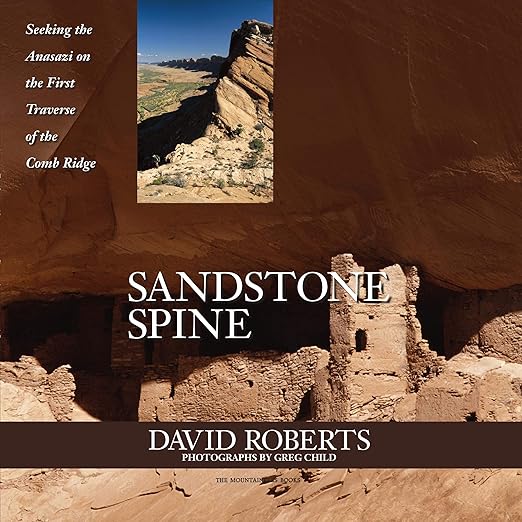
Quick Take
- Narration: David de Vries handles the dual register of adventure memoir and archaeological speculation with ease, giving both the physical and intellectual passages their proper weight.
- Themes: Anasazi mystery and abandonment, friendship tested by wilderness, the draw of unreachable places
- Mood: Dry-aired and dusty, intellectually alive, companionable
- Verdict: A precise and knowledgeable adventure memoir that earns its archaeological digressions – essential for anyone drawn to the canyon country of the American Southwest.
I was halfway through a long stretch of indoor city days when I started listening to Sandstone Spine, and by the second hour I could almost feel the grit. David Roberts is one of the better writers working in adventure memoir, with a background in Himalayan mountaineering and decades of reporting from remote places, and he brings that precision of observation to what is, at its surface, a simpler story: three middle-aged men hiking a hundred miles of sandstone ridge through the Utah-Arizona borderlands with no established trail and only the promise of Anasazi ruins at the end of each day’s push.
The Comb Ridge had never been hiked end to end, and Roberts, Greg Child, and Vaughn Hadenfeldt set out in September 2004 with the dual motivation of physical challenge and archaeological detective work. The ridge is, as Roberts describes it, a mini-mountain range erupting from the desert floor, a hundred miles of ankle-wrenching slickrock with cliff edges on one side and convoluted bedrock on the other. There is not a single mile of established trail. The physical reality of moving through it occupies the book’s foreground, but the Anasazi past gives it depth.
Our Take on Sandstone Spine
Roberts is at his best when he is simultaneously a hiker and a historian, and that is mostly what this book is. The questions he brings to the Anasazi sites they discover, who built these inaccessible cliff dwellings, why they chose positions that are almost defensively hidden, what triggered the abandonment around 1300 AD, why the Navajo believed the Anasazi had magical powers and could fly, are not rhetorical. Roberts engages the archaeological scholarship seriously, drawing on early explorers, modern researchers, and his own conversations with Hadenfeldt, who knows this terrain intimately. The speculation is marked as speculation, which is the intellectually honest approach.
The friendship dynamic among the three hikers provides the book’s human texture. Roberts at 61 is the oldest, and there are moments where his physical limits become relevant to the story in ways he does not flinch from. Child and Hadenfeldt have their own preoccupations, their own methods of looking, their own irritations with each other after days in extreme terrain. One reviewer who had camped extensively in the canyons adjacent to Comb Ridge noted that the book captures the specific quality of being lost in a place where being lost is not entirely the wrong word for what you are doing.
Why Listen to Sandstone Spine
David de Vries’s narration suits the material well. He reads Roberts’s precise, slightly professorial prose without flattening it, and he handles the geological and archaeological terminology with confidence. The book has a dry wit that de Vries catches; there are moments of real humor in the three men’s interactions that land cleanly in audio. At just under seven hours, this is a comfortable single-weekend listen.
The audiobook is particularly good for the landscape descriptions, which Roberts writes with the eye of a climber: always calibrating distance, exposure, and the exact angle of a slope. Heard rather than read, these passages create a spatial imagination of the Comb that visual descriptions on the page sometimes struggle to convey.
What to Watch For in Sandstone Spine
One reviewer noted that Roberts is wordy, which is fair. He does not write lean sentences. The archaeological context sections can run long for listeners primarily interested in the physical adventure narrative, and conversely, readers who came for the Anasazi history might find the discussion of water caches and ankle injuries less riveting than they expect. The book integrates these strands more successfully than most adventure-plus-history hybrids, but the weighting is not always even.
It is also worth knowing that Roberts’s position on certain contested Anasazi questions, particularly around the evidence for violence and cannibalism in late prehistoric Southwest culture, is not presented as settled scholarship but as ongoing debate. He is careful about this, but readers with strong prior views on those questions should be prepared for complexity rather than resolution.
Who Should Listen to Sandstone Spine
Anyone with a love of the American Southwest, whether as a hiker, an archaeology enthusiast, or simply someone who responds to desert landscape writing, will find this richly satisfying. Roberts’s other books, including In Search of the Ancient Ones, provide useful context but are not required prior reading. Listeners who find adventure memoir more tolerable when it has intellectual substance will appreciate how seriously Roberts takes the historical questions the landscape asks. Skip it if you need conventional narrative momentum; the book meanders deliberately, like the hikers themselves.
Frequently Asked Questions
Do I need prior knowledge of the Anasazi or Southwest archaeology to appreciate Sandstone Spine?
No. Roberts builds archaeological context as he goes, introducing the relevant history and debates as the hikers encounter specific sites. Some background in Southwest prehistory will deepen the experience, but the book is written for a general reader with curiosity rather than specialist knowledge.
Is this a book primarily about the physical hike or about the Anasazi archaeological sites?
Both threads carry roughly equal weight, woven together rather than separated. Roberts moves between the physical experience of the terrain and the historical and archaeological questions the ruins provoke. Readers primarily interested in only one thread may find the other a mild distraction.
How does David de Vries handle the specialized geological and archaeological terminology?
He handles it with confidence and clarity. The terminology never becomes a stumbling block in the narration. His pacing through the more technical archaeological sections is measured enough to let the information settle without feeling like a lecture.
How does Sandstone Spine compare to Roberts’s other Southwest books for someone who has read In Search of the Ancient Ones?
Sandstone Spine is more personal and more physically grounded than In Search of the Ancient Ones. The earlier book is more purely archaeological in focus; this one foregrounds the experience of moving through the landscape alongside the historical inquiry. Both share Roberts’s serious engagement with Anasazi scholarship.