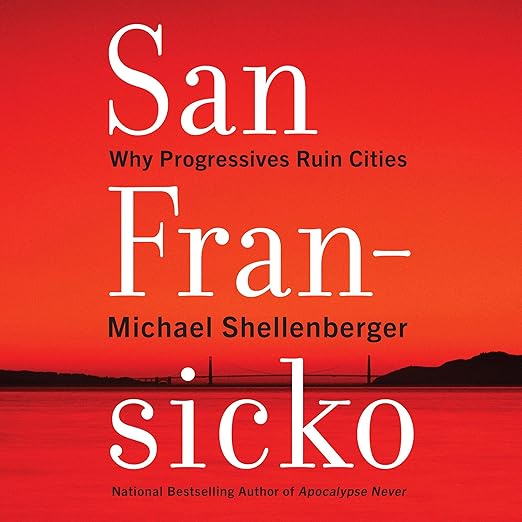
- Performance: Jonathan Todd Ross reads a book whose authority rests on the author having changed his own mind, so the confession reaches you in a borrowed voice rather than the one that lived it.
- What it covers: Urban policy failure, homelessness and drug decriminalization, ideology treated as diagnosis
- Feel: Combative and certain
- Our call: Worth the eleven hours if you want this argument at full strength, much less so if you want it weighed against the other side.
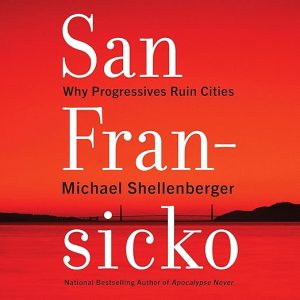
Shellenberger opens by telling you where he stood before he changed his mind, and that admission carries more weight than any argument that follows it. The description says he spent thirty years in the San Francisco Bay Area, and that during those years he advocated for the decriminalization of drugs, affordable housing, and alternatives to jail and prison. Then encampments spread, overdose deaths climbed, and in the publisher's phrasing, what he discovered shocked him. A polemic written by somebody reversing a position is a different animal from one written by somebody confirming it, and this audiobook runs eleven hours and twelve minutes, which is room enough to watch the reversal happen at its own pace.
Five written responses sit under this title, filed from three countries. The earliest landed two days after the October 2021 release, from a reader who says they have lived in the Bay Area their entire life and witnessed much of the history he recounts firsthand. Another arrived from Australia that December. A fifth was written in Japanese, and since I cannot read it, everything I say about this pool is drawn from four.
Is San Fransicko Worth Your Time?
Two fields on this listing disagree with each other. The rating counter shows two ratings behind a 4.6 average, while five full written responses sit on the same page. Two ratings cannot average to 4.6, because with a sample that small the arithmetic only reaches half steps. I am not going to try to reconcile them. The practical consequence for a buyer is simple: treat the star figure as ornament and the five paragraphs as the actual testimony, since the paragraphs are the only part you can check for yourself.
Those paragraphs also tell you what kind of reception this book attracts. One of them, written in Australia, reduces the whole thing to seven words: "Facts and evidence must overcome fake ideas." That response is not describing a book so much as enlisting in it, and knowing that in advance is useful. The publisher's own copy says Shellenberger skewers progressives, and skewering is a mode rather than a method. It wants agreement rather than deliberation, and a reader who arrives undecided will notice the pressure long before the first chapter ends.
Strip the marketing away and the claim underneath is more interesting than its wrapper. The argument is specific: the failure is not a shortage of housing or of money for social programs, but an ideology which designates some people, by identity or experience, as victims entitled to destructive behaviors. Agree with it or not, that is a falsifiable thing to say, and it deserves better than the slogan treatment the packaging gives it. The description even reaches for civilization itself in its closing sentence, which is the register the whole book is pitched in.
One written response makes the case for a wider audience better than the description does. It argues the book earns its time whether or not you live in California, because the mechanics repeat wherever the same policies do, and it names what the book is actually about: "the huge amounts of tax dollars spent by elected officials fail to solve the intertwined and seemingly intractable problems" they were meant to solve. A book about municipal budgets and street conditions is exactly the sort of thing that works while you move through a city.
Jonathan Todd Ross carries the reading credit, and this text hands him a decision he has to remake every few minutes. Nothing in the publisher's copy is neutral; words like skewers and enabling are arguing before the first chapter begins. A sentence of reportage and a sentence of indictment can look identical on the page and cannot sound identical, so somebody had to choose, repeatedly, which one each was. That choice is the largest single variable in how this recording lands, and my advice is to sample a stretch where Shellenberger is describing a condition rather than diagnosing a policy, because that is where the tone for the remaining hours gets set.
Duration works in the book's favor as well. Eleven hours and twelve minutes is not a pamphlet, and the shape the description advertises, good intentions followed by measured outcomes followed by a claim about ideology, is a staircase. In print you can jump to the top and skip the steps. Straight through in audio you climb it, which makes the final claim easier to weigh rather than easier to swallow. A polemic like this one is usually consumed in fragments and argued about by people who read a summary. The format quietly prevents that.
Before You Commit to San Fransicko
You cannot check anything while it plays, and that is the first thing to weigh. This is a book of contested claims about crime, addiction and homelessness, and a skeptical reader in print stops, flips back, and looks something up. In audio the claims keep arriving. If you plan to argue with this book, and plenty of people will want to, budget time afterward instead of expecting to do it in real time.
Consider also the framing. The very first line of the description sells Shellenberger as the national bestselling author of an earlier title rather than introducing this one, which tells you the publisher expects a reader who has already picked a side. Nothing in the recording marks where reported material ends and interpretation begins. Whether that matters depends on whether you came to be persuaded or to be informed, and for most buyers the honest answer sits between the two.
One last caution is about you rather than the book. An eleven-hour argument delivered by one steady voice is persuasive by construction, and that is true of every well-made polemic in this format. Knowing it going in is most of the defense.
Should You Listen to San Fransicko?
The most useful sentence on this page belongs to its only four-star response, which does a buyer's sorting for them. It grants the craft without hedging: "The book was well written. So I give it high marks for that. He lays out his arguments well." Then it refuses the conclusions: "I vehemently disagree with his view on policing." And then it hands you a map of the intended audience: "Chances are if you are a right winger or moderate Democrat" you will enjoy this. That is an honest description of who this recording was built for, written by somebody who is not quite in it.
So listen if you follow urban policy and want the strongest available version of the case against the progressive consensus on homelessness and drugs, or if you live in one of the West Coast cities the description names and have watched the same blocks change year by year. Skip it if you want a survey that weighs competing explanations evenly, or if you need to see a source before you accept a number. And if you disagree with its politics, come anyway, but come rested.
A Few Questions About San Fransicko
Does the San Fransicko audiobook cover cities other than San Francisco?
Yes. The description names Los Angeles, Seattle and Portland alongside San Francisco and treats them as West Coast cities that moved from tolerating homelessness, drug dealing and crime to actively enabling them. The title is local, the argument is regional, and the framing invites you to apply it wherever you live.
Is Michael Shellenberger writing as an outsider to progressive politics?
No, and that is the book's main claim to standing. The description says he spent thirty years in the Bay Area and during that time advocated for decriminalizing drugs, for affordable housing, and for alternatives to jail and prison. The book is presented as a reversal by somebody who held the positions he now attacks.
Will the San Fransicko audiobook change my mind if I lean progressive?
Probably not by itself. It is built to persuade rather than to weigh, and the publisher's copy is combative from its opening line. What it does offer is the strongest version of the opposing case delivered in one continuous pass, which is more than a stack of columns will give you, so treat it as opposition research rather than as a referee.