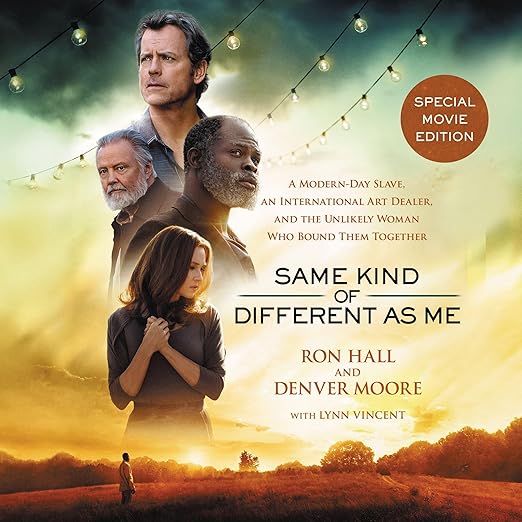
A colleague of mine pressed this book into my hands about three years ago with the words 'you'll cry, but keep going.' I was skeptical. The cover, the tagline, the New York Times bestseller stamp : it all read like something engineered to produce a particular emotional response on cue. But she was right, and I was wrong about the mechanism. Same Kind of Different as Me does not manufacture feeling the way I expected. It earns it through the accumulated weight of two lives told with unusual honesty.
This is the Movie Edition, which includes a new epilogue updating readers on what happened to Ron Hall and Denver Moore after the original publication, plus a behind-the-scenes account of how the film adaptation came together. If you have already heard the original, the movie edition bonus material is the real draw. If you are coming to this story for the first time, it is simply a more complete version of a book that already had substantial depth.
The book works because it genuinely is two stories told from two completely different vantage points. Ron Hall is a self-made millionaire in the international art world, someone who describes his earlier faith as real but shallow. Denver Moore spent decades without a permanent address after escaping what the book calls plantation-style sharecropping in Louisiana, a living legacy of near-slavery that Ron never knew existed until Deborah, his wife, brought them into contact. Their voices alternate, and the contrast is not just stylistic. It is structural to what the book argues about what faith looks like when it is actually put into practice rather than performed.
Barry Scott's narration holds this dual structure together effectively. He navigates between Denver's harder, more guarded voice and Ron's more polished recollections without the transition feeling jarring. This matters enormously for a book built on the tension between two worlds colliding. One reviewer describes Denver as 'totally authentic' on the page, and Scott's performance honors that authenticity rather than smoothing it down.
Why Listen to Same Kind of Different As Me Movie Edition
Deborah Hall is the moral center of this book, which is worth stating clearly because she is sometimes treated as a narrative device in summaries of it. She is the one who sees Denver when others look past him. She is the one who, after receiving a cancer diagnosis, makes her husband promise to continue helping him. The trajectory of her illness runs parallel to the growing friendship between Ron and Denver, and it is what prevents the story from becoming comfortable or easy. Her presence anchors the faith elements in something more costly than uplift.
At nearly ten hours, this is a substantial listen, and it moves through grief and friendship at a pace that rewards attentiveness rather than background listening. It is not a book that delivers its emotional moments in obvious places. Some of the most affecting passages are ones where Denver describes his years on the street with a matter-of-factness that is more devastating than any dramatization would be.
What to Watch For in Same Kind of Different As Me Movie Edition
The book's faith framework is present throughout and not incidental to the story. This is explicitly a Christian memoir, and readers who approach faith with strong skepticism may find the framing limits their engagement. One reviewer describes it as 'somewhat preachy,' which is fair, particularly in the passages where Ron reflects on his own spiritual journey. Denver's sections are considerably less doctrinaire, which is part of why they tend to land harder. If the religious register is something you typically avoid in nonfiction, be aware it shapes the book's emotional logic from beginning to end.
The Movie Edition bonus material is also more interesting for readers who want to understand how the adaptation came together than for those who simply want the story. The epilogue updates are genuinely moving, but the behind-the-scenes filmmaking content is secondary to the memoir itself.
Who Should Listen to Same Kind of Different As Me Movie Edition
This is a book for readers who want a memoir with real narrative weight rather than a feel-good summary, for anyone interested in how faith functions under genuine duress, and for listeners who can engage seriously with material that does not resolve tidily. It is less suited to readers who find Christian framing alienating, or who want a story that keeps its characters at a comfortable emotional distance. For the right listener, it is a ten-hour investment that changes how you see certain things about class, friendship, and what grace actually costs.
Before You Press Play
- Narration: Barry Scott delivers a warm, emotionally calibrated performance that honors the dual-voice structure : his range across Denver's hard-edged story and Ron's measured narration is convincing.
- Themes: Unlikely friendship, faith tested by circumstance, the persistence of grace
- Mood: Emotionally heavy but ultimately hopeful, with flashes of real humor
- Verdict: A memoir that earns its emotional weight through specificity rather than sentiment, best approached with patience for its faith-forward framing.
Does the Movie Edition add enough to justify choosing it over the original audiobook?
If you are a first-time listener, the Movie Edition is simply the more complete version of the same story and is worth choosing for the epilogue alone, which updates Denver and Ron's stories meaningfully. For listeners who already know the original, the added value is the behind-the-scenes filmmaking material, which is interesting but not essential.
Is this audiobook accessible to listeners who are not religious?
Partially. Denver's sections work regardless of your relationship to faith because his voice is so grounded in lived experience rather than theology. Ron's sections are more explicitly Christian in framing and reflection. The book does not require belief to be affecting, but the faith structure shapes the narrative logic, and non-religious listeners should know that going in.