Quick Take
- Narration: Michelle Murillo brings a warmth and conversational ease to Mary Trimble’s first-person account that suits the book’s combination of practical sailing detail and personal adventure.
- Themes: Dream fulfillment against practical obstacles, the Pacific as both destination and character, the logistics and community of offshore sailing
- Mood: Expansive and quietly inspiring, with the honest texture of a real voyage rather than a curated highlight reel
- Verdict: A genuinely satisfying sailing memoir for those who dream about ocean passages or want to understand what such a journey actually involves, particular strength in its practical honesty.
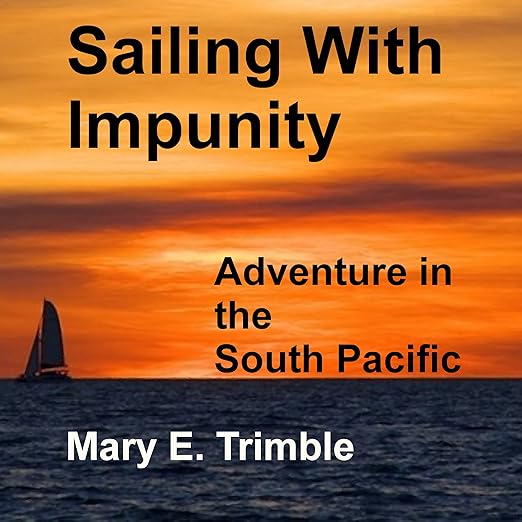
I grew up far from any ocean, which may be why sailing memoirs have always had a particular pull for me. There’s something in the combination of confined space and infinite horizon that literature handles better than most travel writing, you can’t drift away from a boat the way you can drift away from a hotel. When Mary and Bruce Trimble set out from Seattle on a 13,000-mile voyage to the South Pacific and back, they were carrying not just provisions and charts but the full weight of a dream they’d been building toward for years. Sailing with Impunity is the account of what happened when the dream met the ocean.
The practical detail in this book is one of its distinguishing features. Trimble doesn’t skip the provisioning, the boat selection, the regulatory preparation, the mechanics of organizing a life around an extended offshore passage. One reviewer described the book’s detail on provisioning as practically useful as actual sailing directions for anyone planning the same route. That level of specificity is either indispensable or excessive depending on what you’re reading for, sailors who want the texture of the journey alongside the experience will find it invaluable; general readers who want adventure with less technical scaffolding may occasionally find themselves waiting for the story to pick back up.
Our Take on Sailing with Impunity
What Trimble does particularly well is the geography. The route, from Seattle through the South Pacific to Tahiti, Samoa, Tonga, and back, is covered with the attentiveness of someone who was genuinely experiencing these places for the first time while also deeply aware of their history and their meaning to the sailing community. The “magical sights and scents of their first tropical island landfall” and the “bustling, colorful Tahitian markets” are not travel-brochure impressions; they’re observed by someone who spent months preparing to arrive there and was paying the kind of attention that extended preparation produces.
Michelle Murillo’s narration contributes significantly to the book’s warmth. She reads as though she knows Mary Trimble, which creates the sense that you’re hearing an account from someone who was actually there rather than a narrator performing someone else’s story. For memoir, that quality is essential. The book’s conversational prose style, described by one reviewer as “clean, crisp, and conversational,” is well served by a narrator who doesn’t impose interpretation on sentences that are already doing their own work.
Why Listen to Sailing with Impunity
The sailing memoir genre ranges from the purely adventurous to the obsessively technical, and Trimble occupies useful middle ground. She is neither minimizing the difficulty and danger, the midnight squalls and the cyclone in Samoa are handled with honest unease rather than retrospective bravado, nor using the technical aspects as a substitute for the human story. The relationship between Mary and Bruce, the experience of fulfilling a shared dream on a shared boat, is the emotional anchor around which everything else is organized.
Readers who came to this via Kon Tiki or other classic Pacific voyage narratives will find familiar pleasures, the specific texture of isolation, the arrival at ports after long passages, the community of other cruising boats encountered along the route. One reviewer made exactly that connection, noting that Sailing with Impunity took them back to the feeling of those earlier Pacific adventure narratives they’d loved in youth.
What to Watch For in Sailing with Impunity
One reviewer gave it three stars specifically for lacking the detail they look for in a sailing book. That’s an honest datapoint about the book’s position on the spectrum, it is accessible enough that landlubbers can enjoy it (several reviewers with no sailing background describe themselves as such and found it engaging), which means committed sailors may find it less technically immersive than books written primarily for that audience. The reviewer who called it a “city-bred landlubber” experience and meant it as praise is probably the most accurate indicator of the book’s natural audience.
The passage of time is also worth noting. Published in 2017 and based on a voyage from some years before, some of the island details and anchorage descriptions may have changed. The practical information is useful as orientation but should be verified against current cruising guides rather than relied on as up-to-date sailing directions.
Who Should Listen to Sailing with Impunity
This audiobook belongs on the list of any listener who has a quiet dream about offshore sailing and wants to understand what it actually looks like to pursue it. The practical detail, the honest account of difficulty, and the warmth of the personal story all serve that audience well. General travel memoir readers who enjoy adventure narratives with genuine stakes will find it accessible. Sailors with extensive offshore experience may find the book too introductory in its sailing content, though the Pacific route coverage remains interesting regardless of experience level. Michelle Murillo’s narration makes it a pleasure to listen to across nearly five hours.
Frequently Asked Questions
Do I need sailing knowledge to enjoy this memoir?
No. Multiple reviewers describe themselves as landlubbers with no sailing background who found the book completely accessible and engaging. Trimble explains sailing terms and concepts as they arise, and the human adventure is the primary engine rather than technical seamanship. The practical detail is an enhancement for readers interested in it, not a prerequisite for following the story.
How does Michelle Murillo’s narration handle the combination of practical sailing detail and personal adventure narrative?
Murillo navigates both registers well. She reads the practical sections with a matter-of-fact clarity that keeps technical information accessible rather than dry, and she brings genuine warmth to the personal moments and arrival sequences. The conversational prose style suits her narration, and the result feels like a personal account rather than a read-aloud.
Is the route covered, Seattle to the South Pacific and back, documented in enough detail to be useful for someone planning a similar voyage?
One reviewer with sailing experience described the provisioning sections as practically useful as sailing directions. The route detail, island coverage, and logistical information are present throughout the book, though readers should treat it as context rather than a current cruising guide given the publication date. For current regulatory and anchorage information, contemporary cruising guides should be consulted.
How does this compare to other Pacific sailing memoirs?
The closest comparison points are personal accounts of the coconut milk run, the standard Pacific cruising route, rather than record-breaking or solo voyages. It sits closer to the accessible, personal tradition of Lin and Larry Pardey than to the extreme adventure end of the sailing memoir spectrum. Readers who want human story and geography over technical challenge will find it a strong choice in that category.