In Brief
- Performance: Michael Palin narrates his own journey with the same dry warmth and self-deprecating humor that made his BBC series beloved worldwide - the voice completely matches the traveler on the page.
- What it covers: Adventure and discovery, cultural humility, the myth versus reality of desolation
- Feel: Curious and warm, with stretches of genuine wonder
- Our call: Palin's self-narrated audiobook is the definitive companion to his Sahara travels, richer and funnier than any TV episode summary.
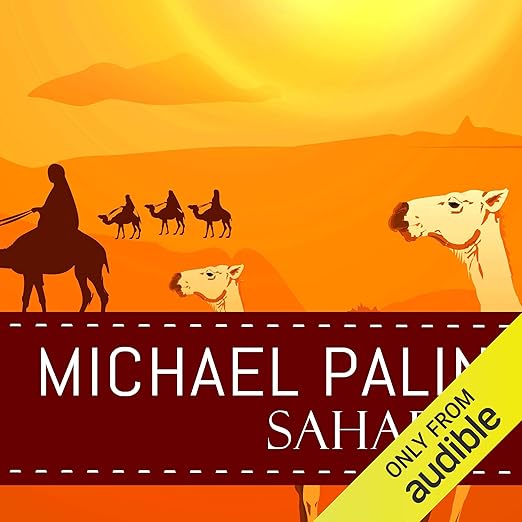
Michael Palin has been crossing the planet on behalf of curious armchair listeners for decades, and this audiobook - the companion to his BBC television series - captures the Sahara in a way that the camera alone never could. The book covers a route from Gibraltar down through Morocco, over the Atlas Mountains, into the little-known territories of Mauritania, Mali, and Chad, onward to Algeria and a then-recently reopened Libya, and finally into the classical ruins of Tunisia. At more than six hours, it finds room for everything the TV format had to compress or discard: extended conversations with people he met along the way, longer reflections on landscape, and the kind of wry, self-aware commentary that Palin delivers better than almost any other travel writer working today. That he reads it himself is not incidental - it is the entire point.
One reviewer who had spent over a year traveling through the Sahara region put it plainly: Palin was funny, respectful, and insightful, and the book took them back to the desert. That combination - humor, respect, and genuine curiosity - is the through-line of everything Palin does, and it is on full display here.
What We Made of It
The most important thing to understand about Sahara is that Palin goes out of his way to dismantle the Western image of the desert as a vast and lifeless nothing. What he finds instead is a landscape saturated with people, trade routes, ancient civilizations, and competing modern pressures. He rides on what was then the longest train in the world. He encounters the Paris-Dakar Rally materializing improbably out of nowhere. He stands before the world's largest mud mosque and arrives, with considerable difficulty, in Timbuktu. Each of these moments is handled with the light touch of a writer who knows that the real story is usually a bit sideways from the famous landmark. The mud mosque gets a paragraph of genuine architectural admiration, and then Palin is immediately worried about what the guide is going to ask him to buy. That ratio - wonder followed quickly by comic deflation - is the book's essential mode, and Palin sustains it across six very different countries without the tone ever going sour.
The chapters dealing with Mauritania and Mali are the strongest, partly because these are territories that most English-language travel books skip entirely. Palin's account of nomadic herders and camel caravans in that central stretch of the route is precise and unhurried, giving the listener time to actually imagine the scale of the desert rather than rushing toward the next famous name. By contrast, the Libyan section arrives with added historical weight - the country had only recently reopened to Western travelers - and Palin handles the political subtext carefully without letting it overwhelm the human encounters.
Palin's self-narration is the clearest reason to choose the audiobook over the print edition. The man is a professional performer with fifty years of practice reading comic timing, and that training is audible in every scene where he is mildly embarrassed, mildly lost, or mildly horrified. He gives himself no special advantage in the telling - he is just as baffled and travel-weary as his team - and the lack of ego in the delivery is genuinely refreshing. A reviewer who described him as brilliant was responding to this quality: the sense that the narrator is honestly surprised by what the desert turns out to be, and that his surprise is contagious.
The BBC companion book format adds something that pure radio or documentary cannot: Palin's personal journals and extended observations. Where the television episodes required a visual hook every few minutes, the book is free to sit with a single conversation or a single view across a salt flat for as long as the description warrants. The result is a travel audiobook that rewards patience, one that is better listened to in longer stretches than in quick commute segments, because the rhythms of the desert itself start to seep into the pacing.
Weak Spots in Sahara
Two threads are worth tracking as the journey unfolds. The first is Palin's consistent attention to the people he meets rather than to the landscape in isolation. He is far more interested in the tea-seller's daily routine than in the dune formations behind him, and that human focus is what separates this from a nature documentary in book form. The second thread is the subtle meditation on what empty and remote actually mean. The Sahara is simultaneously the world's largest hot desert and a place that has supported trans-continental trade for thousands of years, and Palin keeps returning to that contradiction without ever turning it into a thesis.
One reviewer noted that the book starts a little sluggish - this applies to the audio version too. The Gibraltar and Morocco sections are pleasant but familiar territory for anyone who has read European travel writing. The audiobook really finds its footing once Palin crosses into Mauritania and the road genuinely disappears. If you find the opening hour or so slower than expected, hold on: the second half earns the time investment completely.
Who Will Get the Most From It
This audiobook is ideal for anyone who has seen the BBC series and wants more depth, and equally suited to listeners who have no idea what the series is and simply want well-observed travel writing read by someone who was actually there. Fans of Ryszard Kapuscinski's African dispatches or Jan Morris's country portraits will find Palin working in a lighter but not lesser register. Those expecting high adventure or physical danger will be mildly disappointed - Palin is challenged and uncomfortable but rarely at risk - but the tone is honest about that, and the book never pretends to be something it is not. It is an account of a curious, literate man crossing a vast and misunderstood part of the world, and Palin makes that sound like exactly the right thing to be doing.
Common Questions
How does Michael Palin's narration compare to a professional audiobook narrator?
It is different rather than better or worse. Palin is a trained performer with strong comic timing, but he reads as a conversationalist rather than a broadcaster. The result feels personal and unguarded, which suits the material very well.
Does the audiobook include the photographs from the print edition?
No. The photographs in the print companion book are not available in the audio format. Palin's descriptions are detailed enough to compensate for most scenes, but readers who want the visual record should consider the print edition alongside.