Quick Take
- Narration: Richard Fidler narrates his own book, which is the right call, his broadcaster’s ear for rhythm keeps the travel sections alive and his genuine investment in the sagas is audible throughout.
- Themes: The nature of storytelling and anonymous authorship, inherited identity and family mystery, landscape as living memory
- Mood: Contemplative and unhurried, with stretches of real wonder alongside an occasional sense of length
- Verdict: Saga Land earns its Indie Book Award through the quality of its curiosity, Fidler and Gislason are good company for thirteen hours of Iceland, even when the pacing loosens more than it should.
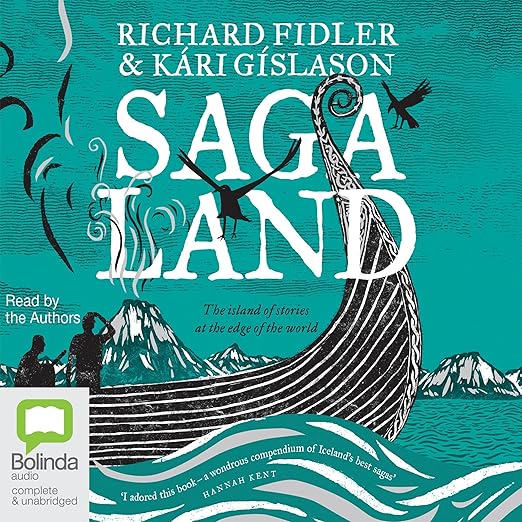
I came to Saga Land through the Iceland rabbit hole, I had been reading about Viking-age literature for a separate project and kept encountering the same observation: that the Icelandic sagas are among the greatest literary achievements of the medieval world, that their authors are almost entirely unknown, and that Iceland itself is essentially a place where that literature is still physically present in the landscape. Saga Land is Richard Fidler and Kari Gislason’s attempt to inhabit that observation rather than just state it, and the difference between inhabiting and stating is the difference between a good book and an interesting premise.
Fidler is an Australian broadcaster; Gislason is an author with Icelandic family heritage. They are good friends, and their friendship is one of the book’s operative premises: two people with complementary relationships to the same body of material, traveling across Iceland to the places where the blood feuds and dangerous women and compelled killers of the sagas actually lived. The blending of travelogue, literary analysis, and personal history is ambitious, and Saga Land mostly earns its ambition while honestly testing the patience of listeners who are not already deep in saga territory.
The Sagas as Living Landscape
The book’s strongest sections are the ones where Fidler and Gislason stand in specific places and explain what happened there a thousand years ago. The Icelandic landscape is unusually hospitable to this kind of exercise, the island has not changed as dramatically as most of Europe over the intervening centuries, and the sagas are geographically specific in ways that make their settings recoverable rather than merely imaginable. When Fidler describes crossing a particular field or stream and then explains what occurred at that location in a saga written in the thirteenth century, the juxtaposition is genuinely affecting in a way that no amount of abstract literary analysis produces.
Richard Fidler narrates his own text, and the broadcaster’s instincts are obvious throughout. He knows how to build a paragraph toward its revelation, how to let a pause do work, and how to make unfamiliar Icelandic names and terminology feel accessible without condescending to the listener. The technical challenge of narrating another person’s voice and perspective, Gislason’s sections of the book, is handled through tonal shifts that are small but reliable across thirteen hours of continuous listening.
Kari Gislason’s Family Mystery
Threaded through the travelogue is a secondary narrative about Gislason’s own Icelandic heritage and a longstanding family mystery connected to his father’s side. That narrative functions as both personal stakes for the journey and as an argument about what the sagas do in a culture: they encode identity and descent, and the question of who you are is not separable from the question of whose stories you come from. Gislason’s search for connection to the greatest of the saga authors, and whether the evidence he finds actually connects him to that lineage, gives the book a resolution that the literary analysis alone could not provide. The personal is doing structural work here, not decorative work.
One reviewer describes this quality: the physical and the metaphorical intertwining, the journey outward becoming a journey inward. That is the book’s real subject, more than Iceland or the sagas specifically. It is a book about what it means to have inherited a relationship to a body of stories you did not choose and cannot fully claim but cannot quite release either. That is a genuinely unusual subject for a travel memoir, and it gives the book a depth that most entries in the genre cannot reach.
The Length Problem and How to Approach It
At thirteen hours and fifty-one minutes, Saga Land is genuinely long for the amount of narrative it is carrying, and this is the most honest thing I can say about the audiobook. The travelogue sections breathe well, but there are stretches where the saga summaries accumulate in ways that are better suited to the page than to audio, keeping track of Norse names, blood-feud relationships, and specific moral codes across multiple different sagas without the ability to flip back is challenging work for an audio listener who has not come in with prior knowledge of the material.
Multiple reviewers acknowledge that the book can run long. One describes getting somewhat tired of it mid-journey but remaining glad to have read it, which is a fair and honest response. The knowledge that Fidler and Gislason are genuine rather than performed enthusiasts helps sustain attention through the denser sections: you sense throughout that these are people who care about the material and are not performing scholarly enthusiasm for a general audience’s consumption. That authenticity is the book’s most reliable quality across all thirteen hours.
A Patient Listener’s Book, With That Said
Listen if you have any existing interest in Icelandic sagas, Norse literature, or Viking-age history, and especially if you are planning or have recently completed a visit to Iceland. The Indie Book Awards Non Fiction 2018 recognition is well-earned for the quality of the curiosity and the warmth of the friendship between the two authors. Also worth listening to if you enjoy travel writing with genuine literary depth rather than surface-level cultural tourism. Skip if you need narrative momentum over a sustained thirteen hours, or if the prospect of extended saga summarization without a page to reference feels like too large an ask. This is a patient listener’s book, and it rewards patience in proportion to what you bring.
Frequently Asked Questions
Do I need prior knowledge of the Icelandic sagas to enjoy Saga Land?
No prior knowledge is required. Fidler explains the sagas’ historical context and summarizes individual works as they become relevant to the journey. That said, listeners who already have some familiarity with saga literature will find the book’s deeper engagements more immediately rewarding and the name-tracking less demanding.
Is the book primarily a travel memoir, a work of literary criticism, or something else?
It is genuinely both, plus a thread of personal history connected to Gislason’s Icelandic family mystery. The book resists simple genre categorization, which is part of its ambition and occasionally part of its difficulty for listeners looking for a more linear experience in any one of those modes.
How does Richard Fidler handle Gislason’s perspective in the narration, given that Fidler is narrating a book partially about another person?
Fidler shifts into something slightly more measured when narrating Gislason’s sections, the tonal distinction is subtle but reliable across thirteen hours. Listeners who have heard Fidler’s broadcasting work will recognize the instincts; he does not disappear into the text but he does step back from it when the focus is on his friend rather than himself.
The synopsis mentions that some saga characters are compelled to kill the ones they love most, is this book emotionally heavy throughout?
The sagas themselves contain genuine tragedy and violence, and Fidler does not sanitize them. But the book’s emotional register is exploratory and curious rather than heavy. The personal mystery thread gives the narrative warmth and forward motion that keeps the darker saga material from becoming oppressive over the course of the full listen.