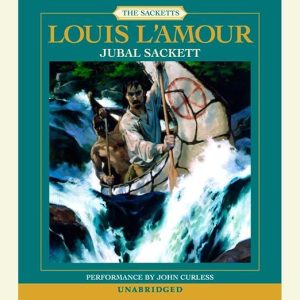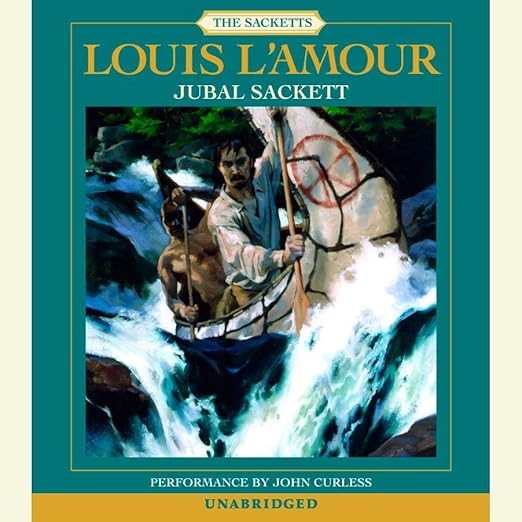
- Performance: John Curless brings a weathered, unhurried quality well suited to Jubal's first-person frontier voice and L'Amour's long descriptive passages, without losing tension in Kapata's antagonist scenes.
- What it covers: Frontier exploration, cross-cultural rivalry and romance, the Sackett family legacy
- Feel: Expansive, patient, quietly tense
- Our call: A slower, richer entry in the Sacketts saga best suited to listeners who want landscape and discovery over gunfights, with one flight of fantasy some readers can't quite forgive.
A Natchez priest's nearly impossible quest is what pulls Jubal Sackett westward at the start of this audiobook, deep into the grassy plains Louis L'Amour's characters call the Far Seeing Lands. This is the fourth entry in the Sacketts saga, and John Curless narrates eleven hours and twenty-six minutes of frontier exploration, a rival power struggle among the Natchez people, and a slow-building romance between Jubal and Itchakomi, the woman set to rule her people once their aging chief dies. It's a bigger, wilder canvas than a typical western, built more around discovery than gunfights.
First, the Big Picture
One reviewer, Jean-Paul Langlais, describes the book as offering ‘a rich tapestry of adventure, emotion, and romance.’ That's an accurate map of where L'Amour's attention actually goes. This isn't a shootout-driven western; the antagonist, a warrior named Kapata, is a genuine threat, but the book spends far more time on landscape, the mechanics of survival in unfamiliar territory, and the slow development of trust between Jubal and Itchakomi than on rapid action sequences. Curless brings a weathered, unhurried quality to the narration that matches that pacing, giving L'Amour's long descriptive passages room to actually land rather than rushing toward the next confrontation.
Another reviewer, going by Bull Run Bear, calls this ‘probably my favorite Sackett story.’ It stands out, in their telling, specifically because it ‘takes place in an earlier time than the usual westerns.’ Everything Jubal encounters, the land, the people, the specific dangers, is genuinely new to him rather than familiar frontier iconography. That earlier historical setting gives the book a different texture than most westerns manage, closer to an exploration narrative than a settled-frontier story, and Curless's steady, meditative delivery suits that unhurried sense of discovery rather than treating it as filler between action beats.
L'Amour's own scale as a writer is worth knowing going in. He published more than one hundred novels over his career, the overwhelming majority of them westerns and frontier fiction, making him one of the best-selling American authors of the twentieth century regardless of genre. The Sacketts saga alone spans many books tracing different branches of one sprawling frontier family across generations, and Jubal's entry sits within that larger architecture as the story of the family's second generation pushing further into unmapped territory than the first. That scale explains both the confident, unhurried pacing Curless brings to the narration and the occasional sense, noted by more than one reviewer, that L'Amour is working from decades of accumulated frontier lore rather than inventing convenient details as he goes.
What Makes Sackett: The Sacketts Worth Hearing
The relationship between Jubal and Itchakomi carries real narrative weight here, not as a subplot but as one of the book's central tensions. Itchakomi is set to rule her own people, and the path there requires her to first defeat her rival, the arrogant Kapata, which places romance and political stakes on the same track for most of the book. L'Amour doesn't rush that convergence, and Curless brings a cold, controlled menace to Kapata's dialogue specifically, giving the antagonist real weight without tipping into melodrama.
For listeners already invested in the broader Sacketts family saga, this entry rewards that continuity while standing reasonably well on its own. The synopsis frames it explicitly as the ‘second generation’ of the Sackett family pursuing their own destiny, distinct from earlier entries' protagonists, which gives new listeners a workable entry point even without having heard the prior three books. Curless's narration doesn't lean on assumed familiarity either, grounding Jubal's first-person perspective clearly enough that the wider family context enriches rather than gatekeeps the experience.
The landscape itself functions almost as a character across the book, per multiple reviewers. Jean-Paul Langlais specifically credits ‘breathtaking landscapes’ alongside compelling fight scenes as part of what makes the book work, and that combination, real physical stakes alongside sustained attention to the Far Seeing Lands' scale and unfamiliarity, is where L'Amour's decades of frontier-fiction experience shows most clearly. Curless's narration gives that landscape writing room to unfold at full length rather than compressing it into scene-setting shorthand, which matters for a story explicitly built around Jubal encountering an entirely new, unmapped world rather than a familiar western setting dressed up with new names.
Angie Lisle's review opens by calling this ‘my favorite book in the series so far’ before raising the animal-related reservations that follow, which is worth sitting with: even a reviewer with a specific, clearly articulated complaint still ranks this entry at the top of the saga. That split verdict, structurally the strongest Sackett book yet, with one specific believability problem, is a fair summary of where this entry lands overall. Itchakomi herself deserves more credit than a plot synopsis usually gives her; she isn't a passive prize for Jubal to win but a leader actively managing her own succession crisis, which gives the romance a political weight most frontier fiction romances don't bother building in.
A Few Reservations
One specific plot element draws real, split reaction in the reviews: the animals. A reviewer named Angie Lisle says the book ‘would've been five-star if L'Amour had just left out the animals,’ pointing specifically to Jubal's pet buffalo and a tamed mammoth or mastodon that appears later in the story. She calls it ‘pure fantasy on L'Amour's part’ and says she ‘had problems buying it.’ That's a fair warning for listeners expecting strict historical realism from an otherwise grounded frontier narrative.
That tension, between meticulous frontier detail and the occasional flight into something closer to tall tale, is worth going in aware of. L'Amour's Sacketts books generally trade on a sense of hard-won authenticity, and the mammoth in particular asks listeners to extend more suspension of disbelief than the surrounding survival detail otherwise earns. It doesn't derail the book, but it's a real seam in the storytelling that at least one careful reader noticed and flagged directly.
Should You Listen to Sackett: The Sacketts?
Fans already partway through the Sacketts family saga will feel most at home here, particularly readers drawn to the series' quieter, more exploratory entries over its faster-paced ones. Anyone who enjoys frontier fiction built around landscape, survival, and cross-cultural encounter, rather than gunfighter tropes, is squarely the intended audience; this is a book that rewards patience with its pacing rather than punishing it. Curless's unhurried narration is a genuine asset for that kind of listener, letting L'Amour's descriptive stretches breathe instead of compressing them.
Strict historical plausibility is not really on offer in every corner of this story, and listeners should know upfront about the tamed-mammoth thread that at least one reviewer found genuinely hard to accept alongside the book's otherwise grounded frontier detail. This isn't the entry point for someone wanting fast-paced western action either; readers hunting for that should look toward other Sacketts titles built around more conventional confrontation. What's here is a slower, richer, more character-driven kind of western, and it's worth choosing with that pacing in mind.
Do listeners need to hear the earlier Sacketts audiobooks before this one?
Not strictly. The synopsis frames Jubal as part of the family's second generation with his own distinct quest, and John Curless's narration grounds his perspective clearly enough for new listeners to follow.
Is this audiobook more focused on action or on character and setting?
Character and setting, according to listener reviews. One reviewer specifically notes it isn't focused on rapid action sequences, favoring depth, landscape, and a slow-building romance instead.
Does this audiobook stay historically grounded throughout?
Mostly, though at least one reviewer flags a tamed buffalo and mammoth subplot as a stretch into fantasy that breaks from the book's otherwise realistic frontier detail.