Quick Take
- Narration: Desmond Manny handles the four-manuscript structure with consistent clarity, keeping the material accessible across a wide chronological range.
- Themes: Russian imperial and Soviet history, espionage and Cold War origins, political transformation and revolution
- Mood: Broad and survey-like, good for building a general framework before deeper reading
- Verdict: A well-assembled overview that delivers exactly what the Captivating History format promises: accessible breadth over scholarly depth.
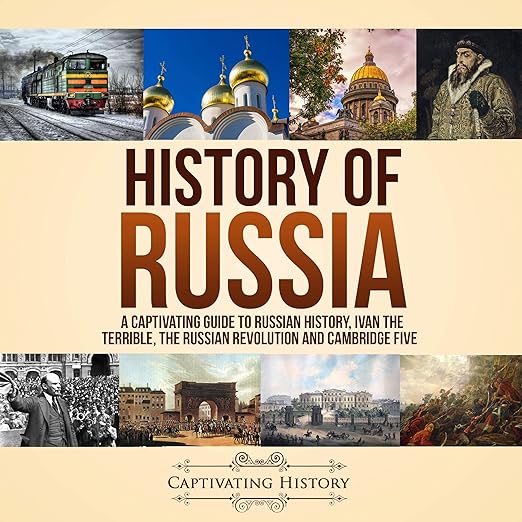
I find myself reaching for Captivating History titles when I want to build a general map of a subject before going deeper, and Russian History is a reliable example of what the series does well. Four manuscripts compiled into eleven hours and twenty-six minutes, covering the sweep of Russian history from the medieval foundations of Kievan Rus through Ivan the Terrible, the revolutions of 1917, and the Cambridge Five spy ring. That is a lot of ground to cover, and the format is honest about what it sacrifices to cover it: depth, sustained argument, and the kind of archival texture that distinguishes scholarship from survey.
I listened to this one across three evenings, which is probably the ideal way to approach a compilation of this kind. Each of the four manuscripts has its own focus and its own rhythm, and treating them as separate listening sessions lets the material settle rather than blur. The Cambridge Five section, which covers Soviet espionage within British intelligence during World War II, is the most narrative of the four and benefits most from the audio format.
Our Take on Russian History
The first manuscript traces the broad arc from the foundation of Kievan Rus and the Mongol invasions through Peter the Great’s reforms and the imperial expansion that followed. It is the most survey-like section and the most demanding in terms of keeping track of names and dates. Desmond Manny’s narration helps here, his measured pace giving the listener enough time to process each transition without making the material feel plodding.
The Ivan the Terrible manuscript is where the series’ strengths show most clearly. Ivan is one of those historical figures whose biographical drama is so extreme that even a broad-strokes account has genuine narrative pull, and the Captivating History treatment captures the key moments, the military successes, the paranoid violence of the later years, the complicated legacy, without getting lost in revisionist debates. One reviewer noted that this was his gateway into Russian history during the US Star Wars period and found it a fascinating look at a country so different from his own. That accessibility is the series’ defining value.
Why Listen to Russian History
Desmond Manny is one of the more reliable narrators in the Captivating History stable. His voice has enough variation to distinguish between different sections and tonal registers without becoming theatrical, and his pronunciation of Russian names, which can be an obstacle to the flow of this kind of material, is consistent and confident. Over eleven hours, that consistency matters more than it might in a shorter listen.
The Russian Revolution manuscript is the thinnest of the four in terms of argument, covering the February and October Revolutions and the early Soviet period in a way that necessarily glosses over the genuine historical complexity of those events. Listeners who already know the Revolution will find it too abbreviated. Listeners who are new to it will find it a useful orientation before moving on to Orlando Figes or Richard Pipes. That is precisely the role these overview volumes are designed to play, and it is better to evaluate them on those terms than to hold them to a standard they are not trying to meet.
What to Watch For in Russian History
The most pointed criticism of the Captivating History format, and one that applies here, is that the overviews can feel like exactly what they are: good-faith summaries of existing scholarship without a distinctive perspective of their own. One reviewer put it clearly: if you are looking for an in-depth look you will be disappointed, but as a concise overview with numerous references for further reading it is excellent. That is the honest bargain the format offers.
The compilation structure also means the four manuscripts vary in quality and focus. The Cambridge Five section is the most engaging and the most tightly constructed. The Russian Revolution section is the most compressed and the most likely to leave listeners wanting more. Listeners who find one section particularly compelling should treat it as a gateway to longer and more specialized works rather than a destination in itself.
Who Should Listen to Russian History
This is well matched to listeners with a general curiosity about Russia who want an organized starting point before tackling more demanding histories. It also works for listeners who have a specific interest in one of the four topics covered and want the surrounding context before diving in. Those already familiar with the field at even an intermediate level will find it too introductory, and the lack of a sustained argument means it offers little to listeners looking for a new perspective on material they already know. For the right audience, though, eleven hours of accessible, well-narrated Russian history is a very good value.
Frequently Asked Questions
How does the four-manuscript format hold together as a single listening experience?
The four sections are thematically connected by their focus on Russian history but have different tones and focal points. The Cambridge Five espionage section feels most narrative and the general history section most encyclopedic. Treating each as a separate listening session helps the material settle. The overall arc from medieval Russia to Cold War espionage holds together reasonably well.
Is this audiobook suitable as preparation for reading more specialized Russian history?
Yes, that is exactly what it is designed for. Reviewers consistently noted it as a solid overview with references for deeper reading. It functions well as a framework before tackling works like Orlando Figes on the Revolution or Robert Service on Lenin and Stalin.
How does Desmond Manny handle the Russian names and terminology throughout the eleven-hour listen?
Manny handles the Russian proper nouns with consistent pronunciation choices throughout. There are no jarring inconsistencies in how key figures like Ivan, Lenin, or the various tsars are named, which matters significantly over eleven hours and dozens of historical actors.
Does the compilation cover the Soviet period and Cold War or focus primarily on imperial Russia?
All periods are covered. The first two manuscripts focus on medieval and imperial Russia. The third covers the 1917 revolutions and early Soviet period. The fourth shifts to World War II-era espionage with the Cambridge Five, who passed British secrets to Moscow. The coverage is uneven in depth but broad in range.