Quick Take
- Narration: Jonathan Oliver delivers this Osprey Essential History with the clean, informative tone the concise format requires.
- Themes: Russian military strategy, Chechen resistance and identity, post-Soviet regional conflict
- Mood: Concise and analytical, suited to focused study rather than leisure listening
- Verdict: The best short introduction available to a conflict that has reshaped Russian military doctrine and Chechen society alike.
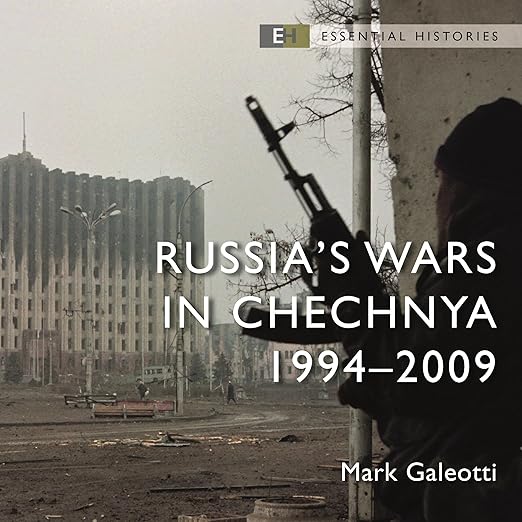
The first time I tried to follow news coverage of Chechnya I was in my early twenties, and I remember the frustration of reading articles that assumed a level of background knowledge I simply did not have. Who were the Chechens? What had Russia been fighting over since the early 1990s? Why did the conflict restart? Mark Galeotti’s Russia’s Wars in Chechnya is the book I wish had existed then, and its 2024 update, which adds material on the Kadyrovtsy’s role in Russia’s subsequent conflicts, makes it acutely relevant again. I listened to Jonathan Oliver’s narration over two commutes, which is almost exactly right for a 3-hour-and-28-minute audiobook.
Galeotti is one of the most readable academic experts on modern Russia. He writes for clarity rather than disciplinary performance, which is rarer than it should be in security studies. This is part of the Osprey Essential Histories series, which has a house style of compressed authority: get the major events, the structural causes, and the lasting consequences into the smallest space that can hold them without losing significant truth. Galeotti executes that brief very well.
Our Take on Russia’s Wars in Chechnya
The book traces the arc from the initial Russian advance in 1994 through the disastrous urban battles in Grozny, the humiliating first-war settlement, the second war’s more methodical and brutal approach under Putin, and the protracted guerrilla campaign in the Caucasus mountains. Galeotti is particularly good on the shifting loyalties and factional complexity of Chechen resistance, which defies simple narratives of unified national uprising. One reviewer noted he does a remarkably good job of summarizing the often shifting loyalties of numerous factions and personalities, and that is precisely where many shorter histories fall short.
The updated material on the Kadyrovtsy, the Chechen forces loyal to Ramzan Kadyrov, is what makes this 2024 edition genuinely new rather than merely refreshed. The Kadyrovtsy have been deployed in Ukraine and in other Russian military operations, transforming from a regional proxy force into a component of Russian power projection. Galeotti’s analysis of how this happened, and what it says about the long-term consequences of the Chechen settlement, is sharper here than anything I have read elsewhere in comparable length.
Why Listen to Russia’s Wars in Chechnya
Jonathan Oliver reads with the measured authority that military history requires. He does not dramatize the combat descriptions or editorialize on the politics, which suits Galeotti’s tone well. The 3.5-hour runtime is actually one of the audiobook’s strengths for this subject. Chechnya is the kind of conflict that benefits from a clear, compressed overview before listeners attempt longer or more detailed histories. Oliver’s pacing keeps the timeline clear and the analytical threads distinct.
A reviewer who described the book as a superb history noted Galeotti’s extensive knowledge and fluid writing style, calling it an excellent primer on a complex conflict. The word primer is exactly right. This is not an exhaustive treatment. It is a framework that allows subsequent reading or listening to organize itself properly. For listeners who want to understand why the Chechen wars mattered, both for Russia and for the trajectory of modern conflict, this is the entry point.
What to Watch For in Russia’s Wars in Chechnya
Galeotti is clear-eyed about the book’s scope. One reviewer who found the analysis surface-deep acknowledged it was worth reading to orient oneself on the main events. That is an honest account of what the Osprey Essential Histories format can and cannot deliver. Readers hoping for detailed operational histories with weapons specifications, troop movements, and unit-level accounts should seek longer, more specialized works. This book delivers strategic context and structural analysis, not granular military detail.
The sections on how the wars shattered the fabric of Chechen society are brief but important. Galeotti resists the temptation to treat this purely as a story of Russian military strategy, keeping the human cost visible without allowing it to overwhelm the analytical framework. That balance is one of the things that distinguishes his writing from both military history in the narrow sense and political journalism.
Who Should Listen to Russia’s Wars in Chechnya
Defense and foreign policy professionals who need orientation on a conflict they have not studied in depth will find this exactly calibrated to their needs. Students of Russian history, anyone following the war in Ukraine who wants to understand the military and political dynamics Galeotti’s updated epilogue traces forward, and general readers curious about post-Soviet regional conflict will all benefit. Those wanting an in-depth operational military history will need supplementary sources, but as a starting framework this is authoritative and efficiently delivered.
Frequently Asked Questions
Does the 2024 update substantially change the original analysis, or just add an epilogue?
The update includes a revised introduction, new content on the Kadyrovtsy’s role in Russia’s subsequent conflicts including Ukraine, and contextual updates throughout. It is meaningfully revised rather than simply appended.
Is background knowledge of Russian or Soviet history required to follow this book?
Basic familiarity with post-Soviet Russia is helpful, but Galeotti explains the structural context of the conflicts without assuming specialist knowledge. He covers the relevant history of Chechen identity and Russian regional policy as needed.
How does Jonathan Oliver handle the Russian and Chechen names and place names throughout the text?
Oliver pronounces Slavic and Chechen terminology with professional consistency. Listeners unfamiliar with the names will find them clearly rendered and consistently distinguishable.
At under four hours, is this audiobook long enough to be genuinely useful, or does the brevity compromise its value?
The brevity is a feature of the Osprey Essential Histories format, not a limitation. Galeotti compresses without distorting. Reviewers consistently note that it functions as an excellent primer that enables deeper subsequent reading rather than trying to replace it.