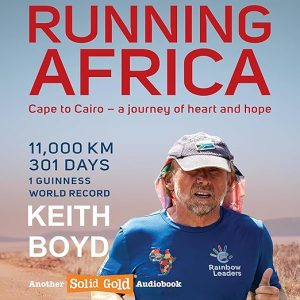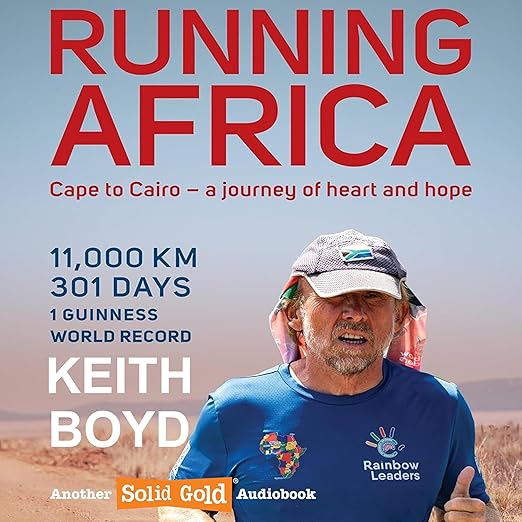
Keith Boyd was fifty-seven, carrying a genetic heart condition, when he set out to run the entire length of Africa, Cape Town to Cairo, faster than anyone had managed in twenty-five years. Running Africa: Cape to Cairo is his own account of that attempt, and this audiobook does not sand down the parts of the story that make it hard to sit with: injuries that should have ended the run outright, illness that crept in over the middle stretch, a period where he and his team were taken hostage, and a firefight involving rebel forces that landed some of his crew in prison. The number attached to the finished attempt is almost absurd on paper, 11,000 kilometers in 301 days, but Boyd spends less time on the statistic than on what it took to keep moving through each individual bad day.
Roughly a Marathon a Day for Ten Months
The book's own structure tracks the geography honestly. Boyd describes a 'soft start' in South Africa, the kind of early miles that build false confidence before the countries further north each raise the stakes in turn. That gradual escalation matters for how the audiobook lands emotionally: by the time the hostage situation and the rebel firefight arrive, a listener has spent enough hours inside Boyd's daily grind, the blisters, the heart condition he is quietly managing the entire way, to feel the danger as an extension of exhaustion rather than a plot turn inserted for drama.
What keeps the book from reading as pure stunt memoir is the forty-year business career sitting behind the decision to attempt this in the first place. Boyd reframed himself in later life as a socio-economic activist focused on poverty, and founded RainbowLeaders.org.za to push young Africans toward voting and holding elected leaders accountable. The run, by his own account, became the platform for that message rather than the point of it. All proceeds from the audiobook go toward that youth democracy work, a stated purpose worth knowing going in, since it recontextualizes some of the slower, more administrative passages about the organization's mission.
The math behind the achievement is worth sitting with directly. Eleven thousand kilometers across 301 days averages out to roughly thirty-six kilometers, close to a full marathon, covered on foot every single day for ten months straight, on top of a genetic heart condition, changing terrain, and the political instability of multiple countries. Most ultramarathon memoirs describe a single grueling event measured in hours or at most a few days. Boyd's account asks a listener to sit with that same physical demand sustained, without a built-in rest day, for the better part of a year.
Flatness That Reads as Still Processing It
Boyd narrates his own account, and a specific value comes from hearing a first-time author read his own captivity and firefight passages himself rather than have a professional actor perform them. He does not have a trained narrator's vocal range, and the delivery stays fairly even even through the most dangerous stretches, but that flatness reads as someone still processing what happened to him rather than someone dramatizing it for effect. Listeners drawn to Ranulph Fiennes or Dean Karnazes style endurance writing will recognize the register: matter-of-fact about suffering, more animated about logistics and strategy than about danger itself.
At eight hours and forty minutes, the audiobook moves at a reasonable pace for the amount of ground it covers, both literally and narratively. It skips the sweeping travelogue tone of a book trying to render each country's culture in full detail; the focus stays tight on the run itself, the injuries, the small victories of hitting a daily distance target, the moments the mission nearly fell apart. That narrowness suits a listener who wants the endurance story more than a broader Africa travel narrative.
Crossing an entire continent overland also means the book inherits a geopolitical dimension most endurance memoirs set within one stable country never have to address. South Africa's early miles give way to a shifting patchwork of political conditions further north, and the hostage situation Boyd describes did not happen in a vacuum. The route itself passed through regions where that kind of danger was a standing possibility long before he arrived, which reframes the danger as circumstantial to the route rather than a freak, isolated incident, and gives the audiobook a documentary weight beyond personal endurance alone.
No Reviews Yet, and a Genuinely Thin Sample
No listener reviews accompany this title yet on the platforms tracked here, so a prospective listener is relying on the synopsis and Boyd's own framing rather than outside confirmation of how the audiobook actually plays over eight-plus hours. A 4.7 rating from four ratings is an encouraging but genuinely thin sample.
This reads as an independently produced project tied closely to Boyd's advocacy work rather than a title from a major trade publisher, and the audio production values should be judged with that context in mind. Do not expect the sound design or pacing polish of a ghostwritten celebrity memoir; expect something closer to a passion project delivered directly by the person who lived it.
Listeners drawn purely for the adventure-survival angle should know the activism throughline is not incidental. Sections on RainbowLeaders.org.za's youth voter engagement mission run alongside the physical account, and a listener hoping for continuous action beat to action beat may find the organizational material slows momentum in places. It works better as a package, the endurance feat plus its stated purpose, than as a pure survival thriller.
The Body's Limits Over Polished Narration
This audiobook rewards listeners who already gravitate toward first-person extreme endurance writing, ultramarathon and expedition memoirs where the physical toll gets described in granular, unglamorous detail. Anyone curious about African geography crossed overland, or about grassroots democracy-building work on the continent, will find real value in the RainbowLeaders.org.za throughline that a pure adventure listener might otherwise treat as a detour.
Skip it if you want polished, professionally paced narration or a book primarily about culture and place rather than the mechanics of covering enormous distance on foot under real physical risk. Listeners expecting a conventional travel memoir, heavy on scenery and encounter, will find Boyd's attention pointed elsewhere, at the body's limits and at the organization his effort exists to support.
Common Questions
Did Keith Boyd actually break a Guinness World Record for this audiobook's run?
Yes. The synopsis confirms Boyd set a new Guinness World Record for the fastest journey on foot from Cape Town to Cairo, breaking a mark that had stood for twenty-five years, covering roughly 11,000 kilometers in 301 days.
Does the Running Africa: Cape to Cairo audiobook explain the hostage situation in detail?
The synopsis confirms Boyd's team was taken hostage and caught up in a rebel firefight during the run, with some team members later imprisoned, though the audiobook is framed as Boyd's personal account rather than an investigative report, so expect his lived perspective rather than a forensic breakdown of the incident.
Where do the proceeds from this audiobook go?
All proceeds from Running Africa: Cape to Cairo go toward funding youth democracy work at RainbowLeaders.org.za, the organization Boyd founded to encourage young Africans to vote and hold elected leaders accountable.
Is this audiobook mostly about the run or about Boyd's activism work?
Both, deliberately. The physical account of the run shares space with Boyd's explanation of why he undertook it, tied directly to his post-business-career pivot toward socio-economic activism.