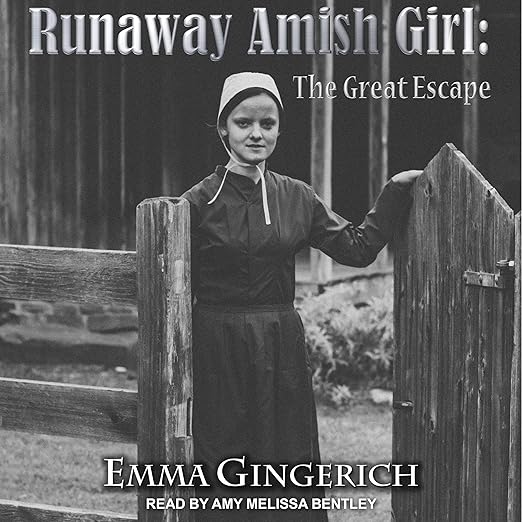
Emma Gingerich's memoir arrives here under half its own name. The listing calls it Runaway Amish Girl, while the description names it in full one sentence later: Runaway Amish Girl: The Great Escape. Nothing reconciles the two. That would be a footnote if the rest of the bookkeeping held, but the star counter reports three ratings and the column underneath it displays five written responses, each with a grade attached. The audiobook itself runs six hours and thirteen minutes and delivers what it promises. The record wrapped around it keeps contradicting itself.
One Listing, Two Different Names for the Same Book
At eighteen, Gingerich left the Amish community in Eagleville, Missouri, having decided she disagreed with the beliefs and traditions she had been raised inside. The description does not soften what came next: the reactions of parents, brothers, and sisters were gut-wrenching, and she was considered no longer a daughter or a sister, temporarily exiled from the only life she had known. Education became the priority once she was out, and the memoir follows her finding a place in what the Amish call the English world. Six hours and thirteen minutes is enough room for that arc without padding it.
The badge does not survive contact with the column beneath it. A 4.3 average across three votes means those three total exactly thirteen points of a possible fifteen. Three fives, a four, and a three are what the page actually displays, and those come to twenty-two. Both figures cannot describe the same set of voters, so either the counter is short or the responses are pulled from a wider pool than the average measures. Either way, a 4.3 resting on three votes is a thin thing to buy on.
Culture is what the responses actually reach for. One writes about the Amish approach to dating for young men and women and reports being caught off guard by it. Another, who lives close to Lancaster, Pa., addresses Gingerich directly by name and thanks her for being transparent. A third, who grew up near a less fundamentalist order, praises a lovely conversational tone and admits the subject matter was difficult at times. The memoir is being read as an ethnography by people who mostly came looking for one.
The Voice You Hear Isn't the Voice That Lived It
Amy Melissa Bentley carries the recording alone, which for a first-person memoir is a particular assignment: the voice you hear is not the voice that lived it. Gingerich wrote the account and someone else performs it. That arrangement can be transparent or it can sit half a step off, and this listing offers no way to tell which. What it does offer is one credit covering six hours and thirteen minutes, and a publisher, Tantor Media, which released the recording on January 30, 2019. Worth noting that the description itself reaches for a listening verb, promising that the memoir captivates even the timid listener, so somebody in the production chain was thinking about this format. Nobody who wrote in afterward followed that lead.
What the memoir promises is access without difficulty. No theology to follow, no chronology to hold in your head, just a young woman describing a household, a courtship system, a departure, and the silence that came after it. One reviewer put the speed in a headline, finishing the whole thing in less than twenty-four hours, and framed it as enlightening and informative in the same breath.
Three write-ups reach for the same register: well written, an easy read, a lovely conversational tone. That consistency is worth something in a genre where the pull is curiosity rather than craft. Nobody is claiming great literature here, and the description does not either. It claims a rare glimpse into the life of a brave young woman, which is a promise about access, and the column reports that the promise is kept.
Little Revealed About How She Transitioned to English Life
Nothing about the shape of the story is polished, and the sharpest response says so directly. The lone dissent, filed in September 2023, calls the personal account full of holes as far as a narrative goes, then names the specific one: little is revealed about how she transitioned to the English life so readily. That is the gap worth knowing about. The book spends its energy on the leaving and very little on the arriving, and even the reviewer who flagged it signed off with worth a read nonetheless.
One response is not addressed to buyers at all. It speaks to Gingerich by name, thanks her for sharing, describes a heart breaking on her behalf, and moves into a statement of faith. It is warm, it carries five stars, and it evaluates nothing a shopper could act on. That is the texture of this column generally: grateful, personal, and rarely assessing the product in front of it. The oldest of the five entries dates to August 2018 and the newest to January 2026, which amounts to more than seven years of accumulated goodwill and almost no usable purchasing information.
A memoir like this one sits on a crowded shelf, and the description positions it by age and by cost. Eighteen years old, no plan, and a family that stopped counting her as a daughter. What it does not promise is a tell-all. Nobody in the column reports scandal or a villain, and the pressure that pushes Gingerich out is described as the weight of belief itself, a harder story to tell and a quieter one to sit with. Readers who arrive expecting a thriller structure, with a chase and a rescue, will find instead a young woman making a decision slowly and then living with what it cost.
No Voice Sample Exists to Test the Narration
Listeners drawn to closed communities, and to the price of walking out of one, are the natural audience. So is anyone who prefers a first-hand account to a journalist's reconstruction, since Gingerich is describing her own household, her own courtship rules, her own siblings going quiet. The runtime keeps it manageable in two or three sittings, and the register the column keeps naming, conversational, means you can follow it while your hands are busy without losing the thread.
Readers who expect a tell-all should recalibrate; the drama here is domestic and internal, and the antagonist is a set of expectations. Someone wanting a voice sample before committing to first-person testimony will also come up empty, since nothing beyond that one credit line touches the recording at all. Skip it if a memoir that stops just short of its second act would frustrate you.
At a Glance
- Performance: Amy Melissa Bentley reads a first-person account written by someone else, and one reviewer's verb, hearing, is the column's only nod to an audio edition.
- What it covers: Leaving a closed community, family exile, education as escape, cultural translation.
- Feel: Plainspoken and confiding, heavier than its easy surface suggests.
- Our call: Worth the six hours for the inside view; the story simply stops soon after the escape does.
Why does the audiobook title drop the subtitle used in the description?
No field here explains it. The title reads Runaway Amish Girl, while the description calls the memoir Runaway Amish Girl: The Great Escape one sentence later. Both name the same work, and a search on either version should land on this audiobook, but the shorter form is what the record actually carries.
How much of the audiobook covers life after leaving the community?
Less than you might expect. The description gives most of its space to the decision, the departure, and the family fallout, and one dissenting reviewer complains that little is revealed about how the move into English life happened so readily. Education is named as the priority afterward, but the aftermath gets the shorter share.
Why do three ratings sit underneath five written reviews?
The counter and the column disagree, and nothing reconciles them. A 4.3 across three votes means those three total thirteen points of a possible fifteen, while the five displayed grades add up to twenty-two. Read the individual responses and set the badge aside.