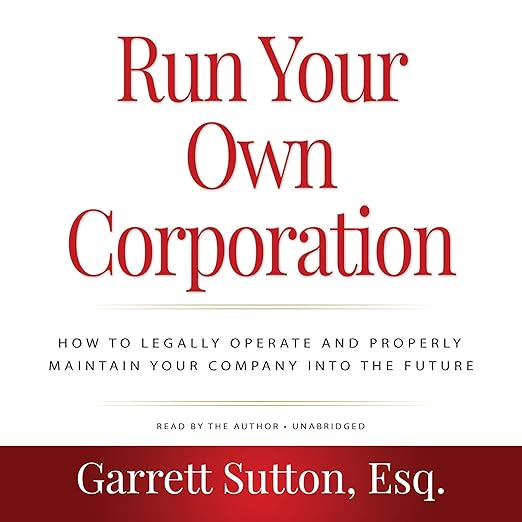
After forming your LLC or corporation, receiving the certificate, and opening a file folder, you may discover you have absolutely no idea what to do next. Run Your Own Corporation, 2nd Edition addresses that exact moment, and this audiobook delivers the answer in a format that works for people who learn better by listening than by parsing static legal checklists. Garrett Sutton, a Rich Dad Advisor and practicing attorney, narrates his own work, and his authority over the material is evident from the opening minutes. He has been through this with enough clients to know where the confusion lives.
The organizing insight of the book is structural: Sutton arranges the compliance requirements chronologically rather than by topic. What must happen on day one, in the first quarter, in the first year, out through year five and trademark renewal deadlines. That framework transforms what could easily be an overwhelming legal catalogue into something that actually maps onto the experience of running a new business rather than reading about one.
Sutton Skips Legalese, Needs No Hired Narrator
Sutton writes, and narrates, without legalese. Bilal Khan's review notes the book is not written in legal jargon, which is both accurate and significant. Most attorney-authored business compliance guides are written for other attorneys, or at least for people who have already spent time around legal documents. Sutton consistently translates the regulatory requirements into plain language while preserving the precision those requirements demand. The employer identification number chapter, which covers one of the first things a new entity owner must do, is a good example: specific, step-by-step, free of unnecessary complexity.
The self-narration is the right choice. Sutton's delivery has the rhythm of someone who has explained these concepts to clients many times, which means he knows where the confusion points are and how to address them before the listener gets lost. He also knows when a particular compliance requirement has real legal teeth and when it is more procedural, and that judgment comes through in how he frames the material. A professional narrator would have delivered a technically competent performance; Sutton's delivery has something a professional narrator cannot provide, which is the direct authority of the person who actually understands the consequences of getting it wrong.
Lists by Corporation Age, Then Fictional Teams
The audiobook structure suits the subject matter particularly well once you understand how to use it. GLo's review notes the simple lists by corporation age as a useful navigational tool, and in audio that means you can return to specific chapters as your business ages and the relevant compliance requirements shift. This is not a one-time linear listen so much as a resource you revisit as your entity moves from its first quarter into its first year and beyond.
Sutton also uses narrative throughout, working three fictional entrepreneur teams through the compliance requirements in ways that personalize what might otherwise be dry regulation. Theo specifically highlights this structure, noting that the lessons are learned via characters rather than delivered as abstract rules. In audio, that narrative scaffolding is especially effective because it gives the listener something to follow and remember rather than a set of facts to retain in isolation. The companion volume, Start Your Own Corporation, covers the formation side; this audiobook picks up exactly where that one ends.
Day-One-to-Year-Five Chronology Outlasts the Specific Rules
Business and tax law changes, and any compliance guide has a shelf life. Sutton's second edition reflects the state of the law at the time of publication, and some specific requirements, particularly around tax filings and employer identification processes, may have been modified by subsequent legislation or agency guidance. The structural framework, the day-one to year-five chronology, remains useful regardless, but listeners should verify specific requirements with a current source or a local attorney before relying on details for actual compliance purposes. Sutton would likely tell you the same thing.
This is a guide for entities already formed. Listeners who have not yet chosen or created their business structure will find some sections assume knowledge that the companion formation guide covers. The audiobook is complete as a standalone on maintenance and compliance, but it does not spend much time on the threshold question of which entity type to choose or why. Listeners at the very beginning of the process may want to start with the formation companion before coming to this one.
Chronological Thinkers Past Formation Will Get the Most
New business owners and real estate investors who have formed their entity and need a clear roadmap for what comes next are the primary audience, and Sutton built the book specifically for that group. Entrepreneurs who learn well from structured, chronological frameworks will get more from this audiobook than from general business law surveys. The self-narration and accessible language make it appropriate for listeners without legal backgrounds, which is essentially its entire intended audience.
Listeners who already work with a business attorney and have an established compliance process may find the foundational material familiar, though the specific chronological checklists can still serve as a useful confirmation that nothing has been missed. Sutton is also clear about the limits of what a compliance guide can do: he provides the framework and the awareness, but he is not a substitute for jurisdiction-specific legal counsel, and he says so directly. That honesty is useful rather than deflating. At just under nine hours, this is dense but not exhaustive, covering the essential compliance landscape without attempting to replace professional legal advice entirely. The 4.8 rating across 268 reviews reflects an audience that found the material genuinely practical rather than merely informative.
- Performance: Garrett Sutton self-narrates, and his attorney's cadence gives the legal content authority without making it feel like a deposition or a lecture.
- What it covers: Corporate compliance, entity maintenance, entrepreneur legal protection
- Feel: Practical and methodical, like a consulting session you can replay
- Our call: The chronological compliance framework Sutton builds here is genuinely useful for new business owners, and his self-narration makes dense legal material more approachable than most alternatives in this space.