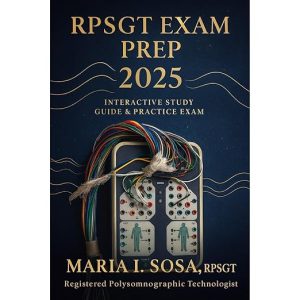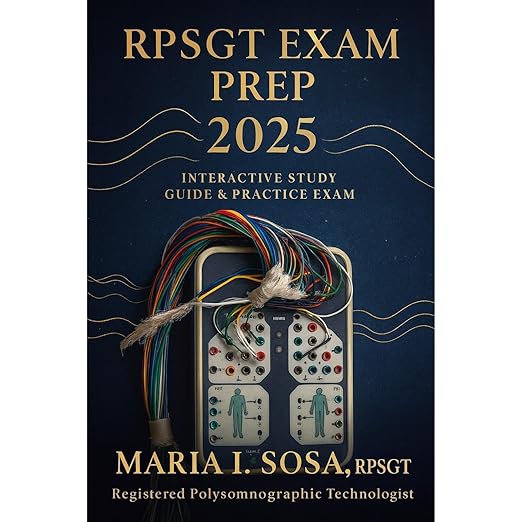
Polysomnography is read with the eyes. The work is done by reading traces on a screen, so an audiobook edition of a study manual that calls itself illustrated is a genuinely strange object, and the strangeness is the first thing to think about. Nine hours and two minutes of it, delivered by a synthetic voice. What matters before you buy is knowing precisely which parts of this material survive the trip into audio and which parts cannot.
Nine Hours Works Best as a Second Pass
Look at what the word illustrated is doing in that title. It is a promise about pictures, and the description doubles down on it: high-quality illustrations created for this book, quick-reference charts, more than two hundred professional flashcards. Every one of those is a visual artifact. The book has been designed around what you can look at, and the audio edition is a translation of a work whose core selling proposition does not translate.
The reviewers confirm it without meaning to. One five-star reviewer praises the book for having "great images, diagrams and charts", and the only critical voice in the pool, at three stars, complains that "some of the print is very blurry and the example pictures are to small to read the print". Both are describing something held in the hands. Neither is listening. That is not a criticism of either reviewer, but it does mean the written feedback attached to this title tells you almost nothing about the recording.
So the honest framing is companion rather than replacement. Nine hours of spoken review over material you have already seen on a page is a legitimate and useful thing to own. Nine hours of spoken review as your first encounter with sleep staging is not, and no amount of careful narration would change that. Decide which of those two purchases you are making before you commit, because the recording is well judged for one of them and close to useless for the other.
Definitions and Protocols Carry Perfectly by Ear
A surprising amount does transfer, and it is worth being specific. Definitions and rule statements carry perfectly: the respiratory scoring rules under the 2023 to 2024 guidance, the distinction between central and obstructive apneas, the separate identities of hypopneas, arousals, respiratory effort related arousals and periodic limb movements. Terminology drilling is what ears are genuinely good at, and this syllabus is thick with terminology that has to be automatic before an exam.
Protocols transfer even better, because a protocol is a sequence and a sequence is a story. Multiple sleep latency and maintenance of wakefulness testing, home sleep testing, laboratory operations, quality control, safety and emergency procedures, oxygen protocols, mask fitting and troubleshooting for positive airway pressure problems: all of these are ordered procedures that run from a defined start to a defined finish. Listening to them repeatedly is a reasonable way to make them second nature, and far less tedious than rereading a checklist.
Six PAP Modes and a 150-Question Mock Exam
The positive airway pressure section is the clearest win. Keeping the six positive airway pressure modes the description lists separate from one another in your head is pure vocabulary work, and vocabulary work is exactly what a long recording does well. The mock exam helps too. The 150 questions with answers, read aloud, function as genuine recall practice, and the other five-star reviewer starts in on the mock exam questions before the comment breaks off.
Currency is a genuine selling point in this discipline and the description leans on it correctly. Scoring guidance carries a date for a reason, and a manual carrying a year in its title while naming the 2023 to 2024 guidance is at least telling you which rule set it was written against. Several descriptive domains suit listening for a different reason entirely. Pediatric polysomnography, parasomnias, actigraphy and circadian rhythm disorders are largely about recognizing presentations and knowing what they are called, and that is knowledge you can carry in your ears and confirm against a page afterwards.
Waveforms and Formulas Resist Being Heard
Sleep staging is where the format hits its wall. Staging is pattern recognition performed on a screen, and a description of a waveform is not a waveform. The same applies to electrode placement and instrumentation, where the geometry of an electrode layout needs a diagram of a head rather than a spoken list of positions, and to artifact identification, which is fundamentally about learning what wrong looks like. These are core areas of the syllabus and the least amenable to listening of anything here.
Numbers are the second problem. The description promises scoring formulas, indices and calculations alongside digital filters and technical requirements, and arithmetic delivered by voice is hard to follow and impossible to check. The flashcards and quick-reference charts raise the same question in a different form, since both are designed to be scanned rather than heard, and how a nine-hour reading handles them is not something the listing explains.
Two smaller cautions remain. The narration is synthetic, which across so many hours of dense clinical vocabulary is a real consideration: acronym-heavy material gives a computer-generated voice more chances to place stress oddly than a novel ever would, and no human reader is present to signal emphasis where a definition turns. The evidence base is also slim, at ten ratings, so treat the 4.7 average as an early signal from a specialist audience rather than a settled judgment.
Reinforcement Earns Its Runtime as a Second Look
The right buyer already owns the visual edition and wants a second pass through it. A candidate in the final weeks before the exam, running definitions, protocols and mock questions on repeat while doing something else, will get real value out of this much structured revision. So will a working technologist refreshing terminology and laboratory procedure rather than learning them, since recognition is a much lower bar than acquisition.
As a primary study resource this does not work, and I do not believe it is meant to. The book's own title advertises the pictures, its reviewers praise the pictures, and its one complaint is about the pictures being hard to see. Buy the audio as reinforcement for something you can also look at, and it earns its runtime comfortably. Buy it as your only preparation for a visual examination and the format will quietly fail you at the point it matters most.
Can an illustrated exam manual work as an audiobook at all?
Partly. Definitions, protocols, terminology and the mock exam questions all carry well into audio and repay repeated listening. Sleep staging, electrode placement, artifact recognition and any scoring calculation do not, because they depend on seeing a trace or a diagram. Treat the recording as revision over material you have already studied visually.
How does the synthetic narration handle nine hours of clinical terminology?
It is a genuine consideration rather than a dealbreaker. Acronym-heavy clinical material offers a computer-generated voice many opportunities to place stress oddly, and a definition turning into an exception is exactly where that would cost you. Nobody has reviewed the audio edition, so sample a section of the scoring material before committing to the full runtime.
Is the 150-question mock exam usable in audio?
Yes, and it is one of the better reasons to own this format. Questions and answers read aloud make workable recall practice, particularly for definitions and protocol sequences. Anything requiring you to interpret a figure or run a calculation will not survive the transfer, so expect a usable subset rather than the whole paper.
Should this audiobook be your primary RPSGT study resource?
No. Whatever this manual is good at is bound up in what it shows you, and even its one complaint is that the figures print too small to read. A book weighted that way cannot serve as a sole audio resource. Pair it with the visual edition and it becomes a strong second pass.