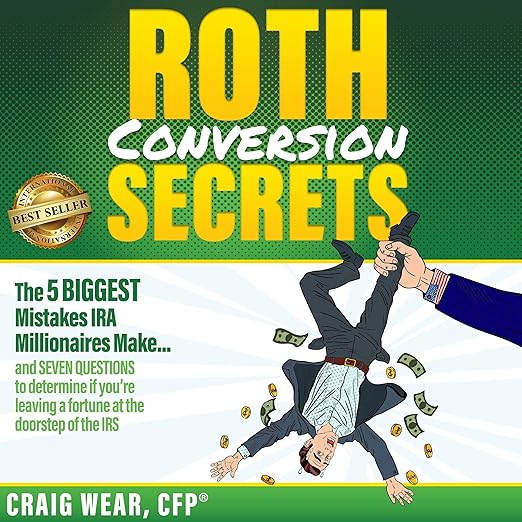
I came to Roth Conversion Secrets at exactly the right time, which is to say I came to it when someone I trust had just told me they wished they had heard this argument a decade earlier. That is the specific note that reviewer Fred struck as well: "Wish I would have had this book many years ago." Craig Wear's short, direct audiobook is best understood as a corrective intervention aimed at a specific mistake he believes most people approaching retirement are making.
The core argument is this: conventional wisdom about Roth conversions, specifically the advice to wait until you are in a lower tax bracket or to convert only small amounts, is almost always wrong. Wear has spent nearly four decades as a financial advisor and over thirteen years specializing in conversions, and his contention is that most people dramatically underestimate how much they will draw from their traditional IRAs over a lifetime and therefore underestimate their lifetime tax burden. He wants you to convert more, earlier, and he has real-world cases to illustrate why.
Drawing More From Your IRA, Then Tracking Net Worth
The book's two central ideas, as one reviewer distilled them with admirable clarity, are these: first, you will draw substantially more from your IRA over your lifetime than your current balance suggests, so paying taxes now even at a temporarily higher rate often makes sense; second, you should track your net worth in your calculations rather than just the immediate tax savings. These are genuinely useful reframings, particularly the net worth point, which runs against the way most people mentally model retirement planning.
Wear backs these points with client stories that are specific enough to feel real without being individually identified. Reviewer Mark Jost noted that the book "answers many of the questions we had and has helped us to move forward with a plan," which describes the book's practical ambition accurately. It is not trying to teach you comprehensive financial planning. It is trying to shift one specific belief.
Wear's Practitioner Voice Fits Two and a Half Hours
At two hours and thirty-two minutes, this audiobook makes its case efficiently enough that the format makes sense. Wear's self-narration gives the material the quality of a presentation from a practitioner rather than a performance from a narrator, which suits a financial guidance book. The conversational register is consistent, and the real-world case studies land more naturally in audio than they might on a page.
The book works best as a complement to a conversation with your own financial advisor rather than as a standalone decision-making tool. Reviewer DJC noted that "each person's situation is unique and there are no good 'canned solutions'" and that the book "spurs some independent evaluation." That framing is accurate and healthy.
Combative Toward Advisors, With a Lead-Gen Motive
The most pointed critique in the reviews comes from a reader who found the central ideas buried in what they called "a 100-page rant against financial advisors and people who do their own spreadsheets." That is somewhat overstated, but the underlying point is fair: Wear has a combative relationship with conventional financial advisor advice, and he names that frustration explicitly and repeatedly. For listeners who find that framing energizing, it adds urgency to the material. For listeners who find it grating, it is a significant portion of the runtime.
The book also functions, transparently, as a lead-generation vehicle for Wear's advisory services. He offers to perform Roth conversion analyses for a substantial fee, and he mentions this. That is not disqualifying, but it is context worth having before you listen.
Meant for Retirees Told to Wait on Conversions
The ideal listener is someone within ten to fifteen years of retirement with a substantial traditional IRA or 401k who has been told by a financial advisor to wait on conversions or to convert only within a specific tax bracket. If that describes you, this audiobook's two and a half hours may be among the most practically valuable you spend this year. If you are early in your career, the content is still interesting but less immediately actionable. If you are already working with an advisor who specializes in Roth conversions, you are likely familiar with most of what Wear covers. And if you are hoping for a comprehensive personal finance education rather than a focused corrective argument, this is not that book.
Before You Listen
Does Roth Conversion Secrets give specific conversion amounts or timelines, or is it more conceptual?
It is primarily conceptual and case-study-based. Wear argues against specific formulas and tax-bracket rules, and he does not provide personalized calculations. The goal is to shift how you think about the decision rather than to give you a precise conversion schedule.
Is the book biased toward selling Wear's own advisory services?
The book explicitly mentions his fee-based conversion analysis service, and some reviewers felt the pitch dominated parts of the content. The underlying ideas are presented independently of whether you hire him, but listeners should know the commercial context going in.
How current is the tax law information in this 2022 audiobook?
Tax law changes frequently, and specific brackets, limits, and Medicare premium thresholds may have shifted since the book's 2022 release date. The strategic framework is durable, but the numerical specifics should be verified with current IRS guidance or an advisor.
Does Craig Wear's self-narration make the financial concepts harder or easier to follow?
His practitioner's voice makes the case studies feel authentic, but the delivery is repetitive in places. Listeners who prefer concise presentation may find the circling back to core arguments over-extended. The short runtime mitigates this somewhat.