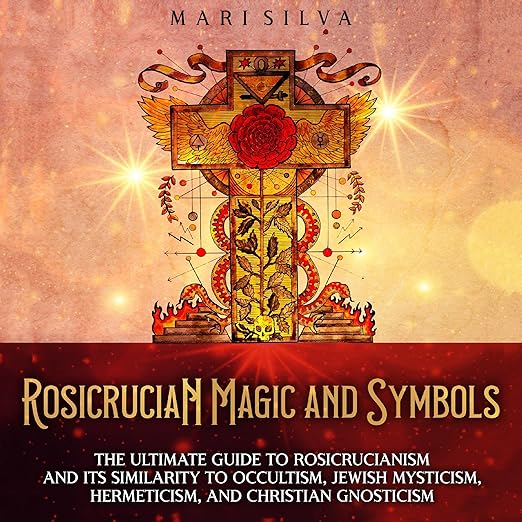
Quick Take
- Narration: Lee Jagow delivers a measured, respectful pace suited to dense esoteric material, though the voice lacks the warmth needed to carry the more devotional passages.
- Themes: Western esotericism, Kabbalistic symbolism, alchemical tradition
- Mood: Methodical and quietly fascinating
- Verdict: A reliable entry point for listeners new to Rosicrucian symbolism, though seasoned occultists will find the depth limited.
I came to this one on a rainy afternoon when I had been working my way through a stack of esoteric history titles. There is something about that particular kind of grey light that makes occult scholarship feel exactly right, and Mari Silva’s Rosicrucian Magic and Symbols slotted in well. I had read broadly about Western esotericism before but had only brushed the surface of Rosicrucianism specifically, so this felt like a genuine opportunity to fill a gap.
Silva has built a prolific catalog of accessible guides to spiritual and esoteric traditions, and this audiobook fits squarely within that project. At just under three and a half hours, it is compact by design. That brevity is both its strength and its most notable constraint.
Our Take on Rosicrucian Magic and Symbols
The audiobook does what it promises: it moves through the origins of the Rosicrucian Order, the legend of Christian Rosenkreuz, the symbolism of the rose cross, alchemical correspondences, Kabbalistic ideas including Merkavah mysticism, and practical dimensions of Western esotericism. Two bonus chapters on broader esoteric symbols round out the listen.
What Silva does well is demystify without condescending. She writes in a clear, survey-style register that genuinely earns the word simplified that reviewers keep reaching for. One listener described it as everything you wanted to know in a simplified way, and that captures the tone accurately. Another praised the fact that she writes clear and simple to understand, noting they had been entirely unaware of Rosicrucianism before picking up the title. For audiences coming in cold, that accessibility is real value.
The limitation is one of depth. Listeners with prior grounding in Hermeticism, Kabbalah, or Freemasonry will find the treatment introductory to the point of feeling thin. The coverage of Merkavah mysticism, for instance, is handled in broad strokes where the subject easily warrants a dedicated volume. This is not a failure of execution so much as a function of the format and the author’s stated intent.
Why Listen to Rosicrucian Magic and Symbols
The strongest case for this audiobook is the breadth of its survey in a short runtime. If you have been curious about the rose cross and wanted to understand what the symbol actually means within its original tradition before pursuing deeper reading, this delivers that orientation efficiently. Silva also does solid work connecting the threads between alchemy, Kabbalistic thought, and the Rosicrucian framework, which helps listeners understand why these traditions are often discussed together rather than as separate silos.
Lee Jagow’s narration is steady and clear, which matters for material that requires careful parsing. He does not impose personality onto the text, which feels appropriate for a subject that carries its own weight of meaning. A more theatrical delivery would have felt out of place here.
What to Watch For in Rosicrucian Magic and Symbols
The audiobook leans heavily on the survey format, meaning it sometimes moves through significant ideas quickly in order to cover the full range of topics. The sections on Kabbalistic symbolism and alchemy feel compressed, and listeners who come in wanting to understand the Tree of Life or alchemical transmutation in any real detail will need to follow up elsewhere. There is also a noticeable emphasis on structure over narrative, which keeps things clear but occasionally makes the listening feel more like an annotated outline than an immersive exploration.
One reviewer who had traveled with the book noted they wished for a pocket edition, which reveals something telling: this is material people want to return to and reference, but the audiobook format does not naturally support that kind of use. If you are a note-taker, keep a pad nearby.
Who Should Listen to Rosicrucian Magic and Symbols
This works well for listeners who are new to Western esoteric traditions and want a structured orientation before committing to more demanding texts. It also suits anyone building out a broad survey of spiritual philosophy who wants to understand where Rosicrucianism sits in relation to alchemy and Kabbalah. Those already familiar with Francis Yates’s work on the Rosicrucian Enlightenment or who have spent time with primary sources will find the coverage insufficient for their purposes. Listeners seeking narrative or ritual instruction will also want to look elsewhere.
Frequently Asked Questions
Does this audiobook explain what the rose cross symbol actually means, or does it stay surface-level?
It covers the symbolic meaning in reasonable detail for a short introductory title, connecting the rose and cross to alchemical and Kabbalistic frameworks, but it does not go into deep esoteric interpretation.
Is this part of a series, and do I need to listen to earlier titles first?
It belongs to Mari Silva’s Spiritual Philosophies series, but each title stands alone. No prior knowledge of Silva’s other books is needed.
Does Lee Jagow’s narration work well for this type of dense symbolic content?
Yes, his measured delivery is well-suited to material that asks listeners to absorb specific terminology and conceptual relationships. He reads clearly without overemphasizing.
What is Merkavah mysticism, and does this audiobook explain it clearly?
Merkavah is an early Jewish mystical tradition involving the contemplation of the divine chariot throne. The audiobook introduces the concept and its connection to Kabbalistic thought, though it does not explore the tradition in depth.