At a Glance
- Voice: Robert Orzechowski's measured, clear delivery suits the intellectual tone of the biography without overdramatizing the story's obvious injustice.
- Big ideas: Scientific attribution and gender, crystallography as discipline, the institutional conditions that shape whose work gets credited
- Atmosphere: Precise and corrective, like a careful reading of the record setting things straight
- Worth it?: A focused, accessible rehabilitation of Franklin's scientific legacy that works best as an honest first encounter with her career rather than a comprehensive study.
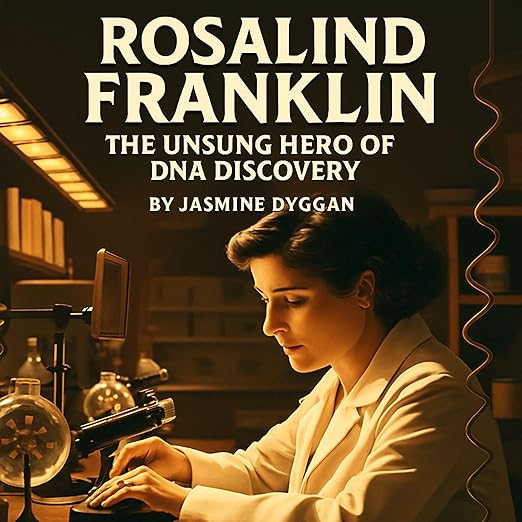
Context shapes how we hear a biography, and the context Rosalind Franklin requires is this: the story of DNA's discovery is one of science history's most documented injustices, yet it keeps being told from the wrong center of gravity. This audiobook, written by Jasmine Dyggan and narrated by Robert Orzechowski, works against that gravitational pull by returning Franklin to her proper position, not as a footnote to Watson and Crick, but as a scientist of formidable independent achievement whose contributions to X-ray diffraction crystallography were indispensable.
I came to this knowing the basic outline, Photograph 51, the unauthorized use, the Nobel Prize Franklin never lived to receive. What Dyggan does well is insist that this is too narrow a frame for a career that started in coal and carbon chemistry, moved through virus research, and only intersected with DNA during a specific and contentious period at King's College London. The audiobook is relatively compact at three and a half hours, which means it moves efficiently through Franklin's career without becoming encyclopedic.
Crystallography Training Comes Before the DNA Story
Dyggan's structural choice is to start with Franklin's training in crystallography rather than with the DNA story. That sequence matters. It establishes Franklin as a practitioner who earned her analytical skills through rigorous work, first at Cambridge, then in Paris, long before she arrived at King's. Her early research on coal and carbon structure honed her ability to interpret complex diffraction patterns, which gave her the technical foundation that made Photograph 51 possible. By the time the famous image appears in the narrative, it reads as one achievement among many rather than as a single flash of genius that was stolen.
The account of King's College is handled with attention to the institutional dynamics that shaped Franklin's experience. The tension with Maurice Wilkins, the gendered condescension embedded in the laboratory culture, the way her insistence on scientific rigor was read as personality difficulty rather than professional standards, these are not background details. They are part of the analytical record of how good science gets attributed incorrectly. Dyggan treats them as such.
Orzechowski Avoids a Narrator's Inflected Grief
Robert Orzechowski's narration is measured and clear, well suited to biographical prose that is trying to convey intellectual seriousness rather than dramatic tension. He does not overdramatize the story's obvious injustice, which is the right call: the facts speak without needing a narrator's inflected grief. His pace is deliberate without being slow, which matches the density of scientific and historical material Dyggan is covering.
At three and a half hours, the audiobook moves quickly through a career that deserves more space in some chapters. The virus research Franklin conducted at Birkbeck after leaving King's, including her crystallographic work on tobacco mosaic virus, receives somewhat compressed treatment despite being, by some assessments, her most technically distinguished work. Listeners who want to go deeper on the Birkbeck period will need to supplement this with Brenda Maddox's 'Rosalind Franklin: The Dark Lady of DNA,' which remains the most comprehensive biographical treatment.
Explicitly Rehabilitative, Deliberately Corrective Rather Than Neutral
The book is explicitly rehabilitative in its framing, which is appropriate given the historical record but means it functions less well as a fully rounded portrait. Franklin's complications and the nuances of her personality, which are documented in the historical record alongside her brilliance, receive less attention here than in Maddox's biography. This is not necessarily a flaw: a book specifically about why Franklin deserves more credit does not need to balance that argument with unflattering detail. But listeners should know the framing is deliberately corrective rather than neutral.
The title is part of the Zentara UK Famous Lives Book Series, which positions it as an accessible popular biography rather than an academic study. That context matters for expectations: this is a well-researched introduction to Franklin's significance rather than a primary scholarly contribution. For listeners who want a starting point in the subject, the accessibility is an asset.
Dyggan's account of the Photograph 51 episode is worth examining for what it does not do as much as for what it does. It does not dwell on the episode as the defining injury of Franklin's career, and it does not frame Franklin primarily as a victim. The image is placed within the context of what Franklin was actually doing at the time, building a rigorous experimental program to determine the precise structure of DNA from first principles, and the significance of the photograph within that program is clarified rather than dramatized. Franklin's own assessment, that the photograph was valuable data requiring further verification before any structural model could be proposed, is presented as the mark of her scientific judgment, not as evidence of a failure to understand what she had found.
The book's treatment of Franklin's personality is handled with care. The historical record contains accounts of Franklin as difficult and exacting, particularly in her interactions with Maurice Wilkins, and Dyggan does not pretend those accounts do not exist. What she does is contextualize them: a woman demanding that her experimental space be respected, that her data not be used without permission, and that her conclusions be drawn on her own timeline was not behaving abnormally for a careful scientist. The difficulty attributed to her character was, in significant part, the difficulty of maintaining standards in an environment that did not apply those standards equally.
Suits the Material Without Particular Distinction
Listeners new to Franklin's story will find this a focused and intellectually honest starting point that reframes the DNA discovery narrative around its actual intellectual architecture. Students and general readers interested in women in science, the history of molecular biology, or the institutional conditions that shape scientific attribution will find the material relevant and the three-and-a-half-hour format efficient.
Listeners who already know Maddox's biography or Anne Sayre's earlier account will find Dyggan's book useful as a concise summary but may want more depth in the Birkbeck sections. Robert Orzechowski's narration suits the material without adding particular distinction to it. For a first encounter with Rosalind Franklin's story, this audiobook does what it sets out to do: correct the record with clarity and respect for the evidence.
How does this audiobook handle Photograph 51 and the Watson-Crick controversy?
The book frames Photograph 51 as one significant piece of evidence in a broader research program rather than the center of Franklin's story. The unauthorized use by Watson and Crick is addressed within the historical record of attribution, but Dyggan's emphasis is on restoring Franklin's full career rather than dwelling exclusively on the famous image.
Is this audiobook suitable for listeners without a science background?
Yes. Dyggan explains the relevant scientific concepts, including crystallography and X-ray diffraction, in accessible terms. The emphasis is on intellectual biography rather than technical instruction. No prior knowledge of chemistry or molecular biology is required to follow and appreciate the argument.
How does this audiobook compare to Brenda Maddox's full biography of Rosalind Franklin?
Maddox's 'Rosalind Franklin: The Dark Lady of DNA' is considerably more comprehensive, covering Franklin's personal life and the Birkbeck period in much greater depth. Dyggan's book is a focused, corrective account aimed at accessible readers. They serve different purposes: Dyggan is a starting point, Maddox is the definitive treatment.
Does Robert Orzechowski's narration add to the audiobook's impact?
Orzechowski's delivery is competent and appropriate: measured, clear, and free of theatrical inflation. He suits the material without getting in its way, which is the right call for a biography of this kind. Listeners wanting a more emotionally inflected performance will not find it here.