Quick Take
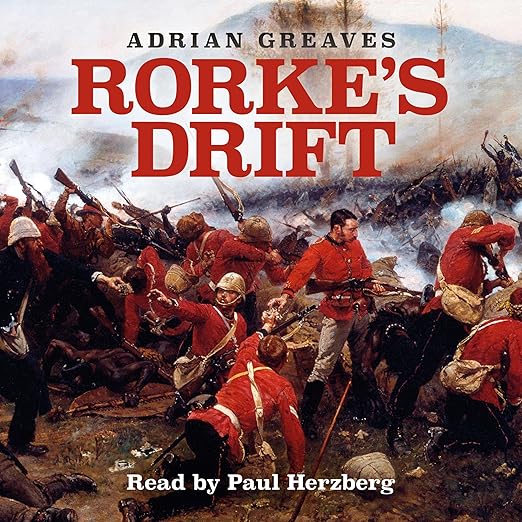
- Narration: Paul Herzberg brings scholarly authority to Greaves’s revisionist account, measured and clear across nearly sixteen hours of dense archival research.
- Themes: Myth versus historical record, institutional cover-up, the real costs of colonial warfare
- Mood: Methodical and revelatory, occasionally dense but consistently purposeful
- Verdict: Greaves insists on the complexity behind the Rorke’s Drift legend, and the result is a more honest and ultimately more compelling account than the heroic version most listeners already know.
I came to this one after finishing Mace’s novelistic account of the same battle, and the contrast is instructive. Where Mace gives you the experience of the engagement, Greaves gives you its meaning, and the two books turn out to be in productive tension. Greaves is not interested in the story you already know from the 1964 film Zulu. He is interested in what that story obscures and why it was constructed the way it was.
The central argument of Rorke’s Drift is one that will be uncomfortable for listeners who came of age on the film. Greaves argues, through new archival research, that the battle’s elevation to legendary status was not simply the natural consequence of extraordinary bravery, though extraordinary bravery was unquestionably present. It was, at least in part, a deliberate construction: a way of managing public attention following the catastrophic British defeat at Isandlwana just hours earlier.
The Eleven Victoria Crosses and Their Political Logic
Eleven Victoria Crosses, the largest number awarded for any single engagement in history, were distributed to the defenders of Rorke’s Drift. This fact has always seemed remarkable, even excessive, to historians who have looked closely at the engagement. Greaves examines it carefully and finds a political logic operating alongside the military one. The British public needed heroes after Isandlwana. The army needed a narrative that redirected attention from the command failures that had allowed nearly 1,300 soldiers to be destroyed in a single afternoon. Rorke’s Drift provided that narrative with almost providential timing.
This does not mean the bravery was manufactured. Greaves is careful about this distinction. Eighty-five men holding a defended position through the night against six full-scale Zulu attacks, sustaining twenty-seven casualties, was a genuine feat. But some of the men decorated were not the most deserving of those present, and some who fought with extraordinary courage were not decorated at all. The distribution of honors, Greaves argues, reflected political pressure as much as military assessment.
The Cases of Cowardice the Legend Suppressed
The book also documents cases of cowardice at Rorke’s Drift that the mythology has entirely suppressed, soldiers who fled, who failed to hold their positions, who survived the night by methods that had nothing to do with heroism. Greaves is not interested in shaming individuals; he is interested in the historical record. Every human account of extreme violence under sustained attack contains complexity of this kind, and the refusal to acknowledge it in the case of Rorke’s Drift is part of what makes the myth a myth rather than a history.
Paul Herzberg’s narration handles this material with appropriate gravity. The book runs nearly sixteen hours and covers considerable ground, not just the battle itself but the broader context of the Anglo-Zulu War, the political situation in southern Africa, the careers of the principal figures, and the postwar fates of the Victoria Crosses themselves. One reviewer describes this last aspect in detail as one of the more unusual biographical threads in the book.
The Companion PDF and the Full Scholarly Record
The Audible listing notes that a companion PDF is available in the listener’s library alongside the audio. Given the book’s research-intensive nature, this likely includes maps, photographs, and documentary evidence that supplement the audio. For a title this dependent on archival material, it is worth downloading before you begin.
Who Should Listen, Who Should Skip
Listen if you have any familiarity with Rorke’s Drift, from the film, from general reading, or from the Anglo-Zulu War more broadly, and are ready to have the mythology complicated. Greaves’s revisionist account is more satisfying than the clean heroic version precisely because it asks harder questions and does not look away from uncomfortable answers.
Skip if you want a straightforward narrative account of the battle without the critical apparatus. Mace’s Crucible of Honour is the better choice for listeners who want the experience of the engagement. Greaves is for listeners who want its history.
Frequently Asked Questions
Is there a companion PDF available with the Rorke’s Drift audiobook?
Yes. The Audible listing explicitly states that a companion PDF is available in the listener’s library alongside the audio. Given the scholarly nature of Greaves’s research, this likely includes maps, photographs, and documentary material that supplement the audio.
How does Greaves’s account differ from the story told in the 1964 film Zulu?
Significantly. Greaves argues that the legendary version of Rorke’s Drift, including the distribution of Victoria Crosses, was partially shaped by political needs following the disaster at Isandlwana. He also documents cases of cowardice that the film and the official mythology have entirely suppressed.
Does the book suggest the bravery at Rorke’s Drift was exaggerated or fictional?
No. Greaves is explicit that genuine extraordinary bravery occurred. His argument is that the transformation of the battle into legend was shaped by political and institutional pressures, and that the distribution of honors did not perfectly reflect who actually performed most courageously.
What does Greaves cover about the fates of the Victoria Crosses after the recipients died?
One reviewer specifically notes this as one of the book’s more unusual features, Greaves traces what happened to the Victoria Crosses after their recipients passed away, a biographical dimension that extends well beyond the battle itself into the long aftermath of the men’s lives.