Quick Take
- Narration: John Telfer was praised by multiple reviewers, and his authoritative, measured delivery suits the scholarly register of Barrett’s historical reconstruction, the kind of narration that makes academic material feel vivid without sensationalizing it.
- Themes: Myth versus historical record, the architecture of imperial power and its vulnerabilities, the long aftermath of catastrophe
- Mood: Rigorously analytical with occasional passages of genuine drama, the controlled authority of excellent academic history writing
- Verdict: The most thorough and honest reckoning with the Great Fire of Rome’s actual history available in audio, from a historian willing to follow evidence rather than legend.
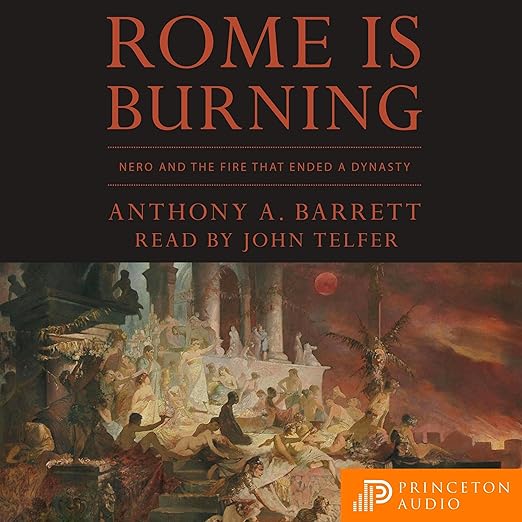
The story of Nero fiddling while Rome burned is one of those historical images so vivid and so often repeated that it has long since detached from any particular evidence. I have known for years that the story was probably false, but I had never read a book that asked the deeper question: if the legend is wrong, what actually happened, and why does the legend persist? Anthony Barrett’s Rome Is Burning is the answer to both of those questions simultaneously.
Barrett is a distinguished Roman historian, and this book belongs to the Princeton University Press “Turning Points in Ancient History” series, which tells you something about its register. This is not popular history in the sense of using historical events as a backdrop for narrative drama. It is rigorous, evidence-based reconstruction, and it is the better for being honest about that ambition rather than pretending to be something more accessible than it is.
Our Take on Rome Is Burning
The book’s central argument is that the Great Fire of 64 AD was genuinely a turning point in Roman history, not because Nero started it, which Barrett argues the evidence does not support, but because of what happened afterward. The financial crisis and currency devaluation the fire triggered, the political damage to Nero’s golden image, and the eventual collapse of the Julio-Claudian dynasty that began with Julius Caesar all trace their roots to that night. Barrett’s reconstruction of these consequences is the book’s most original and durable contribution.
The section on recent archaeological discoveries is remarkable. Barrett surveys physical evidence of the fire’s destruction visible in excavations across the city, and the translation of that evidence into historical argument is a model of how archaeological material can illuminate written record rather than simply illustrating it. One reviewer described feeling as though they had completed a formal course in the subject, which captures the book’s ambition and achievement accurately. It is genuinely instructive rather than merely entertaining.
Why Listen to Rome Is Burning
John Telfer’s narration received specific praise in listener reviews, and the credit is deserved. He navigates the text’s shifts between narrative history, archaeological analysis, and literary survey with consistent authority, and his delivery has a quality that makes even the denser analytical passages feel like they are going somewhere rather than stalling. The ten-hour runtime is appropriate for the scope, Barrett covers the fire, its immediate aftermath, the long-term consequences for Roman political and economic structures, and the fire’s cultural afterlife in opera, ballet, and film.
That last element, the cultural afterlife section, is where the book opens up in an unexpected way. Following the myth of Nero through its transformations in later art and literature reveals something interesting about how historical events get narrativized and what needs they serve. The book earns its final section by arriving at it through everything that came before.
What to Watch For in Rome Is Burning
The book’s most significant critical response concerned Barrett’s deliberate withholding of definitive conclusions on contested questions, whether Nero ordered the fire, whether Christians were actually persecuted as scapegoats for it. One reviewer found this frustrating, and the frustration is understandable. Barrett’s method is to lay out evidence and decline to assert certainty the evidence does not support, which is intellectually honest but occasionally unsatisfying for readers who came looking for resolution.
Another listener found the book started strong with promising structural claims and then failed to fully deliver on the scope of its introduction. This is the perennial risk of ambitious historical framing: the specifics of the reconstruction inevitably feel narrower than the sweeping questions that opened the book. Listeners who calibrate their expectations to rigorous reconstruction rather than narrative drama will find the book consistently rewarding.
Who Should Listen to Rome Is Burning
History readers with an interest in the Roman Empire, particularly the Julio-Claudian period, will find this the most careful and current reconstruction of the Great Fire available. Those who enjoyed Mary Beard’s SPQR or Adrian Goldsworthy’s Roman biographies will recognize the register and find it similarly satisfying. The archaeological focus makes it of particular interest to listeners who have followed recent excavations in Rome.
Listeners who want dramatic narrative history with clear heroes and villains should look elsewhere. Barrett’s method is evidentiary and his conclusions are appropriately qualified. That is the right approach to this material, but it asks something of its audience in return.
Frequently Asked Questions
Does Rome Is Burning definitively answer whether Nero started the fire?
No, and intentionally so. Barrett reviews all available literary and archaeological evidence and argues that the case against Nero is far weaker than the legend suggests, but he does not assert certainty the evidence cannot support. His conclusions are deliberately measured, which some listeners find frustrating and others find intellectually honest.
How much of the book is based on new archaeological evidence versus older literary sources?
A significant portion draws on recent excavations that have revealed visible traces of the fire’s path through Rome. Barrett treats the archaeological and literary evidence as complementary rather than hierarchical, which is part of what makes his reconstruction more current than older treatments of the same events.
Is this book part of a series, and do I need to read other volumes first?
It belongs to Princeton’s Turning Points in Ancient History series, but each volume is independent. No prior reading in the series is needed. Rome Is Burning stands completely on its own.
What background in Roman history do I need to appreciate this book?
General familiarity with the broad outlines of the Roman Empire and the Julio-Claudian dynasty is helpful but not required. Barrett contextualizes the fire within Roman history as he goes, and the book is written to be accessible to engaged general readers rather than exclusively to specialists.