The Short Version
- Voice: Ted Conover narrates his own decades-old fieldwork with a self-aware, lived-in authority.
- Big ideas: Undercover immersion journalism, marginalized subcultures, youthful risk and self-discovery.
- Atmosphere: Gritty, adrenaline-charged, and quietly reflective.
- Worth it?: A strong entry point into Conover's whole body of work, narrated with the authority only the author himself could bring.
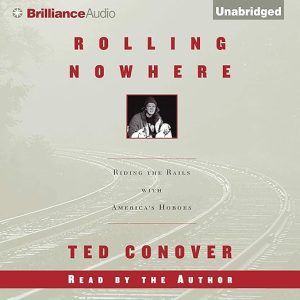
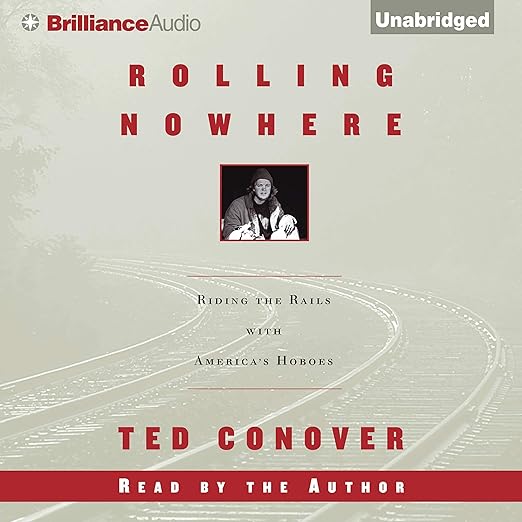
Crouched in tall weeds beneath a highway viaduct, watching freight cars get switched from track to track, a young Ted Conover waited to jump a train he had no legal right to board, and this audiobook opens exactly there, in the nervous stillness before the leap. Conover was a college student when he first went undercover as a tramp, riding sixty-five freight trains across twelve thousand miles and fifteen states alongside companions with names like Pistol Pete and BB, learning to read a train's movement, scavenge food, and dodge the railroad police everyone in that world calls bulls. He narrates his own account, decades after living it, and that firsthand ownership gives Rolling Nowhere a specific, lived-in authority most travel writing about marginalized communities can only gesture toward.
The Review
This is Conover's first book, written well before he became known for the immersive undercover journalism that would later define his career. What is striking listening to it now is how fully formed his method already was: total immersion, real physical risk, and a genuine reluctance to treat the people he traveled with as subjects rather than companions. He earns trust from Pistol Pete, BB, and a hobo he calls Sheba Sheila Sheils not by performing sympathy but by actually living the hardship alongside them, hunger, cold, and the constant threat of arrest included.
Reviewer tolarjev, who says she has read all of Ted Conover's books, saved this one, his debut, for last and came away calling it, in her assessment, the best of the group, an experience she is glad to have heard about rather than ever needing to live through herself. That is a strong endorsement from someone with the full context of Conover's later, more celebrated work to compare it against.
The specific vocabulary Conover picks up along the way is its own kind of education. Learning to identify railroad police as bulls, or understanding the informal etiquette that governed who could ride which car and how newcomers earned trust, gives the book an ethnographic precision that elevates it above simple adventure memoir. Conover treats this slang and etiquette the way a good anthropologist treats a foreign culture's customs, worth recording exactly and without condescension, rather than flattening it into color commentary.
Conover's decision to travel under his real background as a college student rather than fully inventing a false identity also shapes the book's ethics. He does not pretend to be someone he is not in any deep biographical sense, mostly withholding rather than fabricating, which keeps the reporting honest even as he blends into a community that might have reacted very differently to an openly announced journalist in their midst.
Why Rolling Nowhere Works as an Audiobook
Hearing Conover narrate his own decades-old fieldwork adds a layer the printed page cannot fully replicate: this is a much older, more established journalist reading back the voice of his twenty-something self, and the audiobook captures a subtle self-awareness in his delivery, someone who knows exactly how the story ends and how much danger he was actually in, in a way his younger self only partly understood at the time.
Carolyn B.'s review gets at the sensory pull of the material directly, describing how Conover 'took me on his journey, bringing me into the moment, seeing the sights, feeling the adrenaline' of the ride itself. That kind of immersive, present-tense reporting is exactly what benefits from audio narration, since Conover's own voice carrying his own remembered adrenaline closes the gap between the listener and a genuinely uncomfortable, physically real experience most people will never choose to have themselves.
Conover's approach here sits in a long tradition of writers embedding themselves inside marginalized communities to report back with genuine intimacy rather than distant observation, a lineage stretching back at least to George Orwell's Down and Out in Paris and London. What distinguishes Conover's version is how young he was when he did it, a college student rather than an already-established writer, which gives the book a rawer, less calculated quality than similar undercover journalism attempted later in a career.
The Caveats
This was Conover's first book, published decades ago now, and it reads with the specific texture of a very particular late-twentieth-century hobo subculture, one built around specific rail routes, specific yards, and a code of conduct among tramps that has likely shifted or vanished in the years since. Listeners expecting an up-to-date account of contemporary rail-riding culture should know this is a historical snapshot of a world Conover accessed at real personal risk in the early 1980s, not a current-day investigation.
One craft note worth flagging: a Kindle-edition reviewer noted the ebook version specifically suffers from numerous typographical errors, docking a star for editing quality alone despite otherwise enjoying the book. That is a complaint about the ebook's production, not the audio edition, but it is worth knowing which format is cleanest if a listener plans to follow along with the text, since the audiobook itself carries no such liability.
American hobo culture itself has a much longer history than the specific early-1980s window Conover documents, stretching back through the Great Depression and even further to the years after the Civil War, when demobilized soldiers and itinerant laborers first began riding the rails in large numbers. Conover is documenting a late, diminished but still very real continuation of that older tradition rather than something newly invented, and listeners with an interest in American labor history will find useful context here even though the book itself stays focused on Conover's specific 1980s journey.
The title itself plays a quiet trick on the reader. Rolling Nowhere sounds at first like simple hobo slang for a life without direction, but by the book's end it reads more like irony, since Conover's journey, however aimless it looked from the outside, took him somewhere very specific, toward the immersive, high-risk journalism that would define his entire career.
Who Should Listen to Rolling Nowhere
Anyone drawn to immersive, participant-observer nonfiction, writers who embed themselves inside a subculture rather than simply reporting on it from outside, will find this a genuinely rewarding entry point into Conover's whole body of work. Listeners who enjoy adventure travel writing built around real physical risk and unglamorous detail, rather than scenic postcard description, are exactly who this book is written for.
College-age listeners specifically may find Conover's own age at the time of the journey especially resonant, since the book captures a very particular moment of youthful risk-taking and identity experimentation that reads differently coming from a still-young narrator than it would from an older writer looking back with decades of hindsight.
Polished travel-brochure adventure is not what is on offer here. Cold nights, hunger, and the real threat of arrest are, and readers should adjust expectations accordingly, since Conover's account stays close to the actual discomfort of the experience rather than romanticizing the freedom of the open rail.
Does Ted Conover narrate his own audiobook?
Yes, and hearing the author read back his own decades-old undercover fieldwork adds a self-aware quality the printed page cannot fully replicate.
Should I listen to Rolling Nowhere before Ted Conover's other audiobooks?
It works well as a starting point, since it is his first book, though reviewer tolarjev, who has read all of his work, rates it among his strongest regardless of order.
Does this audiobook romanticize the hardship of riding freight trains?
No, Conover stays close to the real discomfort, hunger, cold, and risk of arrest, rather than presenting the experience as pure freedom or adventure.