At a Glance
- Narrator: Andy Cresswell delivers Leeson's first-person account with an appropriately controlled escalation, capturing the mounting desperation without overstating it.
- Subjects: The psychology of covering up small mistakes until they become catastrophic ones, institutional failure as complicity, the self-deception required to maintain a con
- Tone: Tense and increasingly claustrophobic, with moments of dark irony
- Bottom line: Rogue Trader is one of the most psychologically revealing financial disaster narratives available, told by the person at the center of it with a honesty that is more unsettling than triumphant.
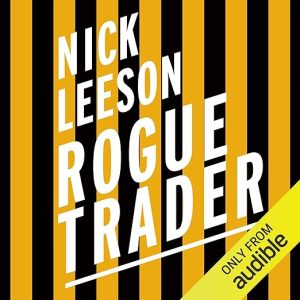
I first came across Nick Leeson's story years before I read Rogue Trader, the way most people did, through the Ewan McGregor film, which is a solid thriller that captures the basic mechanics of what happened. The book is different. Not because the facts change, but because first-person narration from Leeson himself adds a psychological dimension that no dramatization can fully replicate. Listening to Andy Cresswell deliver Leeson's account across ten hours, I kept returning to the same question: at what point did Leeson believe he could still fix it?
The answer the book gives, slowly and with uncomfortable detail, is that the belief never fully disappeared until it was impossible to maintain. That's what makes Rogue Trader more than a financial scandal story. It's a study in the psychology of the hole you can't stop digging. The 1994 trading losses at Barings' Singapore office that brought down Britain's oldest merchant bank, founded in 1762, gone in weeks, were not the product of a deliberate scheme to destroy an institution. They were the product of a 28-year-old from Watford who covered up a colleague's small error and then couldn't figure out how to stop covering.
Account 88888 and the Cover-Up That Grew
Leeson is explicit in the book about the sequence: the original error was small. A junior trader made a mistake that Leeson shielded from London by booking it to the now-infamous account 88888 rather than reporting it up the chain. From that small concealment, everything else followed. The escalating trading positions meant to recover the hidden loss, the increasing complexity of the deception, the complicity of organizational structures that didn't ask questions they should have asked, all of this is rendered with the granular detail of someone who lived it and has had time to think about the mechanics.
One reviewer notes that the book functions as "a great lesson on how our emotions can throw us into a neverending financial problem spiral", which is accurate but understates how systemic the failure was. Leeson's individual psychology was the instrument, but Barings' institutional culture was the condition that made it possible. The book touches on this, though it's necessarily told from one vantage point. Reviewers in finance and auditing note that this is one of the more useful accounts of how internal controls fail and why oversight structures need to be designed assuming that smart people will find their gaps.
Beyond the Film, Into Leeson's Singapore Life
The Ewan McGregor adaptation, released in 1999, is faithful to the broad outlines but compressed in ways that any two-hour film must be. The book adds the layers of daily life, the mundane texture of the trading floor, the social world of expatriate banking in Singapore, the relationship with his wife Lisa, the personal details that make the story feel less like a cautionary tale and more like a life. One reviewer specifically notes that the book "adds more layers of complexity" beyond what the film could achieve, which is the honest truth about the adaptation's relationship to its source material.
At ten hours, the audiobook has room for those layers. Some reviewers note that certain sections feel more detailed than necessary, Leeson's personal life between trading sessions, the texture of his social world in Singapore, but those passages also contextualize the isolation that allowed the deception to continue. A man deeply embedded in his work world, increasingly unable to tell anyone the truth about what was happening, surrounded by people who were profiting from the numbers he was inventing.
Cresswell's Careful Balance Between Sympathy and Judgment
Narrating Leeson's account requires a careful balance. Too much sympathy and the performance becomes an apology. Too much detachment and the psychological texture that makes the book valuable gets lost. Cresswell finds a middle register, controlled, matter-of-fact, occasionally allowing the creeping panic of the book's final sections to surface without theatricality. The escalating dread as the losses mount and the options narrow is genuinely well-handled, and the pacing of those final chapters benefits from Cresswell's restraint in the earlier ones.
For listeners who have no background in derivatives trading or futures markets, the book is accessible. Leeson explains the mechanics clearly enough that you understand what he was doing without needing to pass a finance exam. One reviewer notes that you can take away valuable lessons from the book even if you can't tell futures from options, which is Leeson's achievement as a narrator of his own story, he makes the financial complexity legible without dumbing it down.
Both an Institutional Case Study and a Character Study
Rogue Trader works on two levels simultaneously. For listeners in finance, investment, or auditing, it's a detailed case study in how institutions fail to see what they don't want to see and how individual psychology exploits that institutional blindness. For listeners who come to it as narrative nonfiction, it's a psychologically compelling account of how a person gets trapped between the lie they're living and the truth they can't tell. Both readings are available in the same ten hours. The book is not a comfortable listen, Leeson is not a sympathetic figure in any simple sense, but it's a revealing one.
Do you need a background in finance or derivatives trading to follow Rogue Trader?
No. Leeson explains the relevant financial mechanics clearly enough for a general listener. Multiple reviewers with no finance background found the book fully accessible, and the psychological narrative works independently of the technical detail.
How does the book compare to the 1999 Ewan McGregor film adaptation?
The film is faithful to the broad outline but compressed. The book adds personal texture, more detail about the daily mechanics of the deception, and Leeson's own psychological account of why he kept going. Reviewers who have seen the film note the book offers substantially more complexity.
Is Leeson honest about his own culpability in Rogue Trader or does he primarily blame the institution?
Leeson is relatively candid about his own decision-making and the psychology that kept the deception going. He acknowledges the escalating choices he made. He also documents Barings' institutional failures, and the book implicitly distributes blame across both individual and system.
Is Rogue Trader useful as a practical lesson for traders or risk managers?
Several reviewers in trading and finance describe it as essential reading for understanding how emotional responses to loss can drive compounding bad decisions, and how inadequate oversight structures enable those decisions. It functions as a case study as much as a memoir.