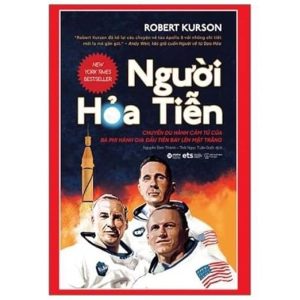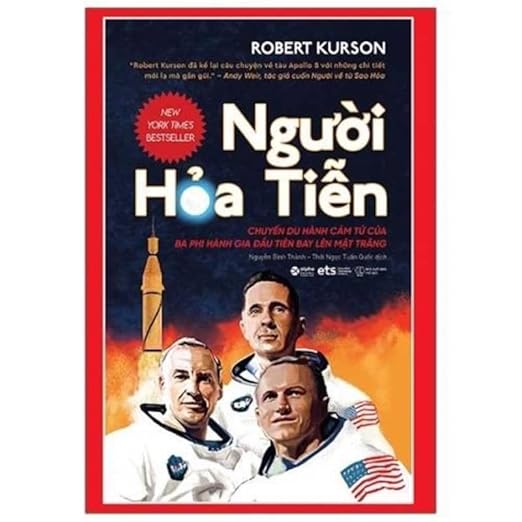
Ray Porter narrating Robert Kurson's Rocket Men is a pairing that earns its twelve hours and twenty minutes with interest. The book's subject is Apollo 8, the 1968 mission that sent Frank Borman, Jim Lovell, and Bill Anders to lunar orbit and back at a moment when the United States had not yet confirmed it could sustain human life in deep space for more than a few days, let alone navigate successfully to the moon and return. Kurson, who established his reputation as a narrative journalist with Shadow Divers, brings the same commitment to human interiority and procedural detail that made that underwater recovery account compelling. A note in available records indicates a Vietnamese edition of the book exists, suggesting the reach of the story across languages; this review addresses the English-language audiobook as narrated by Porter.
Borman's Marriage Gets Equal Billing With Engineering
What distinguishes Kurson's approach from other Apollo histories is his sustained focus on the three astronauts as family men and not merely test pilots. Frank Borman's marriage to Susan Borman is woven through the narrative with unusual care. The book makes the argument that understanding what Borman was flying toward and what he was leaving behind is inseparable from understanding why Apollo 8 succeeded where it could have failed catastrophically. That domestic grounding separates Rocket Men from purely technical histories of the space program and positions it closer to Tom Wolfe's The Right Stuff in its conviction that the astronauts' psychology is as important as the engineering beneath them.
Kurson also gives significant attention to the mission planners and engineers at NASA who made the decision to accelerate Apollo 8's timeline in direct response to intelligence about Soviet lunar ambitions. The choice to send men to lunar orbit on an accelerated schedule, before the lunar module was ready and before the mission profile had been fully tested, is presented as one of the most consequential decisions in the history of the space program, and the book treats it as such. The Cold War political context is present throughout without reducing the mission to a propaganda exercise. The astronauts flew because they believed in what they were doing, and Kurson is careful to preserve that dimension even while acknowledging the national competition that made the timing urgent.
Porter Distinguishes Borman's Control From Lovell's Warmth
Porter's narration is one of the primary reasons to choose the audiobook over print. He has a particular gift for technical material: he can move through orbital mechanics, fuel consumption calculations, and NASA procedure without losing the human story running underneath. Across twelve hours, he maintains subtle but consistent differentiation between the three astronauts that adds clarity and character without exaggeration. Borman's controlled authority is distinct from Lovell's more expansive personality, and Porter holds that distinction throughout without overdoing it.
The mission's climactic passages, particularly the lunar orbit insertion burn that had to work on the far side of the moon with no communication to Mission Control, benefit from Porter's instinct for building tension through measured restraint. He doesn't telegraph the resolution; he lets the procedural detail generate the anxiety itself. The effect is that the technical narration becomes genuinely suspenseful in a way that a more dramatically inflected performance might actually undercut. The 4.8 rating across nearly 2,800 reviews reflects consistent satisfaction from an audience that spans space enthusiasts, general readers, and listeners drawn specifically by Porter's track record with narrative nonfiction. His work on this audiobook belongs among the stronger examples of his output in the nonfiction space.
Porter Delivers the Genesis Reading Without Sentiment
The book's emotional centerpiece is the Christmas Eve broadcast from lunar orbit, when Borman, Lovell, and Anders read from Genesis to an estimated global audience of a billion people. Kurson earns that moment by spending the preceding chapters establishing what it meant for three human beings to be where no human being had ever been, looking at an Earth that had never been seen from that distance by anyone. Porter delivers the Genesis reading with appropriate gravity without making it sentimental. Listeners primarily interested in engineering and mission planning rather than personal narratives may occasionally find the domestic material slows the technical sections; Kurson distributes these threads fairly evenly throughout the book. The balance reflects his genuine belief that neither dimension is secondary, and the audiobook is most effective for listeners willing to give both equal attention. The ending is both triumphant and quietly melancholy, which is the right register for a mission that was extraordinary and also merely the beginning of a program that would not outlast the decade.
Families Get Heroism That Isn't Sanitized
Space history enthusiasts and readers of narrative nonfiction are the natural audience, but Kurson's humanist approach makes the audiobook accessible to anyone with general interest in what human beings can achieve under conditions of extreme uncertainty. Listeners who came to space history through The Right Stuff, Andrew Chaikin's A Man on the Moon, or David Mindell's technical histories will find Kurson occupying a position between Wolfe's literary journalism and the more rigorous technical accounts. The twelve-hour runtime is well justified by the scope. For anyone drawn to moments where engineering, political pressure, and human courage converged under impossible conditions, this audiobook delivers that convergence with precision and narrative intelligence that few popular histories match. Families with children interested in space exploration will also find the domestic framing and the mission's moral clarity give the material a version of heroism that doesn't require sanitizing the actual stakes involved.
Quick Take
- Narration: Ray Porter delivers Kurson's narrative journalism with controlled urgency, building tension through procedural precision rather than melodrama.
- Themes: Apollo 8, Cold War stakes, human courage under extreme uncertainty
- Mood: Propulsive and reverent
- Verdict: Robert Kurson's account of Apollo 8 belongs on the short list of essential space-race audiobooks, and Ray Porter gives the mission's three astronauts distinct and lasting human weight.
Does this audiobook cover the entire Apollo program or just Apollo 8 specifically?
It focuses specifically on Apollo 8, the 1968 mission to lunar orbit with Borman, Lovell, and Anders. Kurson provides Cold War and space-race context but the narrative stays tightly centered on this single mission from planning through recovery.
How does Ray Porter handle the balance between technical detail and human storytelling in this audiobook?
Extremely well. Porter navigates orbital mechanics and mission procedures without losing the emotional thread, and his subtle vocal differentiation between the three astronauts adds clarity across the full twelve-hour runtime. His delivery of the communication blackout during lunar orbit insertion is particularly effective at generating tension through restraint.
Is this audiobook suitable for listeners without prior knowledge of the Apollo program?
Yes. Kurson provides the historical and technical context a new listener needs without dwelling on it at the expense of the narrative. The domestic framing, particularly the focus on the astronauts' families, makes the stakes legible even to listeners without space history background.
How does Rocket Men compare as an audiobook to other space-race histories?
Kurson's book sits between literary journalism and technical history. It has more character interiority than most mission accounts but is grounded in thorough research. Listeners who enjoyed The Right Stuff will find a similar humanist sensibility, though Kurson's tone is more reverent and less satirical than Wolfe's.