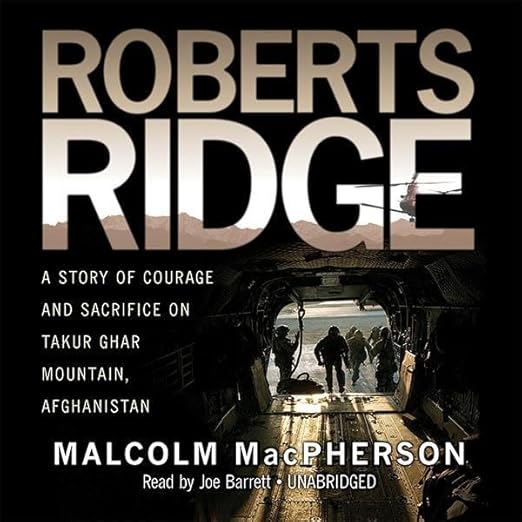
Quick Take
- Narration: Joe Barrett brings the account to life with the steady authority that military history requires, keeping the enormous cast of real individuals distinct without imposing dramatic interpretation on documented events.
- Themes: Brotherhood under fire, command failure at distance, the cost of valor
- Mood: Tense and grief-soaked, the audio equivalent of bearing witness to events that should not be forgotten
- Verdict: Roberts Ridge is among the finest accounts of small-unit action in early-war Afghanistan, and Joe Barrett’s narration matches the material’s demand for precision and respect.
I finished Roberts Ridge on a quiet evening and then sat with it for a while before reaching for anything else. It is that kind of book. Malcolm MacPherson spent years researching the seventeen-hour battle on Takur Ghar in March 2002, and the result is a piece of military history that functions simultaneously as a tribute to the men who fought there and as a clear-eyed analysis of how command and coordination failures at the strategic level compounded the tactical situation that those men faced.
The facts of the case are documented: SEAL Neil Roberts was thrown from a helicopter that had been hit by enemy fire, and his teammates, then soldiers from other special operations units, spent the next seventeen hours trying to reach and recover him on a 10,240-foot mountain peak in eastern Afghanistan while fighting vastly outnumbered. The outcome is not a secret. What MacPherson adds is the texture of testimony, the hour-by-hour reconstruction from eyewitness accounts, and the moral and structural analysis of what went wrong at the levels above the men doing the fighting.
The Research That Makes This Account Different
One reviewer who compared Roberts Ridge to Sean Naylor’s Not a Good Day to Die, the other major account of Operation Anaconda, noted that MacPherson writes without the service-branch bias that Naylor, as a longtime Army Times reporter, brought to his coverage. There is not one slander or slight to any member of any service, this reviewer wrote, and it is straight forward writing without agenda. In a space where accounts of the same events often vary dramatically depending on which unit the author embedded with or which veterans cooperated, that impartiality is a significant achievement.
The eyewitness testimony structure, which MacPherson built through what he describes in the book as painstaking research, gives the reconstruction a granular quality that purely document-based histories cannot match. You understand not just what happened at each stage of the battle but how it felt to the individuals making decisions under fire, often with incomplete information and communications failures that were not of their making. The portraits of individual soldiers and their relationships with each other are drawn with enough specificity to make the human cost of the battle felt at a personal level rather than as a statistic.
The Command Problem That the Book Does Not Flinch From
One reviewer made a pointed observation that deserves direct acknowledgment: the book does a thorough job of chronicling the individual valor on the ground while being less thorough in examining the decision-making that put those men in that position in the first place. The original insertion decision, and the decisions made from afar during the fight by commanders who were not in the kill zone, receive less analytical scrutiny than the ground-level action. This is a fair criticism. MacPherson’s strengths are in the tactical reconstruction and the character portraits. The structural critique of how command authority was distributed, or failed to be distributed, is present but not as fully developed as it might be.
The review that makes this criticism is also the one most likely to resonate with readers who bring serious knowledge of military operations to the text. For general readers, the account of command failure is present and legible. One reviewer draws a through-line to Vietnam, noting that fighting the political side of war began there and is very prevalent in these events, and that the people wearing boots on the ground are the recipients of indecision made far above their heads. That observation colors the emotional weight of the entire book.
Joe Barrett and the Task of Narrating Real People’s Last Hours
Joe Barrett is one of the most reliable narrators in military nonfiction audio, and he brings his characteristic steadiness to Roberts Ridge. The challenge specific to this material is that many of the people Barrett voices died on Takur Ghar, and the narration must carry both the reconstruction of events as they unfolded and the knowledge that the listener already possesses of how those events concluded. Barrett handles this with appropriate gravity. He is not performing. He is documenting, which is the right register for a book where the author’s primary obligation is to the people whose story he is telling.
Reviewers who describe feeling as though they were in the middle of the action, and who describe grieving the men who were killed, are responding to the combined effect of MacPherson’s testimony-based reconstruction and Barrett’s controlled, precise delivery. At eight hours and twenty-six minutes, the runtime is taut, moving through the seventeen-hour battle at a pace that builds tension appropriately without the sense of anything being padded or unnecessarily dramatized. The real events do not require embellishment.
Where Roberts Ridge Sits Among Afghanistan War Accounts
Roberts Ridge was published in 2005 and covers events from March 2002, making it one of the earlier in-depth accounts of the initial Afghanistan operations. In the two decades since, the literature of that war has expanded considerably, and readers who have come to it through later works may find some contextual gaps around the broader strategic picture of what was happening in the country at that moment. The operational context for Operation Anaconda and why Takur Ghar mattered strategically is present but not as fully developed as it would be in a work written with the benefit of longer perspective. What the book sacrifices in strategic breadth it more than recovers in human depth, and the human depth is why the reviews, more than twenty years after publication, still describe it as essential reading for anyone who wants to understand what those men did and why it mattered.
Frequently Asked Questions
How does Roberts Ridge compare to Sean Naylor’s Not a Good Day to Die for someone who has read that account?
A reviewer who had read both describes MacPherson’s writing as more impartial across service branches, while Naylor’s Army Times background produces some perceivable bias toward Army perspectives. Both cover Operation Anaconda but from different vantage points and with different emphasis.
Is the book primarily about the SEAL community, or does it cover all the special operations units involved?
Roberts Ridge covers all the units involved in the Takur Ghar battle, including Army Rangers and other special operations elements that were drawn into the fight as events developed. MacPherson was reportedly deliberate about representing all services without favoritism.
Does the book address the command and coordination failures that contributed to the situation, or does it focus only on the ground action?
The command and coordination failures are present and are part of the analysis. At least one reviewer notes that the book could have examined the original insertion decision and distant command decisions more thoroughly, but the failures at the strategic level are not ignored.
Is Roberts Ridge appropriate for readers who do not have military background or prior knowledge of Operation Anaconda?
Yes. MacPherson writes for a general audience, and the tactical and strategic context is established as needed. Prior knowledge of Operation Anaconda enriches the read but is not required to follow the account of the battle.