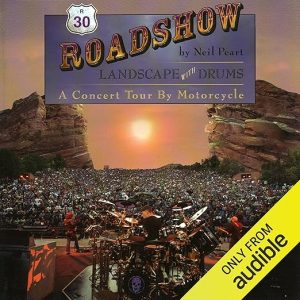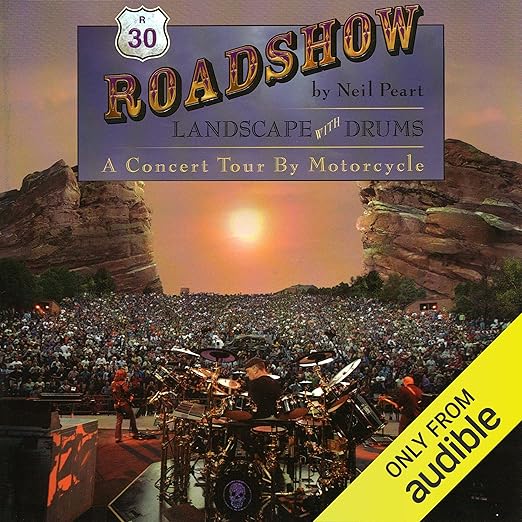
Twenty-one thousand miles by motorcycle, squeezed between fifty-seven Rush concerts spread across four continents: what does a touring rock drummer actually want from his days off? Neil Peart's answer, laid out across this audiobook, is back roads. Not room service, not the tour bus lounge, but Appalachian hamlets, Western deserts, Scottish castles, and Alpine passes, ridden mostly alone or with a small circle of riding companions between soundchecks. Roadshow picks up in the summer of 2004, when Rush marked three decades and twenty gold albums with the R30 30th Anniversary World Tour, and Peart decided the only sane way to survive it was to never actually be on the bus.
That opening frame matters because Roadshow is only Peart's second full-length prose book, and its existence at all says something about how seriously he took writing as a second craft. Between his drumming, he'd already built a reputation as a genuinely careful essayist and long-form writer, someone who treated the page with the same discipline he brought to a drum kit, and this audiobook is the fullest demonstration of that discipline outside the music itself.
The book's real accomplishment is refusing to pick a lane between two genres that rarely cohabit well. Peart calls it part behind-the-scenes memoir, part existential travelogue, and that dual structure holds for the whole runtime. One thread follows the mechanics of a major international tour: load-in, soundcheck, the nine countries and fifty-seven shows the R30 tour actually played, the exhaustion of performing at that scale three decades into a career. The other thread follows Peart alone on two wheels, extending the trip well past the tour's own footprint into nineteen countries across both sides of the Atlantic, chasing what he calls the perfect show, the perfect meal, the perfect road.
What keeps the travelogue half from feeling like padding is how specific it gets. Peart doesn't summarize a country in a paragraph and move on; he lingers on a single mountain pass, a diner conversation, a moment of irritation at a badly timed rainstorm, and lets the specificity do the emotional work. The tone swings, by his own description, from achingly personal to wickedly irreverent, sometimes within the same chapter, and that range is what separates this from a standard tour diary.
It also helps that Peart had already proven he could write this kind of book. Reviewer Justin Opinion, who read Ghost Rider first, calls Roadshow the stronger of the two specifically because Ghost Rider's subject, Peart's grief after losing his daughter and wife within a year of each other, was almost too heavy to enjoy in the ordinary sense. Roadshow carries real reflection but none of that weight, and it reads as the more purely pleasurable listen because of it.
It's worth situating this within Peart's small but serious prose catalog. He'd go on to write further travel-focused books before his death in 2020, and Roadshow sits at a specific hinge point in that body of work: closer to his grief memoir Ghost Rider in form, but much closer to contentment in spirit, a writer testing whether the same honest, unhurried voice could carry a happier story just as well as a devastating one.
Highlights
The obvious audience is Rush fans, and this audiobook rewards them specifically: the people Peart works with, the crew relationships built over decades, the backstage rhythms of a band thirty years into its own mythology. But the travel writing stands on its own for listeners who couldn't name a Rush album. Peart's prose has the patient eye of someone who has spent a career noticing small mechanical details, and he applies that same attention to a Highland switchback or a diner's pie selection.
A real structural pleasure comes from watching two very different scales of experience run in parallel: half a million people across fifty-seven arena crowds on one hand, a solitary rider and an empty road on the other. The book never resolves that tension by favoring one over the other, which is part of what makes the ending, Peart's arrival at something like contentment, feel earned rather than declared.
Reviewer Guy M. Martin frames Peart as an unusual kind of rock star, someone who loved making music more than being adored for it, and this audiobook is the clearest evidence of that claim. The motorcycle isn't a gimmick bolted onto a standard tour memoir; it's the actual mechanism by which Peart kept his relationship with the music honest, chapter after chapter.
What to Watch For in Roadshow
This is not a quick listen. At just under sixteen hours, it demands the patience of someone who wants both the tour and the travelogue in full, not a highlight reel. Listeners hoping for a tight, plot-driven music memoir should recalibrate: chapters can spend as much time on a stretch of Montana highway as on a specific concert.
The prior-knowledge question matters too. Roadshow assumes at least passing familiarity with who Rush is and what three decades of touring together means to three musicians; it doesn't pause to introduce the band from scratch. Newcomers to Peart's writing might do better starting with Ghost Rider, which several reviewers reference as the emotional predecessor this book quietly answers.
Narrator Brian Sutherland has no extensive audiobook track record attached to this listing, leaving no prior performance to point back to here. What the format demands of him is real: sustaining Peart's tonal whiplash, from wry backstage observation to solitary-highway reflection, across nearly sixteen hours without letting either register go flat. Judge his fit against that specific demand rather than assuming a travel-memoir cadence will automatically suit a book this structurally divided.
Listeners new to music-tour memoirs generally should also know this genre tends to reward patience over plot; Roadshow isn't building toward a twist or a reveal, it's accumulating texture across dozens of small, specific moments. If your listening habits favor a tight narrative arc with rising and falling action, budget extra patience for a book that's more interested in accretion than momentum.
Is This One for You?
Rush devotees who already own Ghost Rider and want the fuller picture of Peart as both musician and prose writer are the clearest audience here, and this audiobook gives them both halves of that picture at real length. Listeners who love motorcycle travel writing on its own terms, in the tradition of a long solo road narrative, will find plenty even without caring much about the band.
Skip it if you want a tight, hits-driven rock memoir; Roadshow is deliberately unhurried and covers a huge amount of geography and reflection rather than gossip or milestone moments. Listeners looking for dishy behind-the-scenes drama about Rush specifically should look elsewhere, since Peart's interest here runs toward landscape and interior life rather than industry anecdotes.
The Short Version
- Narrator: Brian Sutherland carries nearly sixteen hours of tonal shifts between tour-diary detail and solitary road reflection, with no prior track record to weigh him against.
- Subjects: touring life and its exhaustion, solo motorcycle travel as a coping mechanism, the search for a perfect ordinary day inside an extraordinary career.
- Tone: reflective, open-road, wry in places and quietly melancholic in others.
- Bottom line: a rewarding, patient listen for Rush fans and road-trip memoir readers alike, provided you're not looking for something fast.
Frequently Asked Questions
Do I need to listen to Ghost Rider before starting this audiobook?
No, but it deepens the experience. Roadshow stands alone, and several reviewers specifically note it works even better once you know the grief Peart was carrying into Ghost Rider, since this book reads as its lighter, more purely enjoyable counterpart.
Is this audiobook more about Rush's music or about the motorcycle travel?
Both, in roughly equal measure. Peart deliberately structures the book as behind-the-scenes tour memoir and travelogue running side by side, and neither thread dominates the other across the full runtime.
How does Brian Sutherland's narration handle Peart's shifts between tour logistics and personal reflection?
The listing gives no prior performance history for Sutherland to reference, so this audiobook is effectively a first data point. The material demands real tonal range, from wry backstage detail to solitary highway introspection, without either side going flat.
Does the audiobook cover the entire R30 World Tour or just selected legs?
It covers the tour broadly, all fifty-seven shows across nine countries, but Peart's own motorcycle routes extend further, into nineteen countries on both sides of the Atlantic, since his riding continued well beyond the tour's official stops.