The Short Version
- Narration: William Least Heat-Moon narrating his own work is not just a formal choice but the only coherent option: his voice carries the same digressive, curious, precisely attentive quality as his prose.
- Themes: small-town America as repository of character and story, the value of the overlooked place and the minor road, language as an act of sustained attention
- Mood: Unhurried and reflective, with warm humor and genuine curiosity maintained across a twenty-one-hour runtime
- Verdict: Roads to Quoz is Heat-Moon's long-awaited return to Blue Highways territory, more leisurely and more detailed, a deeply satisfying audiobook for patient listeners who value the specific over the general.
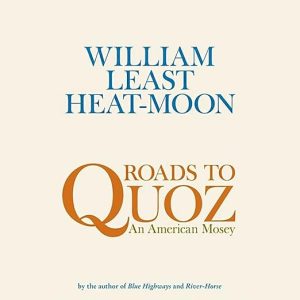
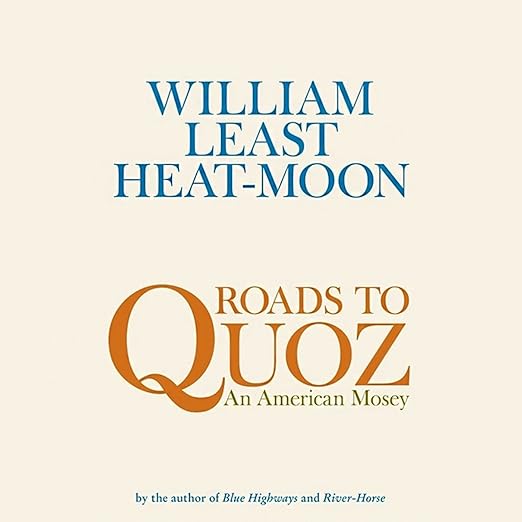
Roads to Quoz works as an audiobook in a way that feels inevitable once you hear it. William Least Heat-Moon narrating his own account of American backroad travel is not just a practical arrangement; it is the only version of this book that fully makes sense. His prose, lyrical and digressive and powered by an attention to the particular that borders on compulsive, was always written in a voice that belongs to one specific person, and that person is Least Heat-Moon himself. The more than twenty-one hours of this audiobook pass in the manner of a very long drive with a gifted companion, the kind of drive where you find yourself circling past your exit to hear the end of a story about a courthouse clock or a feed store owner's theory of local history.
Blue Highways, Least Heat-Moon's 1982 debut, became a landmark of American travel writing by treating the country's back roads and small places as repositories of character and story that the interstate system was designed to bypass entirely. Roads to Quoz returns to that methodology after nearly twenty-five years, and the comparison with the earlier book is both inevitable and instructive. One reviewer who has read all of Least Heat-Moon's books notes that this one addresses its subjects in greater detail than Blue Highways, which is accurate. The book is slower, more willing to stay in a single place until it has given up what it has to offer rather than compressing it to the telling anecdote and moving on. Whether that expanded patience feels like enrichment or self-indulgence depends on the listener, but for those who have missed this writer's specific sensibility over the decades between books, the added depth functions as a gift.
The title refers to Heat-Moon's personal term for the quality of strangeness and unexpected richness that distinguishes a place or encounter worth sustained attention. Quoz, as he uses it, is a quality that resists precise definition, and the text is organized as a sustained search for it through small-town America rather than as an argument arriving at a thesis. That structure is characteristic of Heat-Moon's best work: the accumulation of careful particulars toward an understanding that is felt rather than stated. One reviewer describes the writing as having a way with the language that understates the case; Heat-Moon is a genuinely accomplished stylist, and Roads to Quoz gives that style the room to demonstrate what it can do across an extended work. Another calls it the most wonderful book they have read in a long time, which reflects the specific pleasure this book provides for readers already attuned to its register.
Why Listen to Roads to Quoz
Least Heat-Moon's self-narration is one of those cases where the author's speaking voice matches their prose voice precisely, closely enough to suggest they were never really separate. He reads with the patient, slightly amused attention that characterizes his best descriptive writing, and the rhythms of his sentences, which are often long and elaborately structured, are navigated without strain. The audiobook format suits this particular kind of American travel writing especially well because the genre's pleasures are pleasures of accumulated observation rather than narrative surprise. Roads to Quoz does not build toward revelation; it accumulates toward a kind of understanding that is specific to the experience of having attended to a great many places that most people pass through without noticing. That accumulation works in audio because Heat-Moon's voice carries the continuity across the twenty-one-hour runtime. Returning to this audiobook after a pause feels less like interrupting a narrative and more like returning to a conversation that was willing to wait.
What to Watch For in Roads to Quoz
Listeners who prefer their travel writing to build toward a thesis or argument may find Heat-Moon's commitment to the particular, the singular detail over the generalizable insight, occasionally frustrating across a twenty-one-hour runtime. He is not persuading you of anything in the conventional sense. He is showing you places and people with the implicit argument that looking closely at specific things is its own form of knowledge, and that argument is made by accumulation rather than assertion. The book's length gives that style the room it needs to demonstrate what it can do. Listeners who find the early sections too leisurely should give it a substantial portion before making a final decision; the book earns its pace rather than apologizing for it, and the initial deliberateness establishes the quality of attention that makes the later sections so satisfying.
Who Should Listen to Roads to Quoz
Readers of Blue Highways who have been waiting for Least Heat-Moon's return to American backroad travel have their book. Fans of American literary travel writing in the tradition of John McPhee, Edward Hoagland, or Annie Dillard will recognize the sensibility and find the twenty-one hours well-proportioned to the material. Long-distance drivers who do their best listening on extended trips will find this audiobook works as a direct companion to the experience it describes: the small roads, the overlooked towns, the unhurried pace of sustained attention. Listeners who need strong narrative momentum or dramatic stakes in their nonfiction should look elsewhere without guilt. Those who find the contemporary American landscape, particularly its smaller and less-visited corners, a subject worthy of literary attention will find in Roads to Quoz precisely the kind of sustained, intelligent, affectionate treatment that it so rarely receives anywhere else.
Heat-Moon's treatment of the relationship between language and place is one of the book's most consistently interesting threads. He is a writer who believes that the right words for a specific place are not interchangeable with the right words for any other place, and the care he brings to describing what is particular about each location reflects that belief. In an era of travel writing that often reduces places to generic categories, his commitment to the specific feels increasingly rare and valuable. The audiobook format serves that commitment well because hearing the precise language applied to particular landscapes reinforces the attention he is asking the listener to share.
Heat-Moon's treatment of the relationship between language and place is one of the book's most consistently interesting threads. He is a writer who believes that the right words for a specific place are not interchangeable with the right words for any other place, and the care he brings to describing what is particular about each location reflects that belief. In an era of travel writing that often reduces places to generic categories, his commitment to the specific feels increasingly rare and valuable. The audiobook format serves that commitment well because hearing the precise language applied to particular landscapes reinforces the attention he is asking the listener to share.
A Few Questions About Roads to Quoz
Do you need to have read Blue Highways before listening to the Roads to Quoz audiobook?
No. Roads to Quoz stands fully independently as a travel memoir, and Heat-Moon provides enough context about his earlier work that new readers are not at a disadvantage. Blue Highways readers will find additional resonance in this return to familiar methodology, but prior reading is not required.
Is the Roads to Quoz audiobook really worth 21 hours, and how should a listener approach that commitment?
Whether it earns the length depends on your tolerance for deliberate accumulation over narrative drive. The book is well-suited to interrupted listening, as each section has its own integrity. Heat-Moon readers who found Blue Highways worth its pace will find this runtime proportionate and well-used.
Does Heat-Moon's self-narration hold up for a runtime this long, or does it become monotonous?
It holds up consistently. His reading has the quality of someone who has lived with these observations for years, and the slightly conversational informality of his delivery suits a 21-hour commitment better than a more formal professional narration would. He sounds genuinely interested in what he is telling you, which is the fundamental requirement for audio of this length.
Is Roads to Quoz a single continuous journey or a series of separate trips, and does that affect how to approach the audiobook?
The book is structured as a series of American journeys rather than a single linear route, which makes it well-suited to interrupted listening. Each section has its own integrity, so pausing between entries does not disrupt a developing narrative arc in the way that stopping mid-novel would.