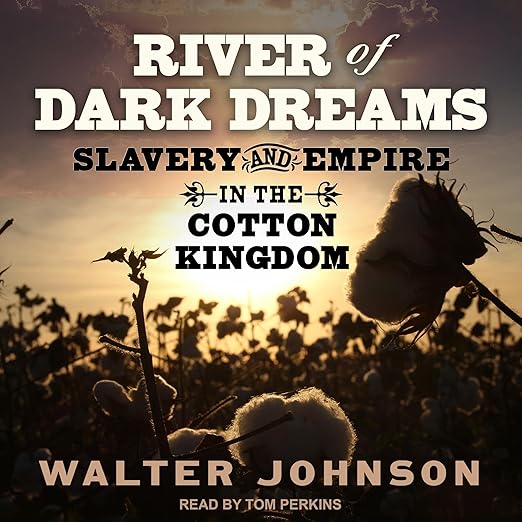
Quick Take
- Narration: Tom Perkins delivers Walter Johnson’s dense scholarly prose with the gravity and patience the material demands, this is not background listening, and Perkins does not let you treat it that way.
- Themes: Slavery and capitalism as inseparable systems, the Cotton Kingdom’s global reach, resistance and daily life under coercion
- Mood: Rigorous, morally serious, and occasionally harrowing, the historical equivalent of a long investigative read
- Verdict: One of the most important works of American slavery scholarship available in audio, best approached as a sustained intellectual commitment rather than casual listening.
I came to River of Dark Dreams after a long stretch of reading about the antebellum South in fragments, articles, adjacent histories, memoir, and I wanted something that would synthesize and challenge. Walter Johnson’s book does both, and it does them with a prose style that has no business being as readable as it is for an academic work of this density.
Johnson is a historian at Harvard, and River of Dark Dreams is the kind of book that reshapes a field. Its central argument, that the Cotton Kingdom of the Mississippi Valley was not a regional anomaly but the engine of American capitalism, fully integrated into Atlantic commodity markets and dependent on the ongoing theft of human labor, is not new in outline, but Johnson assembles the evidence with a specificity that makes the argument feel newly urgent regardless of what you have read before.
Our Take on River of Dark Dreams
The book’s structure moves from the macro to the deeply personal and back again, which is its rhetorical strength. Johnson traces Jefferson’s vision of an empire for liberty, populated by self-sufficient white farmers, through its violent transformation into a booming slave economy commanded by planters, powered by steam, and hungry for land. Andrew Jackson’s removal of Native peoples from the Mississippi Valley is not incidental backstory here; it is part of the same expansionist logic that made the Cotton Kingdom possible.
What distinguishes this from standard economic history is Johnson’s insistence on remaining close to the enslaved people at the center of the story. Using slave narratives, legal records, personal correspondence, and popular literature, he reconstructs daily life under cotton’s dominion with a granularity that does not let the reader retreat into abstraction. Reviewers have described the prose as keeping them on edge and filling them with a roller-coaster ride of emotions, which captures something real about how Johnson writes. This is scholarly argument delivered with genuine narrative craft.
Why Listen to River of Dark Dreams
Tom Perkins’s narration is well suited to material that demands attention. His delivery is measured and authoritative without being academic in the pejorative sense, he does not flatten Johnson’s prose into monotone. At nearly nineteen and a half hours, this is a substantial undertaking, and Perkins’s pacing helps listeners navigate the denser argumentative sections without losing the thread.
The audiobook format is also, unexpectedly, a good vehicle for this kind of history. The slave narratives Johnson quotes land differently in audio, they have a physical presence that on the page can sometimes feel mediated by the scholarly apparatus surrounding them. Heard aloud, they are more immediate.
What to Watch For in River of Dark Dreams
This is genuinely demanding scholarship. One reviewer described it as informative but not exhaustive and noted that the book concentrates heavily on the white planter elite and enslaved people on cotton plantations while giving less sustained attention to other demographics in the region. That is a fair description of the book’s focus, not a fault, Johnson is making a specific argument, not writing a comprehensive social history of the antebellum South.
The density of the argument, particularly in the chapters on ideology and Atlantic markets, will challenge listeners who prefer narrative history in the vein of David McCullough. This is closer to scholarship that reads well than to popular history, the distinction matters at nearly twenty hours of audio.
Who Should Listen to River of Dark Dreams
Readers who have found Edward Baptist’s The Half Has Never Been Told or Baptist’s contemporaries in the new history of capitalism and slavery compelling will find Johnson’s work essential. It pairs naturally with Saidiya Hartman’s Scenes of Subjection for listeners who want to go deeper into the lived experience of enslavement, or with Edmund Morgan’s American Slavery, American Freedom for the longer arc. Those looking for accessible popular history should start elsewhere and return to Johnson later, but returning to him is worth building toward.
Frequently Asked Questions
Is River of Dark Dreams accessible to general listeners, or is it primarily aimed at academic audiences?
It sits between the two. Johnson writes with genuine narrative craft, but his argument is dense and assumes some familiarity with American antebellum history. Engaged general readers who have read widely on slavery will find it accessible; complete beginners may struggle with the density.
How does Tom Perkins handle the slave narratives Johnson quotes throughout the book?
Perkins gives them appropriate weight without performance, he reads them as testimony rather than literary quotation, which suits the gravity of the material. The audio format makes these passages feel more immediate than they sometimes do on the page.
At nearly 20 hours, does River of Dark Dreams sustain its argument across the full runtime?
Largely yes, though the ideological chapters in the middle are the most demanding. Johnson structures the book to move between macro-historical argument and specific human stories, which varies the texture enough to prevent fatigue.
How does this compare to Edward Baptist’s The Half Has Never Been Told as a study of slavery and capitalism?
Both books argue for the centrality of slavery to American capitalism. Baptist focuses more tightly on the mechanics of cotton production and the violence of the slave economy; Johnson ranges more widely into Atlantic markets, imperial ambition, and planter ideology. They complement each other well.