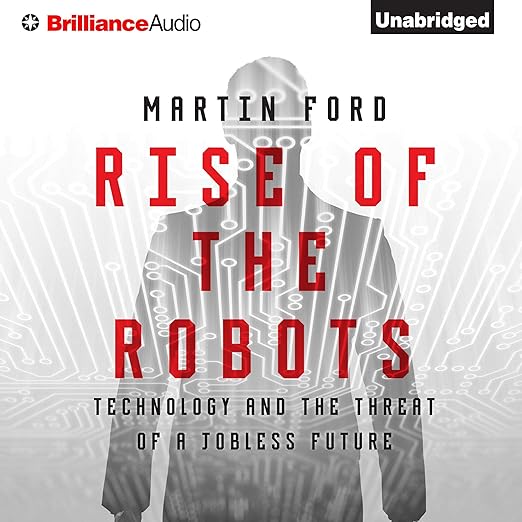
I listened to Rise of the Robots across two train journeys between cities, bookending a conference where several speakers were busy arguing that artificial intelligence was going to liberate workers rather than displace them. The cognitive dissonance was significant. Martin Ford's 2015 book reads, in 2026, like a document from a moment just before the argument became impossible to dismiss, and Jeff Cummings' measured narration gives it a clinical authority that suits the subject.
Ford is not an economist by training, and that turns out to be an advantage. He approaches the question of automation and employment with the rigor of a technologist who has read widely in economic literature, and the combination produces something more readable than most policy analysis while remaining genuinely substantive. The book appeared alongside Erik Brynjolfsson and Andrew McAfee's The Second Machine Age in the same year, and the contrast between those two frameworks reveals a great deal about how the profession was split on what was coming.
The Review
The central argument is precise: this technological disruption is structurally different from previous industrial revolutions. The optimistic case, that new jobs will emerge to replace those automated away as happened after mechanization in agriculture and manufacturing, assumes that human cognitive labor occupies a protected category that machines cannot enter. Ford argues, with considerable evidence from 2015 that has only accumulated since, that this assumption is wrong. A computer winning Jeopardy, he notes, uses the same underlying technology that is making paralegals redundant.
Cummings narrates with appropriate seriousness, calibrating his pace to the density of the analysis without losing accessibility. One reviewer who had taught AI at a major university for three decades found the book compelling enough to abandon his own buggy whip argument after reading it, which is a meaningful endorsement from someone with standing to evaluate the technical claims independently.
Because the question Ford poses, whether accelerating technology can disrupt the entire economic system to the point where fundamental restructuring is required, is no longer speculative. The book predates the large language model boom by nearly a decade, and the jobs Ford worried about in 2015, paralegals, radiologists, software engineers, teachers, are now demonstrably in the early stages of the disruption he described. Listening to this recording now has the strange quality of hearing someone accurately describe a storm that has since arrived.
The international reception of the book, reviewed substantively in the US, UK, Japan, and Germany among others, reflects the global scope of the argument. Automation does not respect national borders, and Ford's framing of the problem as a structural economic challenge rather than a partisan political one gives the book longevity that more topical treatments often lack.
Before You Commit to Rise of the Robots
Ford's policy prescriptions in the final section are less developed than his diagnosis in the first two-thirds. He gestures toward guaranteed income and fundamental restructuring without mapping those solutions in the same detail he brings to the problem. Reviewers who found the book strongest were most engaged by the empirical analysis and less convinced by the prescriptive conclusions, which remain at the level of principle rather than mechanism.
The book also dates in specific places. The examples Ford uses from 2015 about what technology can and cannot do have in several cases been overtaken by events in ways that reinforce rather than undermine his argument, but the specific technological touchstones occasionally feel like artifacts of a moment that has now moved on considerably.
Who It's For
Anyone in the workforce who thinks carefully about where their field is heading in the next decade, managers and policymakers who need to understand automation's economic implications, and readers of books like The Second Machine Age or Average Is Over who want a technology-focused perspective to complement the economic framing. Less useful for listeners seeking concrete career guidance or near-term practical advice about what to do rather than what to understand.
Questions Listeners Ask
Has Rise of the Robots aged well given it was published in 2015?
Substantially yes. The specific technological examples sometimes feel dated, but the structural argument about cognitive labor being as vulnerable as physical labor has been reinforced rather than undermined by developments in AI since 2015. Listening now has the quality of hearing an accurate prediction about a storm that has since arrived.
How does Martin Ford's argument differ from more optimistic treatments of automation like The Second Machine Age?
Ford is considerably more pessimistic about the likelihood that new job categories will emerge to replace those automated away. Where Brynjolfsson and McAfee emphasize human-machine complementarity, Ford argues that the complementarity thesis requires a protected category of human cognitive work that he does not believe will hold as machine capabilities expand.
Does Jeff Cummings' narration make dense economic arguments accessible in audio format?
Yes. Cummings paces the material for comprehension rather than drama, which is the right approach for a book that requires listeners to follow a sustained argument across 10 hours. Reviewers from AI academic backgrounds and general business audiences both found the narration accessible.
Does Rise of the Robots offer actionable career guidance for listeners worried about automation?
Not directly. The book is a structural economic argument rather than a career planning guide. Readers looking for specific advice about how to position themselves in an automated economy will find the diagnosis detailed and the prescriptions broad. Ford gestures toward guaranteed income and economic restructuring but does not map those solutions in operational detail.