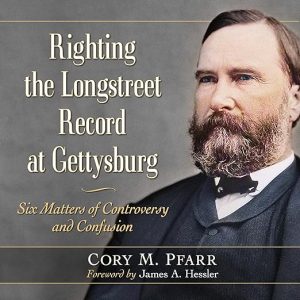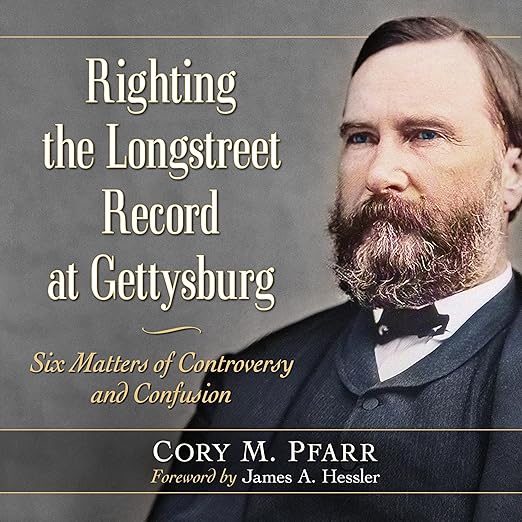
Cory Pfarr's follow-up to his award-winning Longstreet at Gettysburg arrives as a collection of focused essays rather than a single continuous argument, and that structure turns out to suit the audiobook format naturally. Mike Hennessy's narration carries the academic prose without making it feel ponderous, and the essay-by-essay construction means each section has its own shape and conclusion, which works well in audio sessions where a listener may return to specific questions on specific days. Righting the Longstreet Record at Gettysburg is a book for Civil War listeners who already know the battle's outlines and want to understand specifically how its historiography went wrong.
The case being made here is not simple. Pfarr is arguing, with considerable primary source evidence, that James Longstreet's performance at Gettysburg on July 2, 1863, has been systematically misrepresented by contemporaries and historians alike, and that the misrepresentation was not accidental. The Lost Cause mythology required a scapegoat for the Confederacy's defeat, and Longstreet, who had publicly criticized Lee's strategy after the war and endorsed Reconstruction, was available and convenient.
Reviewer John Danek described this as 'a systematic demolition of the negative criticism of the general's performance,' and that captures the method accurately. Pfarr works through influential interpretations one by one, evaluates their evidentiary basis against primary sources, and demonstrates where the accounts are inaccurate, incomplete, or motivated by something other than historical honesty. The essay on Helen Longstreet's early twentieth-century attempt to rehabilitate her late husband's reputation is particularly valuable: she had access to materials and perspectives that later historians ignored, and Pfarr's examination of why her work was sidelined is itself a small history of how bias operates in historical memory.
Reviewer K.J. Kalin recommended Pfarr as essential reading 'not only for Civil War history buffs, but for several contemporary published historians,' which reflects how seriously the research is being taken within the field. This is not popular revisionism reaching for controversy; it is academic argument built on archival work, and it engages with the existing literature at the level of evidence rather than assertion. The distinction matters for listeners deciding how much weight to give the conclusions.
Hennessy Reads the Analytical Prose Cleanly
Mike Hennessy's narration is well suited to this material. He reads the analytical prose cleanly and maintains a consistent pace that keeps the arguments accessible without flattening the nuance. Civil War history at this level of detail can become dense, and a narrator who is comfortable with military terminology and place names is more valuable here than one with a more theatrical range. Hennessy carries a knowledgeable register throughout, and the audiobook benefits consistently from that quality.
The essay format also means that listeners with specific questions about the Longstreet controversy can target relevant sections rather than working through a single unbroken argument. The book examines the roots of the Longstreet-Gettysburg controversy as a historical phenomenon, the specific tactical questions about the July 2 attack, and the reception of Helen Longstreet's rehabilitation effort as distinct threads. That structure gives the audiobook utility as a reference as well as a narrative, which is unusual for a nine-and-a-half-hour scholarly work.
Sidelined for Being Inconvenient, Pfarr Argues
This audiobook assumes prior knowledge, and that assumption is not negotiable. Listeners who do not know the basic facts of the Battle of Gettysburg, the Lost Cause narrative, or the major figures of the Confederacy will find the arguments hard to follow. Pfarr is not pausing to explain who Longstreet was or why the July 2 attack matters; he is arguing about specific claims made by specific sources, and the argument's force depends on the listener understanding what is at stake. A general reader new to this subject should read an introductory Gettysburg history first.
The collection's focus is also deliberately narrow. This is not a full account of the battle, and it is not a biography of Longstreet. It is a targeted scholarly intervention into a specific historiographical dispute. Listeners who come hoping for a broader narrative of Gettysburg will find the scope frustratingly specific. Those who come with the right questions will find it exactly as useful as its reputation promises.
Pfarr's engagement with Helen Longstreet's early twentieth-century rehabilitation effort also reveals something important about how historical memory works institutionally. Helen Longstreet wrote in a period when the Lost Cause narrative was already deeply embedded in Southern culture and in mainstream American historiography about the Civil War. Her work was sidelined not because it was wrong, Pfarr argues, but because it was inconvenient for a narrative that served specific cultural and political purposes. That argument, which Pfarr makes through evidence rather than assertion, is one of the more intellectually interesting threads in the collection and gives the audiobook value beyond its specific contribution to Longstreet studies.
Accessible Without Dumbing Down the Academic Content
Civil War enthusiasts with a particular interest in Gettysburg and its contested legacy will find this audiobook rewarding. Listeners who have read Pfarr's first Longstreet volume will appreciate how this collection extends and deepens the original argument. Those with a broader interest in how historical bias operates, and how Lost Cause mythology shaped American memory of the Civil War, will also find the material valuable. Mike Hennessy's narration makes the academic content accessible without dumbing it down, and the nine-and-a-half-hour runtime is well spent for the listener who comes prepared for it.
The Short Version
- Performance: Mike Hennessy reads the analytical prose cleanly with appropriate scholarly register; his comfort with Civil War terminology keeps the arguments clear and accessible.
- What it covers: Lost Cause mythology, historical revisionism, primary source evidence vs. received history
- Feel: Methodical and precise, a scholarly argument in essay form
- Our call: Essential listening for serious Civil War students interested in how Longstreet's reputation was constructed and distorted; assumes substantial prior knowledge of the battle.
Common Questions
Do you need to have listened to Pfarr's first Longstreet audiobook before this one?
Reading or listening to Longstreet at Gettysburg first is strongly recommended. Righting the Longstreet Record builds directly on that earlier argument and engages with its reception; some of the essay topics will be harder to follow without that foundation.
What is this audiobook's main argument about Longstreet's performance at Gettysburg?
Pfarr argues that the negative historiographical record of Longstreet's July 2, 1863, attack is built on inaccurate and often motivated accounts. The Lost Cause movement needed a scapegoat, and Longstreet's postwar politics made him a convenient target. Primary source evidence contradicts the standard negative assessment.
Is this audiobook accessible to general history listeners, or is it for specialists?
It is aimed at engaged Civil War readers rather than general history listeners. The arguments assume familiarity with the battle, the major Confederate figures, and the Lost Cause as a historical phenomenon. Newcomers to the subject will find the specific debates hard to follow.
How does Mike Hennessy handle the essay structure of this audiobook?
Hennessy maintains a consistent, knowledgeable pace across the collection. The essay format means each section has a natural pause point, which works well in audio and allows listeners to break the nine-plus hours into focused sessions around specific topics.