The Short Version
- Narration: Craig Ferguson self-narrates with full command of comic timing, his Scottish brogue intact and his rhythms unmistakably his own, the performance is inseparable from the material.
- Themes: Celebrity sobriety, Scottish-American identity, fatherhood and mortality
- Mood: Irreverent and unexpectedly tender
- Verdict: Ferguson fans will find this exactly what they hoped for; newcomers get a stranger, more searching book than the comedian's public persona suggests.
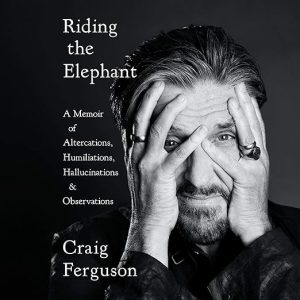
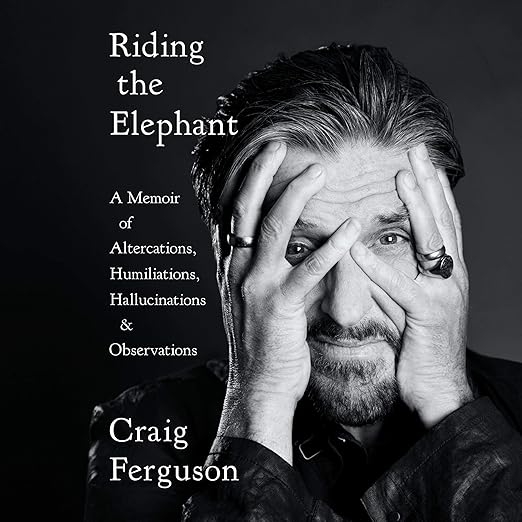
Craig Ferguson self-narrates this audiobook, and that choice is the first and most important thing to say about it. Riding the Elephant is a memoir in essays, and because the voice delivering every word is the same voice that lived every story, the experience carries an intimacy that celebrity memoirs rarely achieve. Ferguson is known to most American listeners as the Scotsman who hosted The Late Late Show for a decade, who pioneered the world's first TV robot skeleton sidekick, and who revived two men in a horse suit as a recurring late-night entertainment form. What this memoir reveals is that the lightness was earned through significant darkness, and that the man behind the robot skeleton has been thinking seriously about mortality, identity, and failure for most of his adult life.
Our Take on Riding the Elephant
The memoir-in-essays format is a structurally honest choice for Ferguson, and it suits him better than a conventional linear narrative would. He moves between eras and emotional registers with the same controlled looseness he brought to television: the comedy is present but never used as a hiding place. He writes about addiction with clarity and without the sentimentality that characterizes so much recovery memoir. He had very public periods of substance use and personal chaos before his sobriety, and the passages where he revisits those years carry a weight in his own voice that no third-party narrator could approximate. When he writes about his native Scotland, the affection reads almost like grief, a love for a place that formed him and that he left and that he can never quite leave behind. And when he turns to aging and fatherhood, the seriousness is not performed or borrowed from a different kind of book. It is a man who has had time to think and has actually used it. One reviewer called this a humorous and well-thought-out account of how his homeland influenced him and how he made a name for himself in stand-up comedy even while struggling with some demons. That is accurate, and it is also an understatement of the book's actual ambition. A different reviewer, someone who had not previously followed Ferguson's career, found the anecdotes engaging and the perspective distinctive. That is the right test for a celebrity memoir: whether it holds up for people who are not coming in as fans. This one mostly does.
Why Listen to Riding the Elephant
The eight-hour runtime is exactly right for a collection of essays structured the way this one is. Each piece functions somewhat independently, which means the audiobook rewards both sustained listening and the kind of dipping-in that memoir listeners often practice. The reason to choose the audio version over print, and the reason to choose it over any alternative, is Ferguson's delivery. His comic timing is built into his sentences at a granular level. A pause before a punchline that would register as whitespace on the page becomes something you feel in your chest when he performs it. The Edinburgh vowels surface whenever sentiment overtakes craft, and that slippage is part of the book's texture: you hear a man who is still navigating the gap between where he came from and where he ended up. He was incapable of this perspective as a younger man, as he says himself, and that admission is what gives the book its particular quality of hard-won honesty. These are not the observations of someone performing wisdom. They are the observations of someone who paid for it.
What to Watch For in Riding the Elephant
Listeners expecting a comedy special in audiobook form will need to recalibrate. Ferguson is funny throughout, but the humor is more often in the register of a writer being honest about absurdity than a performer chasing a laugh. The essays about mortality and his psychic shift around fatherhood are the densest sections, and they require the most patience from listeners who came primarily for the Late Late Show anecdotes. The synopsis promises stories that are too graphic for television, too politically incorrect for social media, and too meditative for stand-up, and all three categories are present. The politically incorrect sections are dated in a few places but never gratuitously so, and the meditative sections are where Ferguson's real literary ambition surfaces. He is interested in questions that do not have clean answers: what is the relationship between the public self and the private one, what it means to change fundamentally as a person, and how do you account for a life that has defied your own worst predictions? The memoir does not resolve those questions, but it sits with them honestly, which is more valuable than resolution.
The Right Listener for Riding the Elephant
Late Late Show devotees will get the deep-access memoir they have been waiting for: behind-the-scenes material, frank assessments of his own failures, and the unmistakable voice they spent years with on their screens. Memoir readers who value honesty over polish will find this more rewarding than the average celebrity book, which tends to flatten the interesting contradictions in service of a redemption arc. Listeners interested in recovery narratives that resist the tidy structure of problem-and-solution will appreciate how Ferguson handles sobriety: as an ongoing condition and daily practice rather than a solved problem that belongs to the past. Skip this one if you need a straightforward chronological biography or if you want your comedians to stay firmly in the comedy lane throughout. Ferguson wanders, deliberately, into territory that is not always funny, and some of it is genuinely heavy. For listeners who can hold both registers at once, this is a more rewarding eight hours than it might appear from the outside.