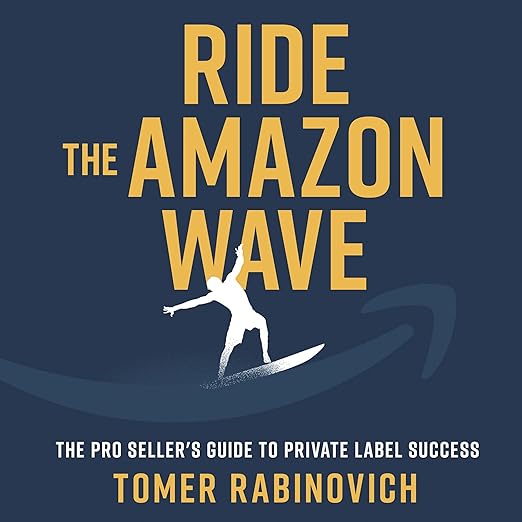
Quick Take
- Narration: Eric Altheide delivers a clean, businesslike performance that suits the instructional register of the material without making it feel dry.
- Themes: Amazon FBA strategy, seller mindset, scaling from seller to business owner
- Mood: Practical and motivating, with the confidence of hard-won experience
- Verdict: One of the more honest and structurally useful guides to Amazon selling available in audio, best suited to intermediate sellers ready to think beyond their next product launch.
I have a complicated relationship with business audiobooks. A large portion of them are extended sales pitches dressed up as instruction, and the Amazon FBA space in particular has produced more than its share of breathless, vague enthusiasm. So when I started Ride the Amazon Wave, I was prepared to be skeptical. About forty minutes in, that skepticism had eased considerably. Tomer Rabinovich writes like someone who has made real mistakes in real markets and come out the other side with specific, transferable lessons rather than motivational platitudes.
Rabinovich built his Amazon business by quitting a stable job and figuring things out through iteration. That origin story could easily become the frame for a self-congratulatory narrative about bootstrapping hustle. To his credit, he uses it only briefly as context and then gets out of the way of the actual content. The chapters on Pay Per Click strategy, Inventory Management, and Key Performance Indicators are the kind of granular, experience-based material that makes a business audiobook worth the hours invested.
Our Take on Ride the Amazon Wave
The book’s structure is deliberate and sensible. Rabinovich starts with mindset, which in most business books is code for padding, but here it functions genuinely as framing for what makes Amazon selling different from other commerce. The constraints of the platform, the data it surfaces and hides, the ways it rewards certain behaviors and punishes others, are more significant than most new sellers understand. Getting those mental models established early makes the tactical chapters land harder.
The prelaunch and product launch sections are the most widely applicable for beginners, and reviewers who came to the book as new sellers consistently report finding it clarifying in ways that saved them from predictable early mistakes. The review highlighting how many people start selling without even knowing what PPC is captures something real about the knowledge gap in the beginner cohort. Rabinovich addresses that gap without condescension, explaining PPC fundamentals before moving into optimization strategies that are more relevant to established sellers.
Why Listen to Ride the Amazon Wave
The audiobook format works for this material in a slightly counterintuitive way. Business instruction books often read better in print because you want to stop and take notes. Eric Altheide’s narration solves this by maintaining a deliberate pace that gives listeners time to absorb concepts without feeling hurried. It’s clean, efficient narration. It doesn’t try to manufacture enthusiasm for accounting ratios or inventory calculations. It simply delivers the information at a pace that suits the genre.
The section on transitioning from Amazon seller to actual business owner is where the book earns most of its value for intermediate and advanced readers. This is where Rabinovich is drawing most directly on his consulting experience, and the distinction he draws between running Amazon listings and building a business with transferable value is one that many successful sellers never quite articulate to themselves. The inclusion of strategies for eventually selling the business, and for using what you’ve built to pursue larger goals, gives the book an arc that extends beyond tactics.
What to Watch For in Ride the Amazon Wave
The book is not a step-by-step operational manual. Reviewers who came in expecting a tutorial occasionally find themselves looking for more granular instructions than Rabinovich provides. The KPI chapter, for instance, tells you what to measure and why, but the specific mechanics of setting up tracking systems and integrating data across tools is not covered in detail. Think of this as strategic orientation rather than tactical implementation. You’ll finish it knowing what to do but likely needing supplementary resources for exactly how to do it.
The publishing date is also worth noting. Released in late 2022, some of the platform-specific details around Amazon’s fee structures and advertising tools may have shifted since then. Amazon’s algorithm and advertising ecosystem evolve rapidly, and listeners should treat the specific tactical advice as a framework to be verified against current conditions rather than current fact.
Who Should Listen to Ride the Amazon Wave
Sellers who have launched one or two products and are trying to understand why their results are inconsistent will get the most from this audiobook. It’s particularly useful for the mindset reframe from launch-chaser to business builder. Complete beginners will benefit from the foundational sections but may find the middle chapters on PPC and KPIs require some prior exposure to Amazon’s platform to fully land. Experienced sellers who have already developed their own frameworks may find less that is new, though the business valuation and exit strategy sections offer a perspective that dedicated seller training rarely covers. Those who want operational checklists and precise how-to instructions should pair this with more tactical resources.
Frequently Asked Questions
Is this book relevant for complete beginners or primarily for sellers who already have products listed?
Both audiences will find value, but it’s optimized for sellers who have already launched at least one product and are trying to build more systematically. Complete beginners will benefit from the mindset and prelaunch sections, while the PPC and KPI chapters assume some platform familiarity.
How does Eric Altheide’s narration compare to having Rabinovich narrate his own work?
Altheide delivers a professional, neutral performance that keeps the instructional content accessible. He doesn’t editorialize or add vocal texture that might distract from the material, which suits a book this densely packed with strategic concepts.
How outdated is the Amazon-specific advice given the 2022 publication date?
The strategic frameworks and mindset content age well. The specific tactical advice around PPC mechanics, fee structures, and algorithm behaviors should be cross-referenced against current Amazon documentation, as the platform changes frequently.
Does the book cover Kindle Direct Publishing or is it focused exclusively on FBA physical products?
The focus is on Amazon FBA private label selling of physical products. KDP and digital publishing are not addressed. Sellers in other Amazon channels will find some transferable strategic thinking but the tactical content is specific to physical product FBA.