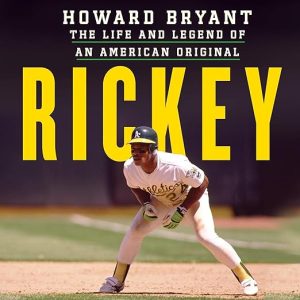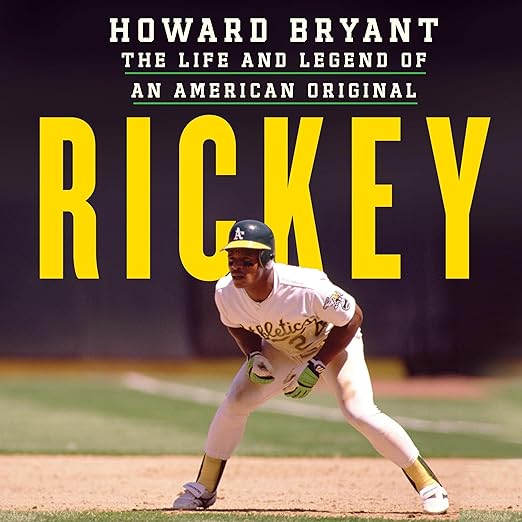
Howard Bryant already proved with The Last Hero, his Hank Aaron biography, that he can hold a whole American century inside one athlete's career, and this audiobook asks the same question of Rickey Henderson: how do you write a definitive account of a man everyone thinks they already understand? JD Jackson narrates with the gravitas this material demands, handling nearly nineteen hours without ever losing the thread across decades of baseball history, Oakland civic history, and the broader story of Black athletes finally earning the celebrity and salaries their white peers had claimed for generations.
Jackson Holds Steady Across Nineteen Hours
Jackson is a recurring choice for cultural biography with racial history at its core, and it is easy to hear why once you spend real time with this performance. He brings gravitas without solemnity, treating Henderson's brashness and his statistical dominance with equal seriousness rather than playing one for comic effect against the other. Nearly nineteen hours is a genuine test of stamina for any narrator, and Jackson holds the register steady from the first chapter to the last.
Bryant's structural choice is to center Oakland nearly as much as Henderson himself, treating the city that produced so many legendary athletes as inseparable from the story of any one of them. That dual-track approach, individual career plus place plus era, is a hallmark of the strongest sports biography, and it keeps this from ever collapsing into a simple highlight-reel retelling of stolen bases and runs scored.
Bryant's Journalism Meets Jackson's Clean Distinctions
Bryant's own background as a longtime baseball writer and cultural critic, the same sensibility he brought to The Last Hero, shows in how comfortably the book moves between granular on-field analysis, stolen-base mechanics, batting stance adjustments, and much broader social history without either mode ever feeling like a detour from the other. Few sportswriters manage that particular balance as consistently across a single book-length project, and it is worth noting Bryant does not treat Henderson's later, more chaotic career stops as a decline narrative either, resisting the easy dramatic shape a lesser biography might have imposed on the back half of a long career.
Jackson's differentiation between Bryant's narrative voice and the many direct quotes woven in from teammates, journalists, and Henderson himself stays clean throughout nearly nineteen hours, a real technical achievement for a book this thick with sourced material. A lesser narrator could easily let quoted material blur into the surrounding narration; Jackson keeps the distinction audible without resorting to distracting vocal tricks to mark the difference.
Bill James's Math Equals Two Hall of Famers
The synopsis includes baseball historian Bill James's own verdict on Henderson, that if you cut him in half, you would have two Hall of Famers, and Bryant builds a real argument around unpacking exactly what made that kind of production possible. One reviewer called the book 'exceptionally well researched and well written' about 'an enigmatic and complicated man,' adding that Bryant makes a strong case Henderson was underappreciated even at his statistical peak.
A second reviewer highlighted how thoroughly Bryant lays the foundation for why Henderson became who he was, tracing the Great Migration and explaining why so much athletic talent concentrated in Oakland specifically during that era. That contextual depth is what separates this from a straightforward career recap; the city and its history are doing real explanatory work throughout.
The synopsis's own description of Henderson as someone who 'stole America's heart' alongside his record-setting stolen bases is a small but telling piece of wordplay, and Bryant's biography earns that double meaning rather than just repeating it as a marketing tagline. The book treats Henderson's charisma and his statistics as two expressions of the same underlying competitive instinct, not as separate, unrelated topics requiring separate chapters.
Treating the Records as Evidence to Explain
The synopsis notes Henderson holds the record for most stolen bases in a single game and has scored more runs than any player in the sport's history, records that have stood for decades against a full field of competitors across the entire modern era. Bryant treats those numbers not as trivia to recite but as evidence requiring real explanation, tracing exactly how that specific combination of speed, patience, and instinct held up for one player across parts of four different decades of professional play.
Howard Bryant's decades of experience as a working sports journalist and cultural critic inform the book's confident handling of baseball's inside details, the kind of granular, insider-level knowledge that comes from having covered the sport professionally for a long stretch rather than approaching it as an outside academic subject for the first time.
A Career-Spanning Survey Instead of One Arc
Eighteen-plus hours is a serious time commitment, among the longer biographies in recent memory, and listeners should go in with realistic expectations about pacing that commitment across multiple sittings rather than trying to absorb it all at once.
Henderson's career sprawled across nine different teams over roughly two and a half decades, and Bryant's narrative reflects that sprawl rather than compressing it into a tidy single-team arc. This is a career-spanning survey with strong thematic throughlines, not a tight three-act structure building toward one climactic season.
The book does not shy away from the more difficult, complicated aspects of Henderson's public reputation, the persona some fans and media found abrasive or self-aggrandizing, alongside the genuine on-field brilliance. Listeners expecting a purely celebratory retrospective should know Bryant treats Henderson as a fully realized, sometimes contradictory person rather than smoothing him into an uncomplicated hero for the sake of a tidier narrative.
This is officially a biography of Henderson specifically, but its middle stretches sometimes widen out into essentially a history of the Oakland Athletics organization and Bay Area sports culture more broadly. Readers wanting a book that never strays from Henderson's own direct point of view should know Bryant's lens pulls back regularly to take in the surrounding institutional and civic picture.
A Full Century of American Sports History
Baseball history fans, readers who enjoyed Bryant's earlier work on Hank Aaron, and anyone interested in the intersection of sports, economics, and civil rights history, particularly Oakland sports fans specifically, will find this a rewarding and substantial listen.
Listeners specifically interested in Oakland as a city, its athletic legacy, its role in the Great Migration, its complicated economic history, will find real substance here even setting Henderson's individual career partly aside, since Bryant treats the city itself as a subject worth this much sustained attention in its own right, alongside the many other athletes, boxers, football players, Olympic sprinters, the city has produced across a full century of American sports history.
A tight three-act redemption arc is not what Bryant is building here, so recalibrate expectations if that is what you came looking for; this spans five decades and nine teams rather than assembling everything toward one clean narrative climax.
A Few Questions About Rickey
Does this audiobook focus only on baseball, or does it cover broader history too?
Both. Bryant weaves Henderson's on-field career together with Oakland's civic history and the broader shift toward equitable salaries and celebrity status for Black athletes in professional sports.
Do you need to have read Howard Bryant's earlier book on Hank Aaron to follow this audiobook?
No, Rickey stands entirely on its own, though listeners who enjoyed The Last Hero will recognize Bryant's same approach to treating an athlete's career as a lens on wider American history.