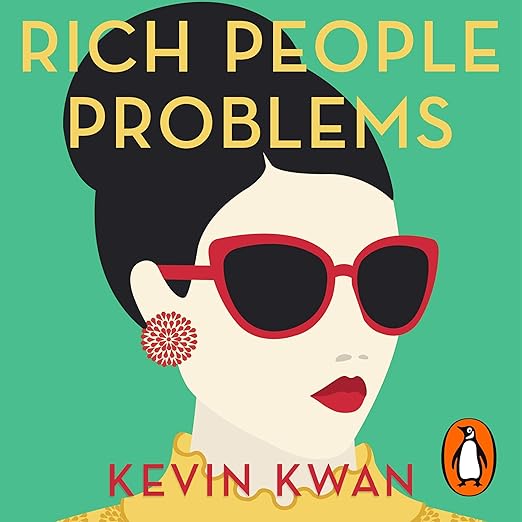
Kevin Kwan built the Crazy Rich Asians trilogy on the premise that the ultrarich of Singapore and their extended networks of allegiance and resentment are a subject as worthy of serious fictional attention as any other closed social world, and the audiobook of Rich People Problems, narrated by Lydia Look, is where that premise pays its final dividends. Su Yi, Nicholas Young's grandmother and the matriarch of a fortune that has survived empires, is dying, and the Shang-Young clan is converging from every corner of the world to stake their claims. Kwan has spent two books establishing exactly who these people are and what they want from each other, and this third installment is where he collects on that investment. Lydia Look has narrated all three books in the trilogy, and by this point her command of the ensemble is total; listening to her move through the Shang-Young-T'sien family is like watching a conductor who has memorized every part.
The Review
The novel functions as a conclusion in the structural sense; threads laid in Crazy Rich Asians and extended through China Rich Girlfriend are brought to resolution here, and Kwan is careful to address nearly every significant relationship in the ensemble. Su Yi's deathbed becomes the gravitational center that pulls everyone into orbit, and the logistics of inheritance, the trophy estate Tyersall Park in the heart of Singapore, give the clan members concrete competing interests that produce comedy, betrayal, and occasional genuine heartbreak. The revelation of Tyersall Park's actual history and the long-buried secrets it contains retroactively reframe events from the earlier books, and Kwan deploys these revelations with the confidence of a writer who knows his audience has invested three books in earning them.
Reviewer Abbie Real noted that she consumed this book on the first day of release, and reviewer Jamie Stewart described the food writing as so detailed they felt they were eating it themselves. Those two observations capture the twin pleasures Kwan delivers: narrative compulsion built from scheming and revelation, and sensory pleasure built from the meticulous rendering of how the extraordinarily wealthy live, eat, travel, and perform their status. From the elegantly appointed mansions of Manila to the private islands of the Sulu Sea, the geography is as lavish as the character dynamics, and Look navigates both with equal facility across 16 hours and 2 minutes.
Look's narration is inseparable from what makes this series work in audio. The Crazy Rich Asians ensemble encompasses characters from multiple generations, social strata, and national backgrounds within the same extended family system, and Look differentiates them with a precision that a less experienced narrator would struggle to maintain. The comedic sequences, the sabotage and scheming that reviewer Ashley Tidwell described with barely contained delight, require timing that Look has developed across all three volumes. When Eleanor Young deploys her particular brand of passive aggression, or when the various cousins attempt baroque schemes to influence Su Yi's will, Look delivers those moments with the deadpan exactitude they require. Kwan's humor is intricate, dependent on the reader knowing who is performing for whom, and Look never loses track of the social architecture that makes each exchange legible.
The historical layers of Singapore itself, the house's colonial-era construction, the Japanese occupation years, the postwar transformation of the city-state, give the inheritance plot a depth that extends beyond satire. Kwan is genuinely interested in what these families carry from the past and what they owe to it, and the audiobook's longer sections of historical family memory are among its most serious and affecting passages. Look handles the tonal shift from comedy to elegy with the same skill she brings to the scheming sequences, which is the quality that makes the trilogy feel like more than a single very long joke about the obscenely wealthy.
Before You Commit to Rich People Problems
The long-buried secrets Su Yi's dying produces are more emotionally consequential than the inherited-fortune plotting initially suggests. Kwan uses the inheritance drama as scaffolding for a series of revelations about who the Shang-Young families actually are, how they came to have what they have, what they sacrificed for it, and what the next generation owes or does not owe to the dynasty. Nicholas's position as a Western-educated scion who has never fully belonged to the world he was born into reaches its most direct reckoning in this volume, and his relationship with Rachel is resolved with a warmth that the earlier books' comedy often deferred.
The comedic register remains sharp but carries a more elegiac quality than the first book. Su Yi's mortality gives the sprawling excess a shadow it did not carry in Crazy Rich Asians, and the awareness that this enormous world is organized around a woman who will soon be gone changes how the comedy lands. Kwan is genuinely interested in what these families lose when the matriarch who held them together is gone, and that question, rather than the question of who gets the house, is the one the audiobook most wants to answer by its close.
Who It's For
Listeners who have read or listened to the first two books in the Crazy Rich Asians trilogy and want the payoff on three books of ensemble investment. Series newcomers should start at the beginning; the emotional weight of this conclusion depends on relationships established over two prior volumes, and the inheritance revelations require knowing the family well enough to understand what the secrets actually change. Fans of satirical family sagas with genuine emotional cores will find this audiobook a satisfying close to a trilogy that earned its reputation. Look's narration is a primary reason to choose the audio format if you have not already made that commitment through the earlier books.
A Few Questions About Rich People Problems
How does Lydia Look's narration handle the large cast of characters in this audiobook?
Look has narrated all three books in the trilogy and her command of the Shang-Young ensemble is by this point complete. She maintains consistent vocal differentiation across multiple generations and national backgrounds within the same extended family, and her comic timing for the sabotage and scheming sequences is precisely calibrated to Kwan's satirical register.
Is this audiobook as funny as the first Crazy Rich Asians book?
The humor remains sharp and the scheming spectacular, but Rich People Problems has a more elegiac register than the first book. Su Yi's dying gives the excess a melancholy shadow that the earlier installment did not carry. The comedy is still very much present, but it operates alongside something more genuinely emotional.
How long is the audiobook and does it feel padded at 16 hours?
At 16 hours and 2 minutes, the runtime reflects the size of Kwan's ensemble and the number of threads he is resolving. Reviewers consistently describe the book as addictive rather than slow. The geography, food, family secrets, and inheritance maneuvering each get room to breathe, which is the experience Kwan's style requires and Look's narration sustains.