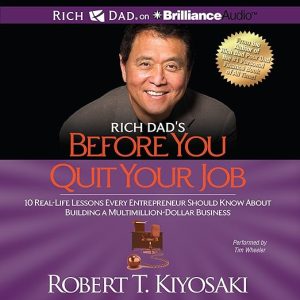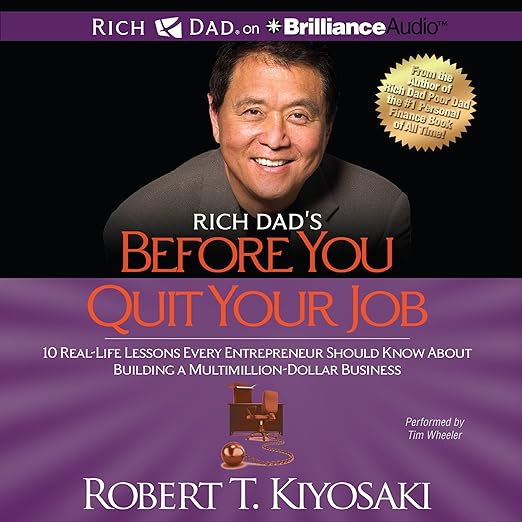
Robert T. Kiyosaki's Rich Dad's Before You Quit Your Job occupies a specific position in the Rich Dad audiobook catalog: it is the title written for people who have already absorbed the financial philosophy and are now at the moment of decision. Narrated by Tim Wheeler, this audiobook operates not as an introduction to the Rich Dad framework but as a practical companion for the specific transition from employment to entrepreneurship, and the questions it opens with capture that purpose directly. Do you have a million-dollar idea? Are you afraid of failing? Are you tired of working hard and not getting ahead?
Those questions are not rhetorical. The audiobook is structured around the honest acknowledgment that most people who start businesses fail, and that the failure is usually not from lack of passion or a bad idea but from a failure to understand what building a business actually requires. The B-I Triangle and the eight integrities of a business that the book introduces are Kiyosaki's framework for understanding what all successful businesses need to have in place before the founder stops having a steady paycheck.
A Closer Look at Rich Dad's Before You Quit Your Job
Tim Wheeler's narration suits the mentor-to-student register that the Rich Dad series has consistently used across its catalog. He delivers Kiyosaki's voice with the patient authority of someone who has absorbed the framework deeply enough to present it without hesitation, and the seven-hour-and-fifty-eight-minute runtime gives him enough material to demonstrate that consistency across the book's full argument. The pacing is deliberate, which matches the content: this is a book that wants you to think carefully before acting, not one that wants to accelerate your decision.
Reviewer Christopher Stenger captured something precise about the book's approach when he noted that it teaches how to think rather than what to think, and explicitly that there is no step-by-step path to a million dollars. That honesty distinguishes this title from the genre of entrepreneurial books that promise systematic wealth. Kiyosaki's B-I Triangle, which maps the interrelated systems any business requires, spans mission, team, leadership, product, legal, systems, communications, and cash flow. The audiobook uses this framework as a diagnostic tool rather than a recipe, helping listeners identify which components of their planned business are underdeveloped before they leave the security of employment. Wheeler's handling of these structural explanations is clear without being mechanical, and the framework's visual logic translates to audio better than might be expected because Kiyosaki builds to it through narrative example rather than introducing it as an abstract diagram.
What Makes Rich Dad's Before You Quit Your Job Worth Hearing
The audiobook was originally written as a guidebook for aspiring entrepreneurs, and its core argument has become more relevant with the changing employment landscape. The observation that job security is increasingly illusory and that creating your own income stream may be more sustainable than relying on an employer is a different claim in a period of high unemployment and accelerating outsourcing than it was when first written. Kiyosaki addresses this directly in the updated framing, positioning the book not just as advice for ambitious risk-takers but as a practical map for people whose employment options are narrowing.
Reviewer Kindle Customer's note about the spiritual dimension of the book, that following the right process to become truly rich fulfills a higher purpose of making the world better for other people, reflects a strand of Kiyosaki's argument that receives less attention than the financial framework but runs through the Rich Dad series consistently. The book argues that entrepreneurial success generates value beyond the entrepreneur, and Wheeler's delivery of this dimension of the material is measured enough to keep it from tipping into self-help sentimentality. Reviewer Jordan Tan's specific note about sales being the most important skill for an entrepreneur reflects a genuine debate within the Rich Dad community, and the audiobook covers sales as a core business integrity without treating it as singularly dominant, which keeps the broader framework intact for listeners who come from non-sales backgrounds.
Things to Know Before Starting Rich Dad's Before You Quit Your Job
The audiobook assumes significant familiarity with the Rich Dad conceptual framework. The B-I Triangle and the vocabulary of assets, liabilities, and cash flow systems that Kiyosaki developed in Rich Dad Poor Dad and its sequels are used here without full reintroduction. Listeners coming to this title without prior Rich Dad exposure will find the concepts accessible but may miss the full analytical weight of arguments that build on earlier material in the series.
The book also does not provide a detailed tactical playbook for any specific business type. Kiyosaki is explicit that there is no step one through five to getting a million dollars, and the framework is intentionally generic enough to apply across industries. Listeners hoping for sector-specific advice or a sequential checklist will need to supplement the audiobook with more targeted resources. What the book does provide is a mental model for thinking about business readiness, which is the prerequisite for any tactical work that follows.
Who Robert T. Kiyosaki Is Writing For
The audiobook's most natural audience is someone actively considering leaving employment to start a business and wanting a structured framework for assessing their readiness rather than an inspirational nudge. Rich Dad series readers who want to progress from the foundational philosophy to practical business diagnostics will find this the most applicable title for that transition. Those completely new to Kiyosaki should start with Rich Dad Poor Dad first to establish the conceptual vocabulary. Tim Wheeler's narration makes the full seven-hour-and-fifty-eight-minute runtime comfortable to complete in a few listening sessions, and the B-I Triangle framework is worth the full engagement for anyone serious about the entrepreneurial transition.
- Read by: Tim Wheeler delivers Kiyosaki's entrepreneurial framework with the measured authority the Rich Dad brand carries; his voice suits the mentor-to-student register the series has always used.
- At its heart: Entrepreneurial mindset, B-I Triangle business structure, fear of failure
- Vibe: Motivational and prescriptive, with underlying urgency
- Short version: A more practically structured Kiyosaki title than the foundational Rich Dad Poor Dad, specifically useful for anyone in the active planning stage of leaving employment for their own business.
Good to Know
Is the Rich Dad's Before You Quit Your Job audiobook practical or primarily motivational?
It is more practical than most Kiyosaki titles. The B-I Triangle and eight business integrities are diagnostic tools for assessing whether your planned business has the necessary components in place, not just motivational framing. Reviewers have noted that the book teaches how to think about entrepreneurship rather than offering step-by-step instructions.
Does Tim Wheeler's narration serve the Rich Dad audiobook format well?
Wheeler's measured, authoritative delivery suits the mentor-to-student register that the Rich Dad series uses throughout its catalog. He presents Kiyosaki's framework with patient authority and handles the full seven-hour-and-fifty-eight-minute runtime consistently.