Quick Take
- Narration: Tom Parks delivers Kiyosaki’s conversational style with consistent energy and clarity, Parks is a reliable narrator for personal finance content and serves the material well.
- Themes: Financial literacy, assets versus liabilities, breaking free from the employee mindset
- Mood: Direct and energizing, with occasional stretches that feel like a motivational keynote rather than a book
- Verdict: The 20th anniversary edition adds useful retrospective context to a foundational personal finance framework, whether you agree with all of it or not, the core ideas are worth understanding.
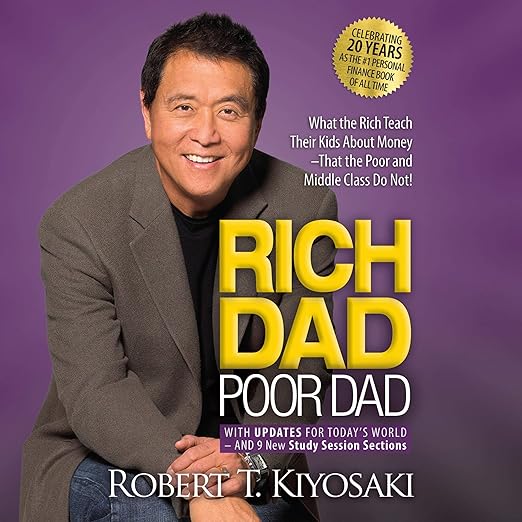
I first encountered Rich Dad Poor Dad the way most people in their twenties did, someone thrust a copy at me with the conviction of a convert. I read it, found it clarifying in some places and frustrating in others, and moved on. Returning to it in the 20th anniversary audiobook edition with Tom Parks narrating is a genuinely different experience. The retrospective sidebars Kiyosaki added give the book a strange dual-timeline quality: you are reading the original argument while a slightly older, more vindicated author comments on it from twenty years later.
That is not always comfortable. Kiyosaki’s confidence in his own rightness is a defining feature of his prose style, and in retrospect he leans into it harder. But the core argument has also held up in ways that critics at the time dismissed too quickly, and the 20th anniversary framing gives him room to say so.
Our Take on Rich Dad Poor Dad: 20th Anniversary Edition
The book’s central framework is simple enough to state in a paragraph: Kiyosaki grew up with two father figures who thought about money in opposite ways. His biological father, educated, credentialed, and chronically financially insecure, represented what Kiyosaki calls the employee mindset: work hard, get paid, spend what you earn, wait for retirement. His friend’s father, self-educated, entrepreneurially oriented, represented a different model: understand what an asset actually is, build things that generate income, make your money work instead of working for it.
The specific arguments that generated the most controversy, that your house is not an asset, that financial education is more valuable than academic credentials, that most people work for money when wealthy people have money work for them, have become more mainstream in the twenty years since the book’s first publication. Whether Kiyosaki deserves credit for that shift or was simply early to articulate a framework others refined later is debatable. What is not debatable is that the ideas are now part of how people talk about financial independence in ways they were not before this book.
Why Listen to Rich Dad Poor Dad: 20th Anniversary Edition
The audiobook format suits Kiyosaki’s writing well. His style is conversational and occasionally repetitive in ways that work better heard than read, Parks keeps the energy up through the more circling passages, and the direct address Kiyosaki uses throughout (he talks to the listener the way a mentor talks to a student) translates naturally to audio. Several reviewers recommended giving this to teenagers specifically, and I think that instinct is right: the core concepts about how money works are things most school curricula never cover, and they are presented accessibly enough here that a motivated seventeen-year-old would find them genuinely revelatory.
The 20th anniversary retrospective elements are the added value of this edition. Kiyosaki assesses which of his predictions came true, which did not, and why he believes the underlying principles are more relevant now than when he wrote them. For listeners who already know the original, this is the reason to return.
What to Watch For in Rich Dad Poor Dad: 20th Anniversary Edition
Kiyosaki is not a precise financial thinker in the way that a certified financial planner is. His framework is motivational and conceptual rather than tactical. He will tell you to think differently about assets and liabilities; he will not tell you which specific investments to make or how to evaluate risk in your particular circumstances. Listeners who come to this expecting actionable investment advice will be disappointed. Those who come looking for a shift in how they understand the relationship between money, labor, and ownership will find it more rewarding.
There is also the question of Kiyosaki’s own track record, which has been mixed. Some of his later ventures and pronouncements have not aged as well as the core book. Take the framework on its own terms, test it against your own thinking, and decide what holds up.
Who Should Listen to Rich Dad Poor Dad: 20th Anniversary Edition
This is a good listen for: people new to personal finance who want a conceptual framework before diving into more technical material, teenagers and young adults who have never been taught how money actually works, and listeners who read the original and want to see how Kiyosaki has updated his thinking for the current economy.
Less suited to: people looking for specific investment strategies, listeners who have already read extensively in the personal finance genre (the concepts will be familiar), and anyone who finds Kiyosaki’s confidence and occasional self-congratulation grating on the page, it is louder in audio than it is in print.
Frequently Asked Questions
What does the 20th anniversary edition add compared to the original Rich Dad Poor Dad?
Kiyosaki added retrospective sidebar commentary throughout the text, updating his assessments of how the principles he outlined in 1997 have played out over the following two decades. He addresses economic shifts, the 2008 financial crisis, real estate markets, and why he believes his core arguments are more relevant now than when he first made them.
Is this audiobook appropriate for teenagers, as some reviewers suggested?
Yes, it is one of the more accessible personal finance books for younger listeners. Kiyosaki writes conversationally and explains concepts like assets, liabilities, and passive income without assuming prior financial literacy. Several reviewers specifically mentioned giving it to teenagers and young adults.
Does Tom Parks add anything distinctive to the narration, or is he essentially invisible?
Parks is a professional narrator who serves the material without inserting himself into it. His style suits Kiyosaki’s conversational prose well, the delivery is energetic without being performative. He is not a narrator who transforms the listening experience, but he keeps the 8-plus-hour runtime from feeling like a chore.
The book challenges the idea that your house is an asset. How thoroughly does it make that case?
Kiyosaki makes the case conceptually rather than analytically. He argues that a primary residence generates expenses rather than income and therefore does not qualify as an asset in the way most people assume. He does not provide detailed real estate analysis but establishes the framework clearly enough that listeners can research the question further if they want to.