Quick Take
- Narration: Robert L. Harris reads his own memoir, and that decision is both the book’s greatest intimacy and its occasional limitation, his voice carries the cadence of a man thinking aloud rather than performing.
- Themes: Solitude and belonging, the relationship between place and identity, the spirituality of the natural world
- Mood: Meditative, lyrical, and at times numbing, best absorbed in small doses
- Verdict: A deeply personal memoir about thirty years on Skellig Michael that is beautiful in passages and deliberately, sometimes frustratingly, repetitive, you need to decide if that repetition is the point.
I listened to the first hour of Returning Light early on a Saturday morning when the light was doing something interesting outside my window, that particular winter-gray quality that makes you want to sit still rather than move. That mood was exactly right for this book, and I am not sure I would have stayed with it had I started at any other time. Returning Light is a memoir that requires a particular readiness from its listener, and not all listeners will have it when they arrive.
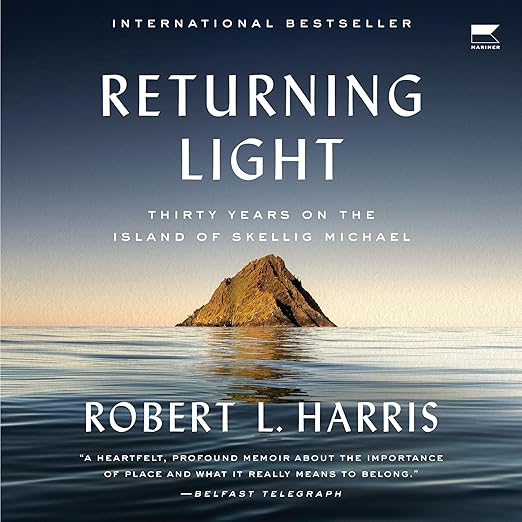
Robert L. Harris is the man who spent every May for thirty years on Skellig Michael, the remote Irish island made famous by Star Wars but known long before that as the site of a medieval monastery carved into the rock. As the island’s warden, Harris observed thousands of puffins nesting, watched the weather roll in and out, and stood on the edge of something ancient. He narrates his own memoir, and that choice matters more here than it would in most books.
Our Take on Returning Light
The New York Times Book Review called this book “a poem,” and that characterization is accurate in ways both generous and cautionary. Harris writes with genuine lyrical sensibility. The passage quoted in the synopsis, about thousands of birds appearing and disappearing, erecting towers of movement over an empty sea, is representative of the prose throughout. It is beautiful. It is also, as multiple reviewers note, representative of a quality that accumulates across 9.5 hours: the descriptions of rock and sky and birds and light become a rhythm that some listeners will find meditative and others will find numbing.
One honest reviewer describes the book as “heartfelt but numbingly repetitive,” noting that “this book needed an editor with a sensitive but firm hand.” That is a fair critique. Harris is trying to communicate an experience that is fundamentally ineffable, the effect of thirty years in one of the most remote places in the Atlantic world, and he reaches for words the way you might reach for something just out of grasp. The repetition may be intentional, a structural attempt to make the reader feel the sameness that shapes a life lived in radical proximity to nature. Or it may be a book that was not edited tightly enough. Both readings are defensible.
Why Listen to Returning Light
Harris narrating his own work is the right decision. His voice is not polished in the way a professional narrator’s would be, there is a roughness to it, a quality of genuine reflection rather than performance. When he describes the isolation becoming a veil between Skellig Michael and the rest of the world, you hear it as something he has actually felt. A reviewer who calls the book a meditation captures this well: it is not a book you read so much as a book you experience at the pace it offers.
The spiritual dimension is real without being religious in any orthodox sense. Harris is not a Christian, but he is living in a place shaped by a millennium of Christian monastic practice, and the holiness of the island, the birds, the light, the silence, seeps into his prose. A reviewer comparing his work to William Blake’s verse about the holiness of everything is not overstating the book’s spiritual register. If that register appeals to you, this is among the most honest accounts of what it feels like to live inside it.
What to Watch For in Returning Light
The repetition is real and should be taken seriously as a decision-making factor before you commit. A listener who described finding it poetic but very opaque and incredibly repetitive is not wrong. Harris circles back to the same images, light on water, puffins visiting the hut, the dizzying terrain, the veil of weather, across the full nine-and-a-half hours. Whether that repetition deepens the reading or exhausts it will depend entirely on what you bring to the book.
The self-narration also has its limitations. Harris is not a trained reader, and the pacing can be uneven in ways a professional would smooth out. For some listeners this adds to the intimacy; for others it will be a friction point, particularly across a long listen.
Who Should Listen to Returning Light
This is for readers drawn to place-writing and nature memoir at its most contemplative, the tradition of Annie Dillard or Barry Lopez rather than the accessible adventure narrative. If you have visited Skellig Michael, or if the idea of a man spending thirty seasons on a remote Atlantic island speaks to something in you, this book will reward your patience. If you need narrative momentum, character development, or anything resembling plot, it will not. Approach it in the spirit it is offered: slowly, with attention, and without expecting it to be something it has no interest in being.
Frequently Asked Questions
Does this memoir tell a linear story, or is it more impressionistic?
It is primarily impressionistic. The book does not follow a chronological narrative arc so much as it circles around the experience of living on Skellig Michael over many years.
How does Harris reading his own work affect the listening experience?
Significantly. His voice carries genuine intimacy but lacks the polish of a professional narrator. Listeners who value authenticity over smooth delivery will find it right; others may find unevenness distracting over 9.5 hours.
Is this book appropriate for someone unfamiliar with Skellig Michael?
Yes. Harris provides enough context about the island’s history, geography, and wildlife that no prior knowledge is required.
Several reviews mention repetition, is that a structural problem or a deliberate choice?
Reviews are split. Some readers experience the repetition as intentional, a way of conveying the cyclical, meditative quality of life on the island. Others find it evidence of insufficient editing. Both interpretations have merit.