Quick Take
- Narration: Kitty Hendrix delivers the financial content in a clear, professional register that keeps dense material moving without rushing through it, a measured pace that suits the reference-book nature of the title.
- Themes: Retirement savings strategies and investment basics, Social Security and benefits navigation, planning across different income levels and ages
- Mood: Practical and reassuring, slightly dry but never intimidating
- Verdict: A solid primer for listeners who need retirement fundamentals organized in one place, best treated as a starting point for research rather than a comprehensive final word.
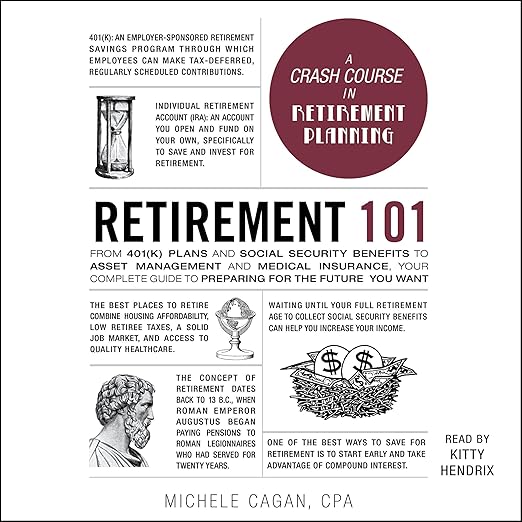
I have a complicated relationship with personal finance audiobooks. The genre exists on a spectrum from actually illuminating to comfortably obvious, and where any given title lands often depends less on the quality of its information and more on where the listener already sits with their knowledge. I came to Retirement 101 after a conversation with a colleague in her late thirties who admitted she still found 401(k) matching rules genuinely confusing, and I wanted to understand what a well-constructed primer in this space actually looks like. Michele Cagan, a CPA who has built a career on making financial concepts approachable for general readers, is a good guide for that purpose.
This is part of the Adams 101 series, which positions itself as comprehensive introductions to practical life topics. The retirement version covers the ground you would expect: how much to save, when to start, what kinds of accounts to use, how to think about Social Security timing, what early retirement actually requires financially, and how investment strategy shifts as you move from accumulation to drawdown. Cagan writes with the precision of someone who has answered these questions in client consultations many times over, the explanations are technically accurate and organized logically. Kitty Hendrix reads with a clean, professional delivery that keeps the material moving without sacrificing clarity.
Our Take on Retirement 101
The most useful thing this audiobook does is sequence retirement planning as a series of decisions rather than a monolithic problem. The structure, organized around specific questions that listeners at different life stages are most likely to be asking, means that a 25-year-old and a 55-year-old can approach the same material and pull out different useful things. One reviewer noted they learned several new facts despite considering themselves fairly well-read on the topic, which is the highest compliment a primer can receive. Another noted some mild repetition between sections, which is a fair critique of a book that has to re-establish context as it moves between topics.
Part of what makes Cagan effective as a guide here is that she writes from the position of someone who has actually sat across a desk from clients who waited too long to ask these questions. That practical impatience, the sense that getting started, even imperfectly, beats waiting for perfect information, comes through in how she presents the decision points. It is a more useful frame than the aspirational tone many personal finance books adopt.
Why Listen to Retirement 101
The audiobook format works reasonably well for this kind of reference material, with the caveat that some listeners will want to follow along with notes. Cagan’s explanations of account types, Roth versus traditional IRAs, the mechanics of 401(k) matching, the best states for retirement tax treatment, are clear enough when heard once, but the denser comparative material benefits from being revisited. Hendrix’s pacing is measured and deliberate, which helps with comprehension on first listen. The book also includes treatment of topics that generic financial advice often skips: how to calculate your actual expected benefits, what happens to healthcare costs before Medicare kicks in, and how to think about working part-time in retirement without triggering tax complications.
What to Watch For in Retirement 101
One reviewer flagged some inaccuracies, which is worth taking seriously for any financial content. The book was released in 2019, which means specific figures, contribution limits, tax brackets, Social Security thresholds, may have shifted since publication. Listeners should treat this as a conceptual foundation rather than a current reference for specific numbers, and verify any figures that will affect actual decisions through current IRS publications or a financial advisor. The series title, 101, is accurate: this is introductory material, and experienced investors or those with complex estate situations will want more specialized sources.
Who Should Listen to Retirement 101
Best matched to listeners in their twenties through forties who have never sat down and thought systematically about retirement, or who want to feel more confident in conversations with a financial advisor. It is also a reasonable refresher for people who have been on autopilot with their retirement accounts and want to revisit whether their strategy still makes sense. Skip it if you already have a strong grasp of retirement fundamentals and are looking for sophisticated guidance on topics like Roth conversion ladders, sequence-of-returns risk, or advanced Social Security optimization.
Frequently Asked Questions
Is the financial information in Retirement 101 still accurate given the 2019 publication date?
The conceptual framework, how different account types work, general investment principles, Social Security mechanics, remains accurate. However, specific figures like annual contribution limits, tax brackets, and Medicare thresholds change regularly, and listeners should verify any numbers that will affect actual financial decisions through current IRS resources or a licensed advisor.
Does this audiobook work for listeners at very different stages of life, or is it aimed at a specific age group?
Cagan explicitly addresses listeners from their twenties onward, including sections on early retirement scenarios and on optimizing benefits for those already close to retirement age. The structure works across age groups, though the most useful sections will differ significantly depending on where you are in your career.
How does Kitty Hendrix’s narration handle the denser financial and regulatory content?
Hendrix reads with clean professional pacing that keeps technical content accessible. The narration does not dramatize the material, this is not a conversational performance, but it maintains enough forward momentum that the drier sections on account mechanics do not become fatiguing.
Does the book cover Social Security optimization strategies in any depth?
It covers Social Security in terms of how benefits are calculated, when to claim, and how spousal benefits work, which is appropriate for a primer. It does not go deep into advanced optimization strategies like restricted application or careful benefits-timing analysis. Listeners who want that level of detail should look at dedicated Social Security planning resources.