Quick Take
- Narration: Mirron Willis brings both vocal authority and appropriate gravity to Gilliard’s blend of statistics, scripture, and personal testimony, giving the material the weight it consistently requires.
- Themes: Mass incarceration as a systemic and theological failure, restorative versus retributive justice, the church’s historical complicity and potential for repair
- Mood: Urgent and theologically grounded, with moments of genuine moral discomfort that linger after the final chapter ends
- Verdict: One of the most carefully argued faith-based examinations of criminal justice in the US, essential for Christians who have not interrogated their assumptions about who ends up behind bars and why.
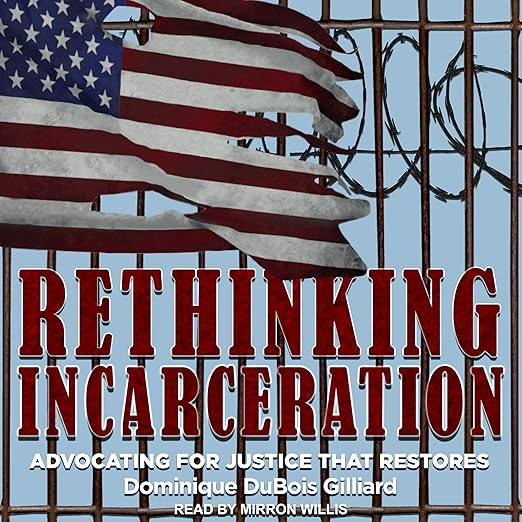
I came to Rethinking Incarceration with a literary critic’s instinct to look for the seams in an argument, the places where the thesis overreaches or the evidence is thinner than the rhetoric surrounding it. I am still looking for those seams. Dominique DuBois Gilliard has written a book that is both rigorously argued and genuinely uncomfortable in the way that serious ethical work has to be: not performatively provocative but quietly insistent, making its case with accumulating specificity rather than rhetorical force. Mirron Willis narrates it with the kind of measured authority that matches the text’s register throughout. I finished it late on a weeknight and sat with it for a while before doing anything else. That is not something I do often after audiobooks, and it is worth noting as the most accurate description I have of what this book does to you when you let it work properly.
The Statistic That Opens the Door
The United States holds five percent of the world’s population and twenty-five percent of the world’s incarcerated people. Gilliard states this near the opening and then refuses to let it remain abstract. He documents that there are more jails and prisons in the United States than degree-granting colleges and universities, and that in many places more people live behind bars than on college campuses. He frames mass incarceration explicitly as a lucrative industry, which is the frame that most public discourse carefully avoids because it implies intentionality and beneficiaries rather than systemic failure and unintended consequences. What distinguishes Gilliard’s approach from the secular policy literature on this subject is his decision to examine the church’s specific role in constructing and sustaining the system, not merely failing to critique it from a comfortable distance. That argument is the book’s most original and demanding contribution, developed with a rigor that earns its conclusions rather than asserting them from a position of rhetorical authority. Mirron Willis gives each of these opening sections the weight they need to land before Gilliard builds on them in the chapters that follow.
The Theologies That Enable Punishment
Gilliard traces the theological lineage of meritocratic justice, the idea that people receive what they deserve and that punishment is therefore both legitimate and proportionate, and shows how this framework has functioned not as a neutral moral position but as a theological cover for a system structured around racial and economic hierarchy that does not produce anything resembling the justice scripture actually describes. This is careful work that requires care in the narration, and Willis delivers. He is not arguing that Christianity is inherently punitive or that all Christians have consciously participated in building a system of harm. He is arguing that specific theological traditions within American Christianity have been selectively deployed to rationalize an incarceration system that God’s justice, as Gilliard reads the full arc of Scripture, does not sanction. Reviewers with deep investment in both Christian theology and criminal justice reform consistently describe this section as indispensable and among the most important writing on the subject available from within the faith tradition. One reviewer noted they had to stop marking pages entirely because every single one contained something that needed to be marked.
Creative Solutions and What They Ask of the Listener
The second half of the book moves from diagnosis to intervention, which is precisely where some social justice texts lose the theological thread they established in the opening chapters. Gilliard does not. His discussion of restorative justice, of innovative interventions by Christian communities that are actually working, of what it means to pursue justice that restores and reconciles rather than simply punishes and warehouses, is grounded in specific documented examples rather than aspirational abstractions. He grounds these examples in both scripture and documented outcomes, providing a framework for action rather than a general call to do better that leaves the listener with no idea where to begin. Willis’s narration serves these sections particularly well, his voice carrying the authority of someone delivering not just an argument but a call to particular and difficult action in a particular institutional context. The book is explicit that it is addressed primarily to Christians, but its analysis of the incarceration system itself is accessible and carefully documented for any listener willing to engage seriously with what the evidence actually shows.
Who Should Listen and Who This Book Is Asking Something Of
Rethinking Incarceration is not a casual listen, and it is not designed to be. It asks you to hold a theological argument alongside a policy analysis alongside a historical account alongside a moral challenge, and to follow Gilliard as those threads reinforce each other across seven hours rather than remaining in their comfortable separate categories. Listeners who bring either a serious Christian faith, a serious interest in criminal justice reform, or both will get the most from it. It is not a comfortable book. But the discomfort it produces is productive rather than punitive, aimed at opening a door rather than closing a conversation. At seven hours, Willis’s narration makes the time feel well spent rather than labored through, which is a real accomplishment given the density of what Gilliard is asking his audience to process and then actually do something about.
Frequently Asked Questions
Is Rethinking Incarceration only valuable for Christian readers, or does it have broader relevance?
Gilliard writes from a Christian theological framework and addresses the book primarily to a church audience. But the analysis of mass incarceration’s history, racial dimensions, and economic incentives stands independently of the theological argument. Non-Christian listeners interested in criminal justice will find the policy and historical sections fully accessible.
How does Gilliard connect Christian theology specifically to the expansion of mass incarceration?
He traces specific theological traditions, particularly the theology of meritocratic justice, the idea that punishment reflects what people deserve, and argues this framework has been deployed to sanctify a system structured by racial and economic inequality rather than by the restorative justice principles he finds throughout scripture.
Does Mirron Willis’s narration suit the weight of this material?
Yes. Willis brings vocal authority and measured gravity to both the analytical and personal testimony sections throughout the seven-hour runtime. The narration avoids performative urgency that can undermine serious nonfiction, and it suits Gilliard’s careful, building argumentative style throughout.
What practical solutions does Gilliard offer for Christians who want to respond to mass incarceration?
The second half focuses on restorative justice frameworks and highlights specific communities where Christian intervention has produced genuine reform rather than performative charity. He grounds these examples in both scripture and documented outcomes, giving the book a forward-looking structure beyond its diagnostic sections.