Quick Take
- Narration: Peter Berkrot captures Chas Smith’s gonzo, self-aware voice without tipping into parody, handling the tonal instability as an asset rather than a problem.
- Themes: War journalism as extreme tourism, Western ego in conflict zones, the absurdity of looking for surf in Yemen
- Mood: Disorienting and darkly comic, with genuine unease underneath the bravado
- Verdict: A divisive piece of gonzo travel writing that will either fascinate you with Smith’s particular kind of reckless intelligence or leave you cold; worth sampling before committing.
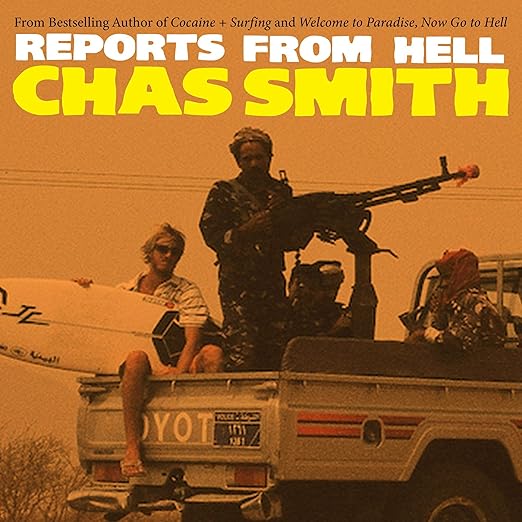
I picked up Reports from Hell on a Friday evening specifically because I wanted something that would not let me settle. Chas Smith’s writing does not let you settle. The award-winning author of Welcome to Paradise, Now Go to Hell and Cocaine + Surfing has a voice that is simultaneously self-aggrandizing and self-aware, which is either irresistible or exhausting depending entirely on your tolerance for that particular register. I find it irresistible, which means I came to this one already predisposed in its favor. That bias is worth naming upfront.
The premise reads like a bad idea that somehow became a book: Smith and a group of companions travel to war-torn Yemen looking for unsurfed waves, searching for the origins of Al Qaeda, and generally testing the thesis that the margins of the global war on terror contain the last genuinely interesting places on earth. They end up, eventually, being kidnapped by Hezbollah. There is something characteristically Chas Smith about the fact that this is not the plot of the book so much as its logical endpoint.
Our Take on Reports from Hell
The reviews split sharply on this one, and both camps are right about what they describe. The reader who loved it said Smith is one of their favorite writers and that this book made them want to go to Yemen, a feat they previously thought impossible. The reader who disliked it, a self-described fan of Smith’s previous two books, called this one a colossal borefest and the worst experience of Smith’s output. Both assessments are genuine. What divides them is not quality of prose but expectation management.
Reports from Hell is less conventionally structured than Welcome to Paradise, Now Go to Hell. The Yemen sections, which one reviewer singled out as the book’s strongest material, sit alongside Beirut dispatches and a general meditation on what it means to be a white Western male seeking adventure in places defined by their own people’s suffering. Smith is aware of this contradiction. He does not resolve it, which is either the book’s most honest quality or its most frustrating, depending on your position.
Why Listen to Reports from Hell
Peter Berkrot’s narration handles Smith’s voice with necessary skill. Smith writes in a register that is not quite first-person gonzo journalism and not quite performative memoir; it sits somewhere between Hunter S. Thompson and a surf magazine editor who has read too much David Foster Wallace. One reviewer actually made the Wallace comparison, specifically noting stylistic similarities in how both writers repeatedly reference themselves in self-aware ways. Berkrot captures this without tipping into imitation or mockery. At just over eight hours, the runtime gives the Yemen and Beirut sections room to develop properly.
The surf angle is not incidental. Smith approaches conflict zones the way surfers approach new breaks: with obsessive curiosity about what is there, combined with a willingness to accept physical risk that most observers would classify as disproportionate. Seeing Yemen through this lens produces observations that straight journalism would not generate. The mud skyscraper cities, the coastal geography, the specific texture of life in a country between wars: Smith notices these things because he is looking for surf, and the specificity of his noticing produces something genuinely valuable.
What to Watch For in Reports from Hell
If you have not read Smith’s previous books, this is not the right starting point. Welcome to Paradise, Now Go to Hell provides the stylistic context that makes Reports from Hell’s more fragmented structure interpretable. New readers may find the voice gratingly self-involved without the prior investment that makes Smith’s particular brand of ego bearable.
The more critical reviews also reflect something real about the book’s structural looseness. Smith’s two previous books have stronger narrative throughlines. Reports from Hell meanders in ways that are thematically intentional but experientially challenging. The kidnapping that ends the book is handled with characteristic Smith deflation: less climax than logical consequence, less dramatic resolution than shrug. Whether that registers as authentic or anticlimactic is the book’s central gamble.
Who Should Listen to Reports from Hell
Existing Chas Smith readers who enjoyed Welcome to Paradise, Now Go to Hell will find this worthy of their time, particularly the Yemen sections, which represent some of Smith’s most specific and unexpected writing. Listeners who enjoy gonzo travel writing in the tradition of Thompson and Wallace, and who are comfortable with an unreliable, self-implicating narrator, will find the format engaging. New Smith readers should start with his first book. Anyone who needs their adventure travel writing to have a clear moral position or conventional narrative structure should look elsewhere.
Frequently Asked Questions
Is Reports from Hell appropriate to listen to without having read Chas Smith’s previous books?
It is technically a standalone but works significantly better as a third book in an implicit progression. Welcome to Paradise, Now Go to Hell establishes the voice and the self-aware persona that makes Reports from Hell’s more fragmented structure interpretable. New readers going in cold may find Smith’s ego difficult to separate from self-parody without the prior investment.
The reviews are sharply divided on this book. What is driving that split?
Expectation management, primarily. Readers expecting the narrative momentum of Smith’s first two books will find this more meandering. The book is deliberately structured around the absence of resolution rather than building toward climax, and its moral ambiguity around Western thrill-seeking in conflict zones is acknowledged but not resolved. Those who find Smith’s self-awareness charming will read that as honesty; those who want cleaner payoffs will find it evasive.
How does Peter Berkrot handle the tonal instability of Smith’s gonzo style?
Well. Berkrot captures the self-aware bravado without tipping into parody, which is the difficult balance this material requires. Smith’s prose sits between journalism and performance, and Berkrot finds a register that serves both registers without overcorrecting toward either. The Yemen sections in particular benefit from narration that can hold the absurdity and the genuine observation simultaneously.
What makes the Yemen sections specifically stronger than the rest of the book?
Smith is at his most specific there. The mud skyscraper cities, the coastal geography, the texture of daily life in a country between active crises: his surf-focused attention generates observations that straight journalism would not produce. One reviewer specifically noted being driven to search for images of the towns and locations Smith describes, which is the mark of travel writing doing its real work.