Quick Take
- Narration: Neil Shah reads Akyol’s arguments with appropriate clarity and scholarly weight, this is a book of ideas, and Shah keeps the listener’s attention on the reasoning rather than the delivery.
- Themes: Islamic intellectual history, the medieval roots of reason and universalism within Muslim thought, the case for reform from within tradition
- Mood: Measured, intellectually urgent, and genuinely hopeful without being naive
- Verdict: An accessible and serious contribution to debates about Islam and modernity, strongest when recovering the lost tradition of medieval Muslim rationalism.
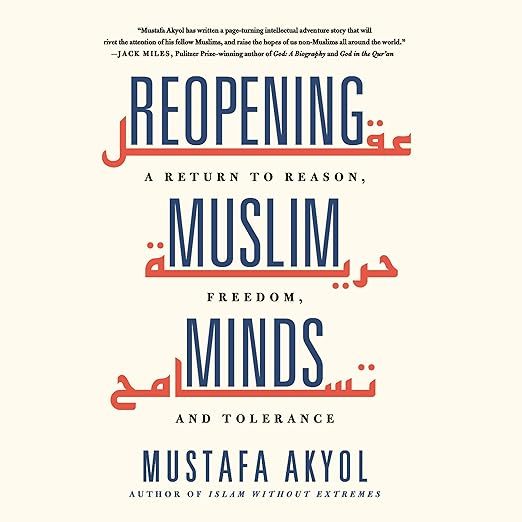
I finished Reopening Muslim Minds on a long flight, seven hours from New York to Reykjavik, which turned out to be exactly the right amount of time and exactly the right kind of remove from ordinary life. This is a book that asks you to slow down and engage with the actual history of Islamic intellectual tradition, and the altitude helped. Mustafa Akyol is a senior fellow at the Cato Institute and an opinion writer for The New York Times, and those affiliations tell you something about where he is positioned: he is writing for a broad, Western-educated audience that includes both Muslims who want an argument for reform from within their tradition and non-Muslims who want to understand how that argument can be made coherently.
The core claim is both historical and prescriptive. Historically, Akyol argues that values we tend to associate with the Western Enlightenment, freedom, reason, tolerance, an appreciation of science, had genuine Islamic counterparts in the medieval period. The figure of Ibn Rushd, known in the West as Averroes, is central here. The philosophical tradition he represents was not a deviation from Islam; it was a legitimate expression of it. What happened subsequently, the suppression of that tradition in favor of more dogmatic views, often for political ends, was a contingent historical outcome, not an inevitable one. That history matters because it means reform is not an imposition of Western values but a recovery of something that was always already present in Islamic thought.
Our Take on Reopening Muslim Minds
The prescriptive argument is where Akyol is at his most ambitious and where some reviewers find him less persuasive. He addresses human rights, equality for women, and freedom of religion and from religion, all of them genuinely sensitive areas, and tries to show that a reformist Muslim worldview can accommodate each of them on its own terms rather than by borrowing from secular liberalism. Whether he succeeds will depend on what you bring to the argument. Readers who are already sympathetic to liberal Islamic reform will find the framework clarifying. Readers who are skeptical of the project will find the cases occasionally underbuilt, as one reviewer noted, some positions would benefit from more robust support and deeper analysis.
One of the book’s most valuable qualities is its honesty about what the problems actually are. Akyol does not traffic in defensive minimization. He is frank about the failures of Muslim-majority societies on questions of pluralism, women’s rights, and intellectual freedom. The book is not a whitewash, it is an argument about what the tradition contains that could address those failures, and why that matters more than either apologetics or external critique.
Why Listen to Reopening Muslim Minds
Neil Shah’s narration is well-suited to the material. This is a book of sustained argument, it is not narrative-driven in the way a memoir or thriller is, and Shah reads it with the kind of measured intelligence that keeps the listener engaged with ideas rather than distracted by performance. The pacing is careful without being slow, and he handles the transliterated Arabic terms and the references to medieval Islamic philosophers with appropriate confidence.
The book also shares elements of Akyol’s own life story, which grounds the intellectual argument in personal experience. Those sections are among the most engaging passages in the audiobook, and Shah’s delivery in them is noticeably warmer. The combination of theological history, philosophical argument, and personal narrative makes this more accessible than a purely academic treatment of the same material would be.
What to Watch For in Reopening Muslim Minds
The one-star reviewer’s complaint that the ideas lack originality is worth engaging with seriously. Akyol is working in a tradition of Islamic reform that includes many other voices, and readers who are already familiar with that literature may find that the book’s contribution is more synthesis and accessibility than genuine novelty. As an introduction to Islamic reform thought for a general audience, it is excellent. As a contribution to specialist academic debate, it is less groundbreaking than its framing sometimes suggests.
The final chapter, where the positive vision for Islam’s future is articulated most fully, is where the book’s argument arrives. Several readers noted that the payoff is strongest if you have followed the historical and diagnostic sections carefully rather than skipping ahead.
Who Should Listen to Reopening Muslim Minds
Non-Muslim readers who want a genuinely informed and internally coherent account of the case for Islamic reform will find this essential. Muslim listeners interested in liberal reform arguments that draw on rather than reject their tradition will find Akyol’s historical recovery of the Mu’tazilite and rationalist traditions particularly valuable. Skip it if you are looking for academic depth or novelty rather than accessible synthesis, or if you have already read widely in contemporary Islamic reform literature.
Frequently Asked Questions
Is Reopening Muslim Minds sympathetic to Islam or critical of it?
Both. Akyol is a practicing Muslim arguing from inside the tradition. He is critical of specific historical and contemporary developments within Islam, particularly the suppression of rationalist philosophy, while being deeply committed to Islam as a tradition with the resources to address those problems.
Does the book require prior knowledge of Islamic theology or history?
No, Akyol is a skilled explainer and the book is written for a general educated audience. Technical terms and historical figures are introduced with sufficient context. It is an accessible starting point rather than an advanced text.
How does Akyol treat the question of apostasy and freedom of religion?
He addresses it directly and argues that the traditional Islamic position on apostasy is not theologically inevitable, that there are genuine grounds within Islamic thought for freedom of conscience, including the freedom to leave the faith. It is one of the book’s more contentious sections.
Is Neil Shah a Muslim narrator, and does that matter for the material?
Shah’s personal background is not publicly foregrounded in the production notes. What matters for this material is whether the narration conveys respect for and familiarity with the subject, and listeners consistently find that it does.