Quick Take
- Narration: Jarrett Adams narrates his own story with quiet, controlled intensity; no performance, just the voice of someone who has lived every word and knows its weight.
- Themes: Wrongful conviction, systemic racial injustice, redemption through legal advocacy
- Mood: Infuriating, then galvanizing; the emotional arc is deliberate and earned across every hour
- Verdict: One of the most compelling legal memoirs in recent memory, made more powerful by Adams’s decision to read it himself; a free audiobook that demands to be heard by anyone who cares how justice actually works.
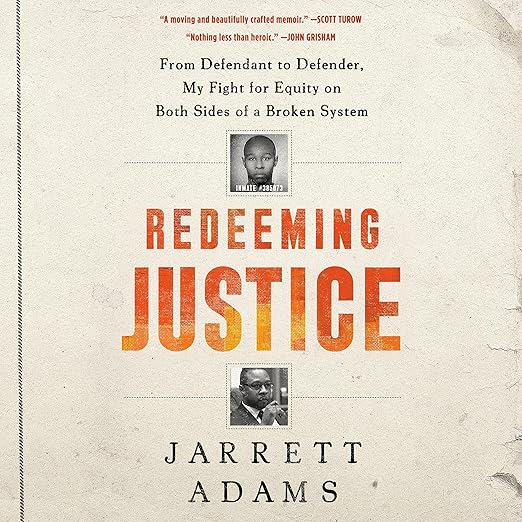
I started Redeeming Justice on a Sunday evening thinking I would listen for an hour before bed, and I was still listening at one in the morning. Not because the book is relentlessly paced in the thriller sense, but because Jarrett Adams writes with the kind of controlled honesty that is very difficult to walk away from. You keep listening because you need to know what happened next, and then what happened after that, and then how someone becomes the kind of person who goes back to fight in the same court that wronged him.
Adams was seventeen years old when an all-white jury convicted him of a crime he did not commit and sentenced him to nearly thirty years in prison. He was nineteen when the cell door closed on him. What this book documents is not only the injustice of that conviction but everything that came after: nearly a decade of learning to survive incarceration, the self-education that led him to discover how his constitutional rights had been violated, the work of the Wisconsin Innocence Project that eventually won his release, and then the improbable journey through law school to a career fighting for people in exactly the position he once occupied.
The Architecture of a Wrongful Conviction
Adams is precise about how it happened. The book doesn’t traffic in general outrage. It walks through the specific mechanisms by which a Black teenager from Chicago found himself facing decades in prison on the basis of unreliable testimony, inadequate defense, and a legal system that failed him at every structural level. He writes about his attorney’s performance, about the jury’s composition, about the gap between what the law promises and what it delivers to people without resources. This is not abstract criticism. It is documented and specific, and the specificity is devastating in the way that facts, arranged carefully, can be devastating.
One reviewer described this as “an incredibly powerful, page-turner of a book about the America no one talks about,” and while that framing slightly undersells the book’s broader legal argument, it captures the emotional register accurately. Adams is a gifted storyteller who can hold two things simultaneously: the systemic critique and the human interior of being the person that system fails. That combination is what separates this book from the many wrongful conviction accounts that exist and what makes it matter beyond its own story.
Jarrett Adams Reading Jarrett Adams
The decision to have Adams narrate his own memoir is the right one, and not just for authenticity. His voice has a particular quality: measured, never self-pitying, occasionally weighted by something you can’t quite name but can hear clearly. He reads the passages about his mother and aunts, whose letters sustained him during his years inside, without melodrama. He reads the passages about prison itself with the same absence of performance. Scott Turow called the book “moving and beautifully crafted,” and John Grisham called Adams “nothing less than heroic.” Both assessments are fair, but they don’t fully describe what it’s like to hear Adams speak these words in his own voice. That’s an experience the audio format delivers that no blurb can replicate.
At eleven hours and thirty-two minutes, this is a substantial listen, and it earns its length. Adams doesn’t rush and doesn’t pad. The book’s structure, moving through his incarceration, his self-education, his release, law school, and his early cases back before the very court that convicted him, is carefully designed, and each phase has material to justify its place in the running time.
From Client to Counsel: The Full-Circle Cases
The final third of the book, covering Adams’s work with the New York Innocence Project and the cases he fought on behalf of others, is where the memoir becomes something more than personal testimony. Adams is notably the first exoneree the Innocence Project ever hired as a lawyer, and his account of returning to court, arguing before the same judges in systems he knows from both sides, is extraordinary reading. The cases he describes are individual to his clients, but they illustrate the same patterns that produced his own wrongful conviction. His argument is structural: this is not about bad actors; it is about systemic design that produces predictable outcomes for predictable categories of people.
One reviewer said this book made them feel what Scott Turow described as “unbounded admiration” paired with “a need to scream ‘We must do something.’” That combination is rare in legal memoir, and Adams achieves it without ever letting the argument become propaganda. He trusts the facts to do the work, and they do.
For Listeners Who Need This Story
Redeeming Justice belongs on the same shelf as Bryan Stevenson’s Just Mercy and Michelle Alexander’s The New Jim Crow: books that make the gap between American legal ideals and American legal reality impossible to look away from. It is available as a free audiobook on Audible, which removes every barrier to listening. The audience is broad: law students, parents of Black sons, anyone who has ever wondered how the justice system actually works for people who can’t afford adequate representation. The answer is here, told in the first person, by someone who lived it and then dedicated his career to changing it. The combination of personal testimony and legal analysis, delivered in Adams’s own voice, is what makes the audiobook format particularly powerful. This is not a book you hear from a distance. It reaches through the speaker and insists on being taken seriously, which is exactly the kind of insistence that the subject requires.
Frequently Asked Questions
How does Redeeming Justice compare to Bryan Stevenson’s Just Mercy?
Both are first-person legal memoirs by advocates who experienced the justice system’s failures directly. Adams’s book is more tightly focused on the wrongful conviction experience and its aftermath, while Stevenson’s covers a broader range of capital cases. They complement each other well and reward being read in either order.
Is this audiobook appropriate for younger listeners, such as high school students studying criminal justice?
Yes. Several reviewers specifically recommended it for parents and students. The content is serious and includes passages about prison life and systemic racism that require mature processing, but Adams never writes for shock value, and the book is constructive rather than nihilistic in its overall shape.
Does Adams discuss the Innocence Project in depth, or is it background to his personal story?
Both. The Wisconsin Innocence Project’s role in his exoneration is covered in meaningful detail, and his later work with the New York Innocence Project forms a significant part of the book’s final third. Listeners interested in innocence work more broadly will find substantive material throughout.
Does Jarrett Adams name the people whose failures contributed to his wrongful conviction?
He is specific about the structural failures, including the inadequacy of his legal representation, the jury composition, and the procedural violations, but the book’s emphasis is systemic rather than aimed at individual blame. He is more interested in why the system operates this way than in settling personal scores.