Quick Take
- Narration: Brian Emerson delivers steady, authoritative narration well-matched to Cold War nonfiction, clear and unflashy, which is exactly what a thesis-driven history requires.
- Themes: Cold War nuclear brinkmanship, Soviet military intrigue, classified history and government concealment
- Mood: Tense and conspiratorial, reading like a thriller that insists it is not fiction
- Verdict: An unsettling account of events that may never be officially confirmed, built from evidence that is hard to dismiss and impossible to fully verify.
There is a particular kind of unease that comes from reading about events that almost certainly happened but that no government will officially confirm. I first encountered Red Star Rogue through a recommendation from a retired naval officer who described it simply as the book that changed how he thought about the Cold War. That is the kind of recommendation that sticks. I came back to it recently, and the passage of years has not made the central thesis feel any less disturbing, if anything, the political climate has made it feel more relevant than I would like.
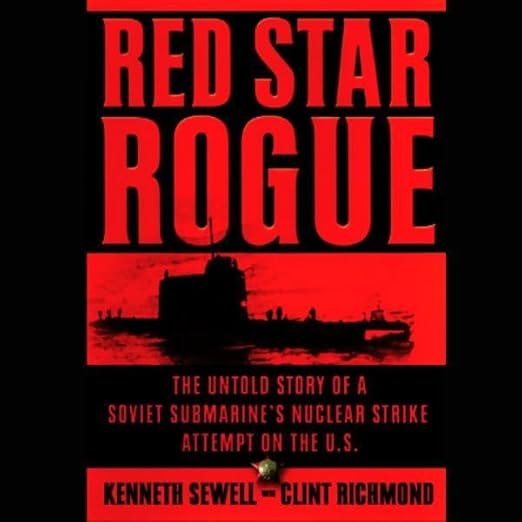
Red Star Rogue is Kenneth Sewell’s account of the Soviet ballistic missile submarine K-129, which sank in the Pacific in March 1968 in circumstances that have never been officially explained. The New York Times bestseller status the book carries is one data point; the 4.5 rating from nearly 700 Audible listeners is another. Narrated by Brian Emerson for Blackstone Audio, the full listen runs over twelve hours. Sewell’s thesis is that K-129 was not lost to accident or equipment failure, but to a deliberate KGB-backed conspiracy to launch a nuclear strike on Pearl Harbor and blame it on China, with the goal of triggering a war that would draw the United States away from Soviet interests in Europe. The official files have never been released. The book works from what is available: declassified documents, naval records, witness accounts, and physical evidence recovered during the CIA’s secret Project Azorian salvage operation.
How a Thesis Without Complete Proof Still Convinces
Sewell’s approach to evidence is methodical rather than sensationalist, which is both the book’s greatest strength and, for some readers, its most frustrating quality. He builds his case from objective factual elements that are not disputed: the K-129’s anomalous early departure before completing scheduled maintenance, the nature of its ballistic missile configuration, and operational specifics that fit his narrative better than any official explanation fits the known facts. A maritime lawyer who reviewed the book, noting his own background on NATO submarines in 1967, called it a convincing yarn even while acknowledging the unsatisfying nature of the inference-heavy assembly.
That tension between plausible and proven is central to the reading experience. Sewell cannot deliver certainty because the governments involved have not released the documents that would provide it. What he can do is present the available evidence and ask whether the official silence makes more sense than his interpretation. A reviewer who described the book as a horrifying yet fascinating look at near-Armageddon captured the feeling accurately. Another described it as one of the most disturbing books they had ever read, not because of graphic content, but because of the implications. If the thesis is correct, the world came very close to a nuclear exchange in 1968, and the near-miss was concealed by both superpowers for reasons that do not reflect well on either.
Brian Emerson and the Weight of the Material
Narrating speculative history requires a specific discipline: you need to convey seriousness without tipping into melodrama, to let the evidence carry its own emotional weight without editorializing. Emerson handles this well. His delivery is consistent and authoritative, which suits the material’s register. This is not a book that benefits from a narrator who performs urgency, the events themselves provide enough of it. The twelve-hour runtime means Emerson spends a great deal of time in fairly technical naval and intelligence territory, and he navigates those sections with clarity rather than allowing them to become monotonous.
One reviewer called the epilogue a chilling reminder of where we stand today, and I think that is the right note. Red Star Rogue was published in 2005, but its core argument, that nuclear-armed states can and do make decisions that bring the world to the edge of catastrophe without the public ever learning the full story, has not aged out of relevance. One reviewer from Germany observed that while no proof is given for the thesis, it reads like a good thriller anyway, which is an accurate secondary endorsement: the book works as a story even for readers not fully persuaded by its conclusions.
The Questions the Government Has Never Answered
The book is most compelling in its treatment of what the American and Soviet governments both chose to do with their knowledge of the K-129’s sinking. The CIA’s Project Azorian, the secret operation to raise part of the submarine from the ocean floor, is not disputed. What was found, and what was decided as a result, is. Sewell’s reconstruction of those decisions, and the bilateral silence that followed, is the chapter of the book that lingers. Governments protect secrets, which is not surprising. What Sewell makes unsettling is the specific nature of what appears to have been protected here and the calculation that must have been made about what the public could not be allowed to know.
The Listener This Demands and the Listener It Will Frustrate
Readers who need conclusions supported by declassified primary sources and official confirmation will be frustrated here, the book’s central thesis cannot be fully proven, and Sewell is honest about that. Listeners who find well-constructed argument from available evidence persuasive, and who are comfortable sitting with conclusions that remain technically unverified, will find this among the more compelling Cold War histories available. Naval history enthusiasts, Cold War researchers, and anyone drawn to events that governments choose to keep classified will find the twelve hours well-spent. Currently available as a free audiobook on Audible, there is no financial barrier to finding out which camp you are in.
Frequently Asked Questions
Is Red Star Rogue based on verified historical facts or primarily speculation?
The book combines documented, publicly available facts with inference and analysis. Sewell builds from real events, the K-129’s sinking, Project Azorian, declassified naval records, but his central thesis about a KGB conspiracy remains unconfirmed by any official release. He is explicit about what is established versus what is inferred.
How does Red Star Rogue compare to other Cold War submarine histories?
It is more thesis-driven than most in the genre, closer in structure to investigative journalism than straightforward military history. Readers who enjoyed Blind Man’s Bluff will recognize the approach, though Sewell’s central argument is more provocative than most.
Is Red Star Rogue a free audiobook on Audible?
Yes, it is currently listed at $0.00 on Audible. At over twelve hours, this free audiobook represents significant listening value for Cold War history enthusiasts.
Does Brian Emerson’s narration handle the technical naval content clearly?
Yes. His delivery is clear and authoritative throughout. He keeps the technical passages, submarine operations, naval classifications, intelligence terminology, accessible without simplifying the content.